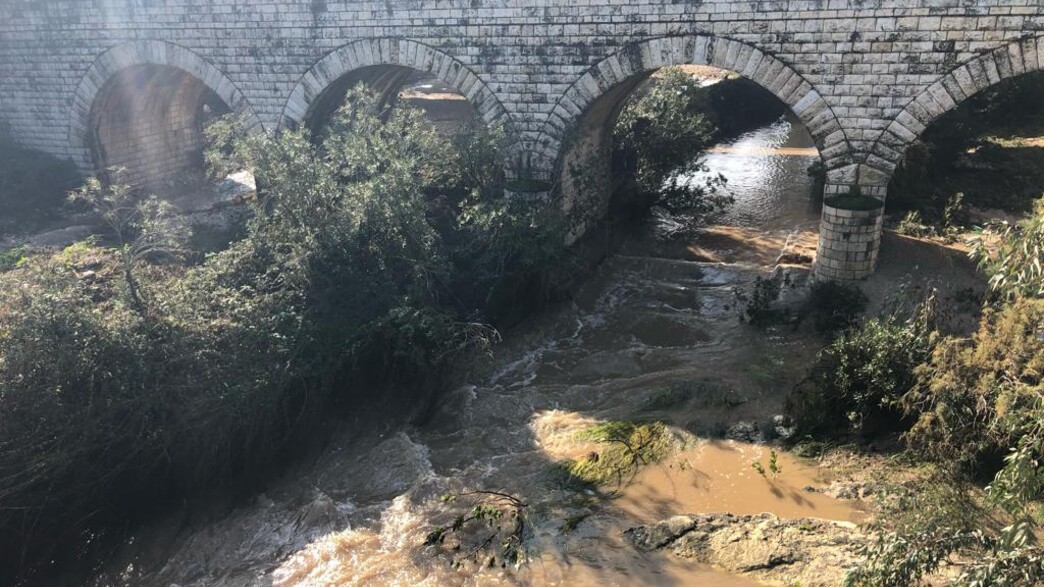
Every year at the beginning of summer, we are informed about the closure of streams and springs for bathing, mainly in the north of the country, due to various infections. The Ministry of Health conducts frequent sampling, and when bacteria are detected in a count above the permissible limit, the Nature and Parks Authority is forced to warn and even close streams and springs for bathing, until the count drops below the standard.
The samples are taken in Eitan streams that have a natural flow, mainly in the large ones and in the shallows, in order to maintain the health of the bathing public. The causes of contamination can be the hazards of cattle grazing in the environment, contamination from drains and sewage, or a high temperature of the water that allows bacteria to multiply. It is not so pleasant to see a polluted stream closed, but as mentioned, it is a matter of contamination of Eitan streams, and what is happening in the Nakhli streams?
In Little Israel, 790 different and unusual streams flow: Eitan streams and Nakhali streams, narrow and wide, short and long, straight or winding, plain or canyon. All of them have a great contribution not only to the water system, but also to the movement of the promenades. We all like to travel along river routes because they enrich nature with landscapes and challenges, and provide a refreshing summer attraction.
Once upon a time, many of them overflowed with clear water and flowed happily, but times have changed. With the introduction, the plight of the streams turned into a major epidemic, many streams dried up due to over-pumping, some were diverted from the natural route to an alternative artificial route due to infrastructure, and there are some even at this moment threatened by various construction projects and public struggles around the country. Others have been damaged by persistent infections, and not only are they inaccessible, they are a source of health danger to humans, animals and plants.
The pollution map: from Nahal Kidron to the southern Jordan
To understand the magnitude of the challenge, it is useful to look at the local river map, which shows a complex mosaic of hazards alongside solutions on the ground. in Nahal Hadera, For example, there were two significant effluent hazards that were removed, the water quality improved and a central spring was released that adds animals to the stream.
Kidron streamwhich flows from Jerusalem to the Dead Sea, is known as a sewage drain from East Jerusalem that flowed raw into the stream. After a significant investment by the Water Authority, a collection pipe was built for a dedicated treatment facility in the Judean Desert and soon it will be clean: the Dead Sea will not receive the pollution, and visitors will be spared the dangers of the stench and pollution that characterized it for years. the streams Ayalon and Yarkon You still get high quality effluent, but less good than what you expect to see in such streams.
A particularly difficult challenge was recorded in southern Jordan. There is a national plan for its restoration, under which an allocation will be received from the Kinneret waters and many pollutants will be removed from the valley, but the stream crosses borders and suffers from both the Jordanian and the Palestinian sides, therefore the creation of an infrastructure for interregional cooperation is required for the stream to function well. Nahal Kasiv suffered from contamination from two localities; The hazards were taken care of and at the same time they released two springs into nature that have been popular for years. In Nahal Tsiprithanks to a national program, two significant effluent sources were removed and are now being led to a new reservoir. And yet, the streams Alexander, Lachish, Shork and the Annunciation They suffer from large amounts of sewage that flowed into them and pollute them.
When sewage replaces nature
Pollution of rivers, also in the world, occurs when there is no infrastructure to remove industrial pollutants or sewage water, and every country used to emit the polluting surpluses into the riverbeds without thinking about the consequences. Once upon a time there was no regulation, no enforcement either, and an honest man in his eyes was foreign and ugly. The water of the streams was replaced by sewage, toxins, chemicals and a host of disease-causing pollutants that turned their channels into foul-smelling and dangerous neighborhood “sewer”.
A polluted stream is first of all an existential threat to the delicate ecology, and in extreme cases it may affect the structure of the stream, the flow regime, the chemical composition of the water and hydrological and biological characteristics. The effect can be direct and indirect, and thus the streams may turn from a resource into a hazard that also has a lasting effect on humans, on the quality of drinking water and on agriculture.
It is interesting that the public health regulations (waste water quality standards and rules for wastewater treatment) do not solve the pollution and do not stop it, but rather perpetuate it by setting discharge standards instead of finding a comprehensive solution. Continuous pollution even prevents the possibility of restoring rivers and restoring them for the benefit of nature and man. Restoring a river is not only the flow of clean water, but also a healthy environment that includes its entire watershed. In-depth restoration requires comprehensive spatial planning from the spring, along the flow path, to the estuary to the sea, while maintaining the natural route that knows how to regulate the water in case of flooding.
The climate changes in recent years, which led to severe flooding, brought to the surface the difficulties, including the lack of floodplains for streams and land that can absorb the excess water. Intensive construction, it turned out, prevents seepage, and the green organizations in the planning committees deal with this as well.
Streams are a natural source of life, therefore many parties support nature-based solutions, which imitate the natural system in streams and rely on its wisdom, assuming that it is intact and not violated. In this way, human artificial intervention can be avoided and let nature restore itself from whatever infections they may be. However, infections are not destiny, they are the product of a policy that does not attach sufficient importance to nature as a resource worthy of investment. Nature is not on the list of national priorities, and there is no internalization of the future consequences of pollution. As was the case with Nahal Yarakon, which received a rehabilitation procedure and proved that it is possible to restore a stream and let nature exercise its powers, the task is not impossible.
In recent years, the green bodies have been at the forefront of the struggle to preserve the streams, and despite the trend of improvement, Israel is far from optimal. A look at a government map reveals 58 centers of pollution in the streams, some of them at several points in the same stream. Furthermore, pollution has a price: the total cost of stream pollution to the Israeli economy is estimated at approximately NIS 130 million per year, an amount that could have been invested in the cultivation of streams and drainage basins for the benefit of nature and the public.
Do you only learn from disasters?
Ariel Cohen, a hydrologist in the science division at RTG, says that until the 1990s, untreated industrial wastewater was discharged daily into streams such as the Nahal al-Hashur and the Kishon, and since then the pollutants have been pooled and there is no discharge except in cases of malfunctions or accidents. “Unfortunately in Israel we only learn from disasters,” says Cohen. The submarines of the fleet. The state then cleaned the stream, removed pollutants and required factories to pretreat the pollutants. Today we know how to deal with it, but we have to invest resources. Treating an existing hazard is more expensive than preventing it, as happened in the Nahal Ashlim disaster.”
One of the known hazards were the fabric houses that discharged excess into the streams, and later, following good enforcement by RTG and the Ministry of Environmental Quality, there was an improvement. Cohen explains that the supervision is closer today: they make sure that the products do not reach the sewer and cause it to collapse, and they are treated in dedicated facilities including controlled disposal and other solutions.
According to Cohen, the main pollution in Israel’s streams today comes from wastewater, the product of waste water treatment in water treatment plants (wastewater treatment plants) throughout the country. “Israel is a leader in the field of treatment and half of the irrigation water in agriculture is from a source of wastewater. But wastewater is produced all year round at the same rate, and in winter the demand is low because there is rain. For this purpose, about 300 sewage collection reservoirs were built that are active all year round from north to south. When they are full, about 15 percent flows into the streams and the sea, which is more than 100 million cubic meters, like two desalination plants that spill into the streams and the surrounding area.”
Cohen claims that this is a phenomenon that characterizes less developed countries, since in developed countries the pollution is low and managed by the natural flow in the streams and is less noticeable, and in addition the wastewater undergoes serious treatment and is piped directly to the sea. In Israel this does not happen; The streams absorb the pollution, and the water authority is also working to reduce the phenomenon, but the amount of effluent increases with the increase in the population and there is a lag in the infrastructure.
Infrastructures are in many cases the Achilles heel, and Cohen makes it clear that they work in cooperation with the decision makers. The Water Authority, for example, has built a strategic plan for the year 2040 to deal with sewage contamination, but Cohen claims that it does not meet reality, does not provide an answer and requires thorough treatment and not a Band-Aid. “We need a thorough plan that will show the agricultural potential and the expected amounts of effluent in each stream basin, and accordingly to develop alternatives, both for intensive treatment and for finding solutions such as exporting to Jordan or advanced treatment of the effluent and disposing of it in the Mediterranean Sea, an operation that experts have proven does not significantly harm the sea. Right now everything is damaged: the stream, the coast and the sea, and the ambition is to shorten the process.
The vision is streams based on natural water and not sewage, even if they are of high quality, because this creates pressure for life and vegetation and this is not a proper solution. It is also possible to achieve quadruple level purification (“advanced purification” in four stages) which removes the bacteria and pollutants effectively to the point of drinking water. We have a lot of the best engineering and planning in the world, but we need to invest the right resources in these tools and make them a priority.” In reformed countries, Cohen emphasizes, there is strict enforcement and regulation, and rivers like the Rhine and the Danube, which suffered from pollution about 40 years ago, have come a long way thanks to resources and legislation. “Today in Europe there is no option for pollution because there are fines and lawsuits with personal liability of managers, so everything looks like a pharmacy. Even in Israel there is great progress, but the reality requires dealing with and regulating a lot of resources.
A stream is a public space that must receive super significant consideration by the decision makers and the public. From the moment that streams were defined by the planning administration as kit sites for man as a resource, we need to have a clean resource, and the reference to this should be expressed in budgets and involvement, but also in public concern on the part of the traveler who needs to protect the resource of the stream.”
The front of the fight: whoever pollutes – pays
In both of these contexts, the Society for the Protection of Nature fits in. Dana Tavacnik, director of the streams department in the company’s environment and nature conservation department, claims that they feel that the coastal streams have been neglected and are the most polluted in the country. “There has been a slight improvement over the years because streams used to be sewage infrastructure to the sea, and not enough has been done to completely prevent the sources of pollution,” says Tavacnik. “We would expect zero malfunctions in the sewage systems, but they happen all the time because the infrastructure is old and there is no supervision, and sometimes it takes a long time to fix because there is no incentive. For years we have been working to change legislation and we have succeeded in part, and the goal is to deter, the polluter pays. We did research work and compared to other countries, and it was proven that a levy or fine on a company that discharged pollution into a river changed its behavior. In addition, at the policy level, we act For administrative enforcement that immediately gives a high fine to the polluter.”
In the field there is also a lot of work with “river communities”, a public that helps with more “eyes” in the field, can make contact, and receive content and information. “We don’t have the ability and resources to help in any case, and the goal is for the public to know what to do, how to act and who to report in the event of contamination. We are passing on knowledge and training to a network of river communities that understand that this is a national matter and know how to act. Streams are an ecological and strategic resource, we are disappointed with the way they are treated and we would expect them to look different.”
Tavacnik emphasizes that a stream knows how to restore itself to its original state and should not be disturbed, but only to stop polluting, and therefore there is hope: “The world understands that neglecting a stream destroys and harms, and a healthy stream that flows clean and does not dry up protects the entire area. Pollution can be solved and not by investing a lot of money, but the streams are simply not in the priorities.”
In the meantime, the HLA representatives are active in the planning committees, along with other green bodies, and talk about streams, nature and ecological corridors. Recently, they jointly led changes in the national planning related to streams, which outlines principles for stream conservation (Amendment 7 in TMA 1). “We don’t give up,” concludes Ariel Cohen, “and try in every situation to promote actions to remove impurities and release natural water into the streams – even in cases where the challenges are greater.”
https://www.backofhouse.art/forum/topic/online-gaming-13/#postid-7498
https://www.verokruta.com/group/verokrutayoga-group/discussion/5ca01a8c-2f5a-4449-bcb0-1a59ad2f0773
https://www.shellsonly.com/group/shellsonly-group/discussion/ca274cdc-47f4-48de-b339-bee2a69113ca
https://ivebo.co.uk/read-blog/311349
https://medium.com/p/966a3ed150c4?postPublishedType=initial
https://slides.com/d/lrACPgM/speaker/fi9jWFk
https://www.salesfully.com/group/discover-awesome-features/discussion/e3dbb172-4710-4e6d-bbd7-d66380450533
https://www.showsofintegrity.com/group/shows-of-integrity-group/discussion/1d09d06f-0c9a-4d96-ba54-eecd28f43c7a
https://friendship-bracelets.net/forum/thread/86334
https://lessons.drawspace.com/post/1071618/a-fast-and-pleasant-site-without-lags
https://www.ironmaiden-bg.com/forum/showthread.php?tid=1193
https://answers.themler.io/questions/264894/online-gaming-with-some-cool-bonuses?page=1
https://www.imaginedanceacademy.com/group/mysite-231-group/discussion/1ac2916d-4139-4927-b307-a08d938dca2a
https://www.copalretreat.com/group/instructor-profiles/discussion/3850d4c3-d11e-4be3-a419-abec1a43db52
https://ivebo.co.uk/read-blog/311440
https://medium.com/p/5ac5dc6eccac?postPublishedType=initial
https://www.rubiolongsnapping.com/group/young-ninja-group-ages-3-5/discussion/b11fe916-279f-4523-af9e-c59b3e171837
https://www.hulladek.in/group/mr-e-dropbox/discussion/808e9a06-0a85-4322-8e1b-8b38ce21d837
https://poster.4teachers.org/worksheet/view.php?id=202525
https://www.backofhouse.art/forum/topic/online-gaming-11/#postid-7363
https://wakeuptaylor.boardhost.com/viewtopic.php?pid=50413#p50413
https://www.rctech.net/forum/groups/chatting-d7291-online-gaming.html#gmessage24888
https://submeet.vet/forum/topic/3226?page=1#post-5479
https://www.gaudiclub.com/forum/mensajes.asp?CODE=4857
https://www.crossroadsbaitandtackle.com/board/board_topic/9053260/8259064.htm?page=1