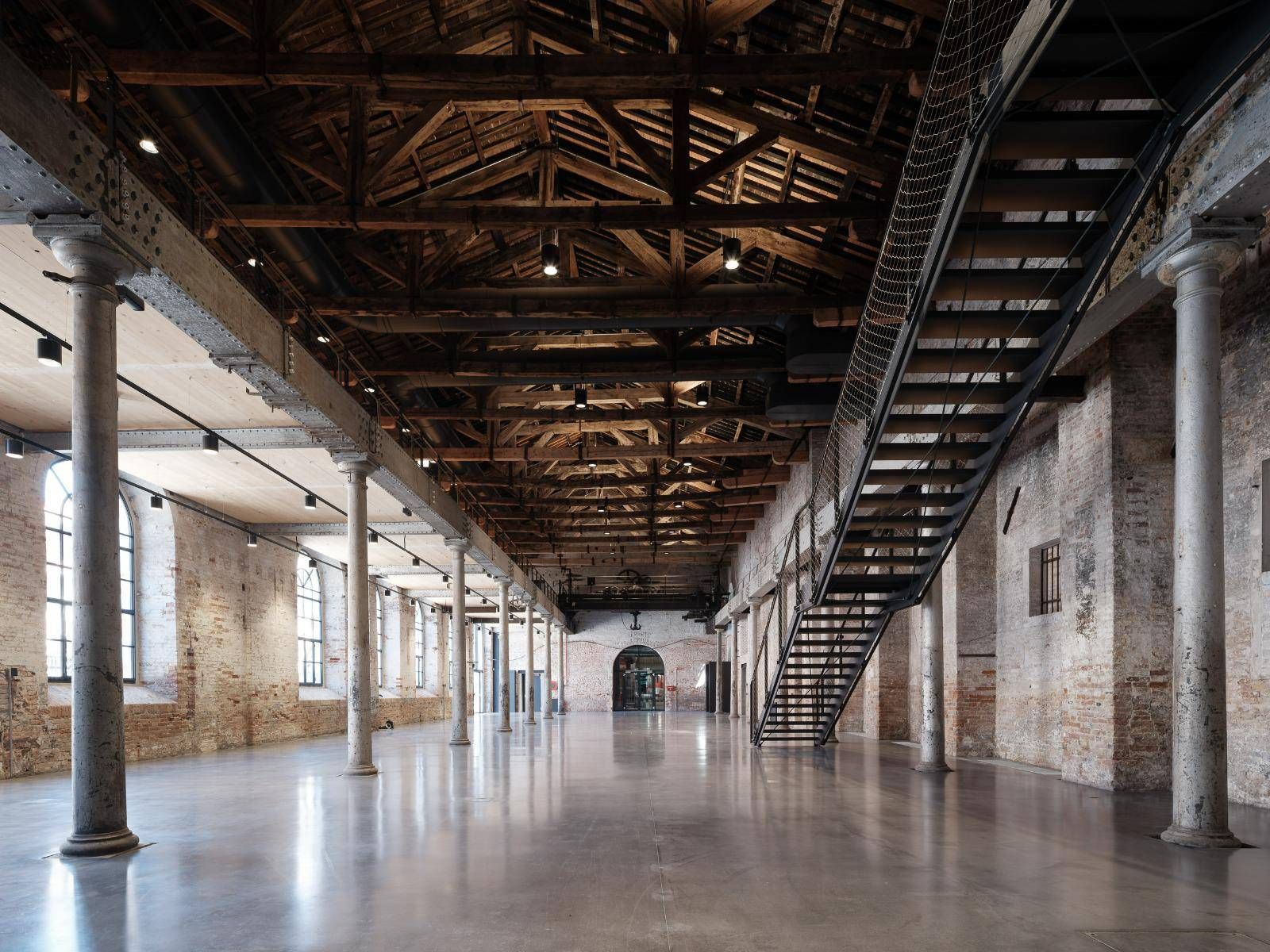
The Historical Archive of the Venice Biennale changes home and moves to the heart of the Arsenale. The new headquarters of the Asac – International Center for Research on Contemporary Arts has 8,000 square meters obtained from the recovery of five historic buildings, with over 38 million euros of public investment and a new cultural infrastructure intended to conserve, study and relaunch over a century of memory of contemporary arts, starting from the first Art Biennale of 1895. No longer just an archive, but a permanent center for research, training and cultural production, intended to connect the past and future of the Biennial.
The new headquarters of the Historical Archive was presented today on the occasion of a special three-day program developed by the artistic directors of the different sectors of the Biennale: Alberto Barbera for cinema, Caterina Barbieri for music, Willem Dafoe for theatre, Wayne McGregor for dance, Wang Shu and Lu Wenyu for architecture, and Maria Magdalena Campos-Pons and Kamaal Malak for art. Debora Rossi, director of Asac, and the president of the Biennale, Pietrangelo Buttafuoco, will do the honors. The ceremony was attended by the new mayor of Venice, Simone Venturini, the former presidents of the Biennale Paolo Baratta and Roberto Cicutto, and Angelo Piero Cappello, general director of Contemporary Creativity of the Ministry of Culture, representing the minister Alessandro Giuli, held in Rome for institutional commitments.
Over the last four years, the Venice Biennale has strengthened the activities of its Archive in view of the transfer from the Vega – Science and Technology Park of Marghera, where it is currently located, to the new headquarters of the Venice Arsenal, which will be officially opened to the public at the beginning of 2027. In this context, the International Center for Research on Contemporary Arts was established in 2021, a reference place for relationships, collaborations and shared projects with students, scholars, cultural institutions and national and international research bodies. The materials preserved in the Archive generate new research, experiments and productions, also offering the artistic directors of the various sectors the opportunity to deal directly with the documentary heritage and to develop exhibition itineraries and special projects based on the archive materials. To this end, a complex of historic buildings in the Arsenal adjacent to the Corderie was identified as the new headquarters of the Historical Archive. The works, started in March 2024 and completed in compliance with the timetable, involved a total investment of over 38 million euros allocated by the Ministry of Culture: 20 million from the “Major Cultural Heritage Projects” funds – allocated in 2019 – and a further 18 million from the PNC to the Pnrr “Major Attractors of Cultural Heritage” – in 2021. The Historical Archive of the Biennale from now on strengthens its vocation to be not only a place for preserving memory, but also a lively center of research, training, cultural production and innovation, capable of relating the historical heritage to the challenges and artistic expressions of the present and future.
The Historical Archive of Contemporary Arts of the Venice Biennale (Asac) documents the Foundation’s activity since the first International Art Exhibition in 1895, preserving materials relating to the artists, works and various disciplines that have crossed its history. An extraordinary heritage, a true contemporary Wunderkammer in the spirit of Aby Warburg, articulated in the Library, located in the Central Pavilion in the Giardini, and in the Historical Fund, preserved at the Vega in Porto Marghera. The Library, specialized in contemporary arts, collects all the catalogs of the Biennale’s activities and preserves a heritage of over 164,000 volumes and 3,200 periodicals. The Historical Fund, the central nucleus of the Archive, includes over 10,000 files, supported by a very rich photo library, media library, Artistic Fund, posters, press reviews and heterogeneous materials, including photographs, correspondence, audiovisual materials, scores, works of art and vinyl records. With the transfer from the Vega in Porto Marghera to the new headquarters of the Arsenale, the Historical Archive fully enters the system of the Biennale’s exhibition spaces, between the Arsenale and the Giardini, strengthening the link between memory, research and contemporary production.
There are multifunctional areas dedicated to consultation, college and research activities, workshops, exhibitions and the production of special projects as well as areas for storage, cataloging and restoration. In particular, the area intended for conservation will accommodate compactable shelving on multiple levels, restoration laboratories, cataloging environments and climatic boxes capable of guaranteeing thermo-hygrometric conditions suitable for the protection of the documentary heritage. The project also includes the strengthening of the digitalisation of the collections – audio, video and photo library – and the expansion of the archiving spaces, with approximately 8,000 linear meters compared to the 5,000 of the current headquarters at Vega in Marghera.
“The new headquarters of the Historical Archive will be a place open all year round to students, researchers and scholars, designed not only to preserve the memory of the Biennale but also to produce new knowledge”, explained Debora Rossi, head of the Historical Archive. “Today symbolically concludes a journey started 26 years ago and made possible thanks to the fundamental economic support of the Ministry of Culture. A unique heritage will come together here which documents the history of the Biennale since 1895: not only paper documents, but also photographs, audiovisuals and materials which continue to be enriched year after year. The Archive will not only be a place of conservation, but a real factory of research, study and valorisation of the heritage. A space where different skills and experiences meet, because memory is not only used to preserve the past, but also to imagine the future”.
The new Archive represents one of the most complex interventions in the multi-year process of redevelopment of the Arsenale, the Lido and the mainland sites carried out by the Biennale and begun in 1999 under the presidency of Paolo Baratta, for the benefit of the cultural offer of the Biennale itself and the City of Venice. It was, in fact, an idea of the then president of the Biennale Paolo Baratta to aim for the redevelopment of historic spaces to be used on a permanent basis. And it was the former president of the Biennale Baratta who observed during today’s ceremony: “In its 92nd year of life, the Archive changes location and makes a symbolically significant transition: from the mainland it returns to the lagoon, in a choice that goes against the trend of many decentralization processes. Among the large cultural institutions that preserve archives and documentary heritage, the Historical Archive of the Biennale leaves the outskirts to return to the heart of the city, transforming itself into a living place of research, study and discussion. With this initiative the Arsenale will be experienced all year round and not only during temporary exhibitions. A broad development program started in 1999 is thus completed and a long-term institutional plan takes shape. The new headquarters reinforces the idea of a place dedicated to cultural production and critical reflection on art, at the service of the public and its ability to interpret the present, without pedagogical purposes of an ideological or political nature. the value of freedom”.
Roberto Cicutto, former president of the Biennale, underlined how the new Historical Archive represents “a beautiful story of the Biennale’s ability to give substance to its vision of an institution alive 365 days a year, open not only to professionals but also to those taking their first steps in the world of the arts”. Cicutto highlighted the role of the Archive as a “centre for the collection and dissemination of an extraordinary wealth of knowledge”, recalling that “the solidity of the structure today allows us to travel new paths and further expand the activities of the Biennale under the presidency of Pietrangelo Buttafoco”.
Angelo Piero Cappello, general director of Contemporary Creativity of the Ministry of Culture, brought the greetings and best wishes of the minister Alessandro Giuli, kept in Rome by institutional commitments. Cappello expressed “great satisfaction with the regeneration of the spaces at the Arsenale” and underlined how the new Historical Archive “manages to welcome and preserve the past in an extraordinarily contemporary context, while maintaining an eye towards the future”. Recalling a thought by Gabriele D’Annunzio, he recalled the importance of “welcoming the beauty of the past into the present”, defining the intervention as “a tangible sign of the coherence of a path that the Biennale has been pursuing without interruption since 1895”.
The new mayor of Venice, Simone Venturini, in one of his first public commitments after the election, said: “When we talk about a historical archive we immediately think of the past. I instead believe that this place should above all be a great center for research on contemporaneity. Not a mausoleum to preserve what has been, but a living place, capable of producing the future. This is why I think that what we are doing today is also an industrial policy operation. The Arsenale has always been a production site and continues to be so: it’s just that today we no longer produce ships, but knowledge. There is an inexhaustible deposit of knowledge here. People will not only extract knowledge, but also refine, transform and export knowledge. In an era where there is so much talk about rare earths, perhaps the true rare material of the future will be knowledge.”
The president of the Biennale, Pietrangelo Buttafuoco, concluded the ceremony. “The Venice Biennale is an institution and therefore nothing exists in this dimension other than the awareness and conscience of being participants in a work that involves reflection, effort, with a lot of enthusiasm – he said – The new Historical Archive is the outcome, the result of a project, and I would also like to say of a process, the investigation of which was based on awareness in giving, step by step, something that we all need: a study centre, a center of cultural production”. The new Historical Archive, Buttafuoco underlined, is the fruit of “an enlightened intuition that follows the path of at least three Ministers of Culture whom I want to thank. Dario Franceschini, with whom it began, Gennaro Sangiuliano with whom it continued, and Alessandro Giuli, who welcomed, accompanies and shared the work. A work reminiscent of that speech that Gabriele d’Annunzio made in Venice in 1895 at the conclusion of the first Art Biennale, i.e. the city, the place where mental freedom, the critical spirit, dialectics and therefore also disobedience, accompany creativity and the responsible sense of a living, always plural identity”.
Buttafuoco then recalled that in recent weeks “in a very important authoritative daily newspaper such as ‘Avvenire’, Father Antonio Spadaro opened a public discussion involving authoritative personalities of art and culture around the ‘Biennale question’. And it is wonderful to be able to give an answer to one of these articles today, where the problem of making the work of an institution that accompanies exhibitions, festivals a daily basis was posed. Here, then, is the daily breath that comes from the Archive and give her special plans.” (by Paolo Martini)
https://eternalslots.org/
https://spin-rider.com/
https://zota-bet.com/
https://wintopia.net/tr/
https://temple-nile.com/tr/
https://casino-miamidice.com/
https://gamblezencasino.net/fi/
https://jackpotvillage.org/
https://grand-ivy.net/
https://aviamastersjeu.fr/
https://vegasinospielen.de/
https://frumziau.com/en-au/
https://lunubetpelata.fi/
https://chicken-roads.com.tr/
https://nvcasinohrat.cz/cs-cz/
https://betandyoucasino.cz/
https://aviamasters-official.sk/sk-sk/
https://truefortuneplay.net/
https://www.urbansplatter.com/2024/06/what-is-bim-building-information-modeling/