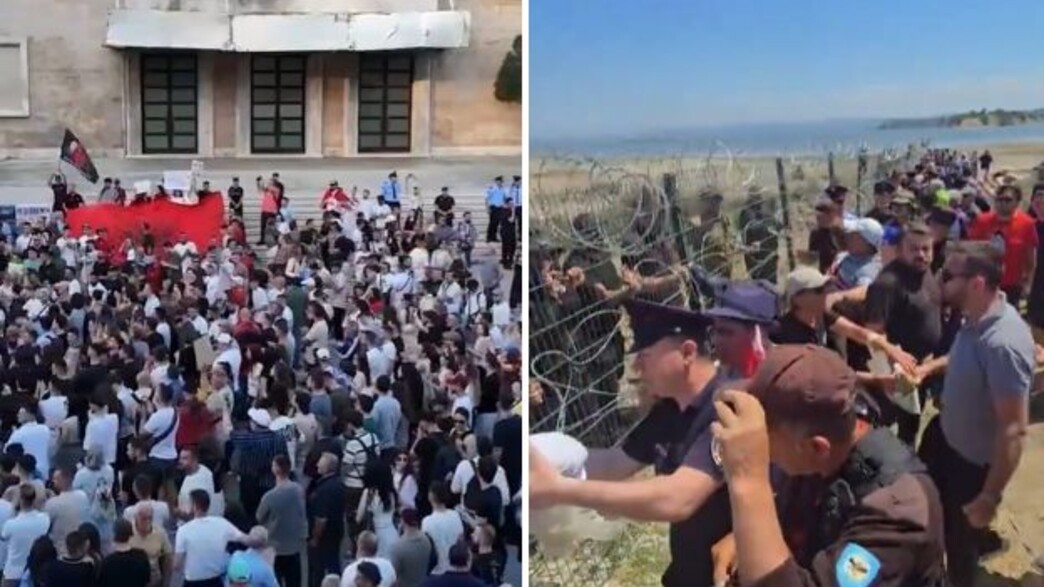
Huge protests are sweeping Albania’s capital as public outrage rages over a planned $4 billion luxury tourism project linked to Jared Kushner and Ivanka Trump. Thousands of protesters marched from Skanderbeg Square to the Prime Minister’s Office in Tirana yesterday, demanding the resignation of Prime Minister Edi Rama.
The demonstrators, who shouted slogans such as “Albania belongs to the Albanians” and “Albania is not for sale”, raised grave concerns about environmental destruction and sharply criticized a lack of transparency on the part of the authorities. Many of those protestors in the streets and networks also accuse the Albanian government and Kushner of selling Albania to Israel, and claim that the goal is to “buy Albania and sell to Israel.”
The multi-billion dollar initiative, which is led by Kushner’s investment company, is intended to cover approximately 2,500 dunams within one of the most ecologically sensitive coastal areas in Albania. The construction plans focus mainly on Sezan Island, an uninhabited island in the Adriatic Sea, and parts of the nearby Vjosa-Narta marshes and lagoon system, near the coastal city of Vlora. Non-governmental environmental organizations and local activists have been warning for a long time that the huge project could destroy the region’s rich biodiversity and fatally damage the bird migration routes.
Public concern increased significantly already at the beginning of May, when bulldozers and heavy mechanical equipment arrived in the area and began clearing pine forests and sand dunes to pave new access roads and prepare construction sites. However, public outrage peaked over the weekend, following videos circulated on social media of private security guards forcibly evicting and dragging to the floor an activist protesting an illegally erected fence. The demonstrations held over the weekend at the site intended for the project quickly deteriorated into physical confrontations, during which the security guards used pepper spray that injured both the demonstrators and local police officers. Following the incident, the private security company announced the suspension of some of the employees who were involved in the clashes.
The stormy protests, which began as mentioned at the end of the week, continue with great intensity and until this hour they bring thousands of citizens to the streets throughout the entire country. The demonstrators refuse to evacuate and hold huge demonstrations even throughout the night, which repeatedly deteriorate into severe physical skirmishes and violent confrontations with the police forces in the field. The current wave of anger is fueled by mass chants against the country’s leadership, when at the center of the protest harsh accusations are heard from the demonstrators and opponents of the project, demanding that the government immediately stop the entire move, which they claim is nothing more than a deliberate sale of Albanian lands and assets to “the Zionists and the Israelis”.
Beyond the environmental struggles and the physical conflicts on the ground, the project revealed deep political and social divisions in the country. Political activists at the protests in Tirana openly accused the government of approving the works behind closed doors, noting that construction began without any public consultation or transparency. Opponents claim that Prime Minister Rama’s administration actively paved the way for the project, through controversial legislative changes adopted in 2024 that weakened the legal protection of nature reserves and protected areas. In addition, local activists point out that the large-scale resort is also expected to damage properties and land owned by families belonging to the Greek minority living in the Velora area.
On the other hand, Prime Minister Edi Rama resolutely defended the high-profile project, insisting that the project is progressing in accordance with all legal and environmental requirements. The Albanian government continues to promote investments in luxury tourism as part of a broader economic strategy, and sees the influx of foreign capital as a critical channel for expanding the country’s premium tourism sector. Even so, with the protests showing no signs of abating, the current conflict highlights the increasingly tough arena of struggle between the administration’s ambition for aggressive economic modernization, and the public trying to save its country’s natural assets.
https://tutos.cemea.org/s/mD8VO894b
https://pad.pixie.town/s/0LbR_Jg57g
https://md.darmstadt.ccc.de/s/Ckz38dCXGw
https://doc.head-publishing.ch/s/BUUd2GUeM
https://md.eris.cc/s/4Jx-PW8AGg
https://md.coredump.ch/s/MJ99DLRzd
https://verwirrung.institute/s/Notk12Sxv4
https://hackmd.k15.synology.me/s/ZHZmEng1l
https://md.emile.space/s/O3vnbszsVb
https://md.chaospott.de/s/pM63kKSDfq
https://md.emile.space/s/i1nKXmKDuu
https://cocossurfhouse.com/ejercicios-basicos-de-calentamiento-antes-de-entrar-al-mar/
https://pad.keks.cloud/s/lF7JpljQYt
https://codimd.avt-imt.de/s/qGvNJJdgj
https://hack.utopia-lab.org/s/p620Lagrr
https://md.darmstadt.ccc.de/s/p94m6kOhK3
https://open.spotify.com/episode/5o2p7rNP2vZ7OsQz0tnrSZ
https://md.jakefarrell.ie/s/fOS2OdxFV5
https://hackmd.diverse-team.fr/s/Hyb64uWgzl