After 6 months of losing contact, NASA announced that Maven, the spacecraft flying around Mars to study the atmosphere, officially stopped operating.
The last time NASA’s Deep Space Network (DSN) received a signal from Maven was December 6, 2025, before the solar-powered spacecraft flew behind Mars. According to telemetry data, when it reappeared on the other side of the planet, the ship went into safe mode and spun out of control, resulting in a loss of power. NASA has been trying to reestablish contact with Maven for months but has been unsuccessful.
The investigation board concluded that Maven may have lost power within a few hours after the December incident, causing the communications system to stop working and the spacecraft to fall into an unrecoverable state. Mike Moreau, Maven project manager, praised the project team’s efforts, sharing: “They truly experienced the feeling of losing a loved one when the mission ended.” The root cause of the incident is still under investigation.
Shannon Curry, lead researcher on the Maven team, called the spacecraft “the most amazing Mars mission ever” during a meeting on June 3. “The whole team is certainly sad about this, but we are also incredibly proud of the scientific achievements of the past decade,” Curry said.
“Data collected from Maven will continue to provide valuable knowledge about Mars for decades to come,” said Louise Prockter, director of NASA’s Planetary Science Division.
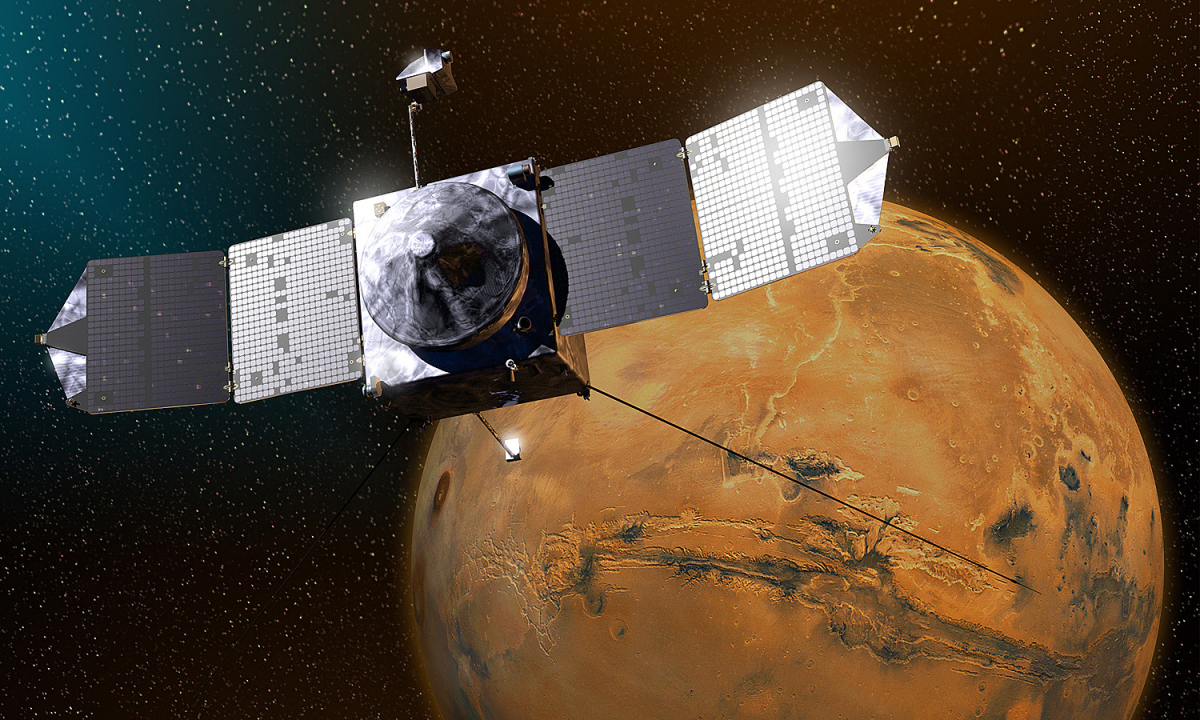
Simulation of the Maven spacecraft flying around Mars. Image: NASA
Theo SpaceMaven launched into space on a ULA Atlas V rocket in November 2013, the first probe to carry equipment to measure how the Martian atmosphere develops and interacts with the solar wind. 10 months later, the ship reached the planet’s orbit. Scientists later concluded that the Sun was the cause of Mars losing most of its atmosphere into space, turning it from a warm, wet world into the cold, arid place it is today.
Maven’s mission was originally planned to last only one year, but was later extended for another 10 years due to the ship’s continued performance. The loss of Maven left NASA with only two probes left in Mars orbit, including Mars Odyssey, launched in 2001, and Mars Reconnaissance Orbiter (MRO), launched in 2005. Both of these spacecraft have also operated far beyond the initially expected time.
In addition to scientific research, Maven is also an important communication link with several robots on the surface of Mars. It coordinates with the MRO and Mars Odyssey (NASA), Mars Express and TGO (European Space Agency ESA) spacecraft to relay communications to rovers such as Perseverance and Curiosity (NASA). According to APthe remaining 4 ships will continue to undertake this work and no scientific data from the robots will be lost.
https://gitea.com/zu3t5wxajq/-/projects/11935
http://postheaven.net/loachmuan/m-n-bel-platformalarda-ilk-novb-d-umumi-istifad-rahatligina-diqq-t-edir-m
https://able2know.org/user/wiocojr3kn/
https://findaspring.org/members/wiocojr3kn/
https://www.notebook.ai/documents/2555707
https://app3.mockplus.com/app/share-32c65fd69560b41f29031c78a6658439share-SujDw_DdZ/prd/OHPfhbaYB
https://portfolium.com/o2hapgqi9g
https://www.posersoftware.com/users/o2hapgqi9g
https://6a1932cdcadaf.site123.me/
https://inkbunny.net/o2hapgqi9g
http://renderosity.com/users/id:1864418
https://idol.st/user/181573/o2hapgqi9g/
https://etextpad.com/6ykcxrx0wp
https://gitea.com/o2hapgqi9g/-/projects/11980
http://devfolio.co/@o2hapgqi9g/readme-md
http://bricklink.com/aboutMe.asp?u=o2hapgqi9g
https://gitea.com/ysziw54gig/-/projects/11612
http://fanart-central.net/user/ysziw54gig/profile
http://anobii.com/en/01ebcda36529da3abf/profile/activity
http://empowher.com/groups/blogs-4/posts/pinco-casino-1
https://vocal.media/authors/ysziw54gig
http://123s-amazing-site-8ab174.webflow.io/
http://posersoftware.com/users/ysziw54gig
https://6a0ad54630c3a.site123.me/
https://muckrack.com/ysziw54gig-w54gig/bio