Pompeii has always been a place where narration risks prevailing over historycrushing thehuman experience under the weight of the final tragedy. Every book on Pompeii must deal with this pitfall: the temptation to transform a living city into a countdown towards destruction. A ‘trap’ he doesn’t fall into Gabriel breeding barwho has been directing the since 2021 Pompeii Archaeological Parkwhich publishes for Feltrinelli ‘When the gods left the world. The last summer of Pompeii‘ (Scintille series, pages 251 – Price: 24 euros).
Breeding barsborn in 1981 a Weingartenin the Southern Germanyhe studied classical archaeology, prehistory e Greek philology a Berlin ea Romahe achieved the doctorate all’University of Bonn in 2010. From 2015 to 2021 he directed the Paestum Archaeological Park. He is not a historian who writes about Pompeii from the outside: it is the man who enters the excavations every morning, who supervises the research campaignswho knows every fresco and every graffiti as you know the backyard. This changes the book, and you can feel it. The author proposes a dense and highly interpretative reading, in which theeruption of 79 AD it does not represent so much an isolated event as the terminal point of one crisis deeper and already underway.
The religious and cultural crisis
The statueThe sacred spaces hey temples show a landscape where the ancients Greek cults they are disappearing, leaving room for new ones beliefs more fragile. The divinityonce at the center of public and religious life, become almost decorative elements in homes. This is the central thesis of the book: the Vesuvius it is not the cause of the end: it is the dramatic conclusion of a process already underway. Breeding bars usa Lucretius as a key to understanding: in ‘Of the nature of things‘gods exist, but they don’t rule the world — we need to study the nature to understand it. THE’empire it was expanding, but it needed more and more laborOf slaves. In this context of spiritual crisis latent, the gods appear increasingly unattainable, the imperial power creeps into everyday rituals, and a strange new sect — i Christians — starts to take root.
Dionysus and Christ compared
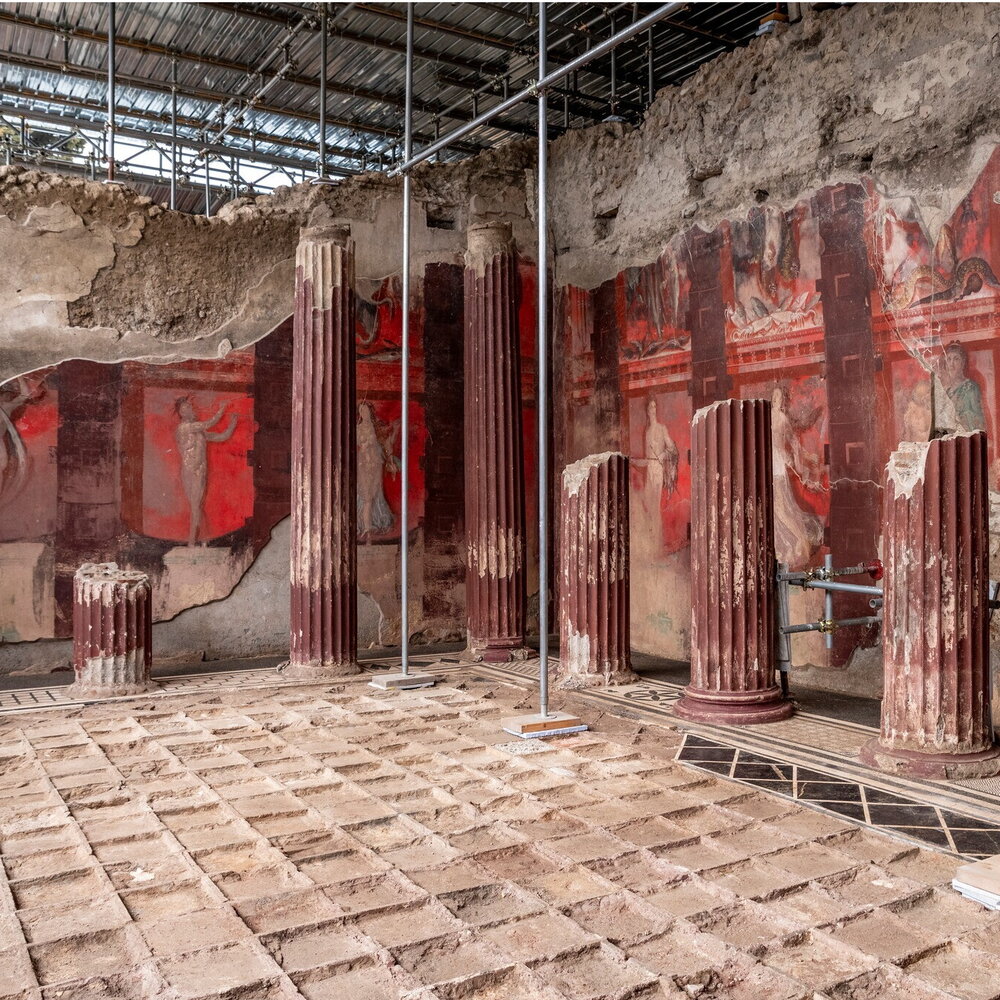
The boldest and most controversial passage in the book is the juxtaposition between Dionysus e Cristo. Describing the megalografie from the Villa of the Mysteries and of House of Tiasorecently discovered, Breeding bars note that both represent i Dionysian mysteries. When the eruption destroyed every form of life, the Roman populations had to think of the gods abandoning the world: it was only Dionysus to resist and oppose the Christianity which spread. As Cristo, Dionysus he was the son of a father god – Zeus — and of a woman. Both embodied a superior power. Both died and were reborn.
Sex, morality and interpretations
Breeding bars himself knows well that his thesis is bold: “I imagine that this book will not be welcomed by colleagues,” he said, presenting it to Castellammare di Stabia. Then there is the chapter on sex and on morale. Sex, in frescoes and in graffitithere is a preponderant part. Yo to be hunted they were frequented environments. In 1885 a German archaeologist published aregistration found in via dell’Abbondanza: just two words, “Sodom and Gomorrah”, the biblical cities destroyed by God with brimstone and fire.
Moralistic readings and empathetic approach
Tertullian in the 2nd century he wrote that Pompeii it had been destroyed because it did not accommodate Christians. Breeding bars he does not shy away from these materials: he uses them to show how much the moralistic reading Of Pompeii as old as it is Pompeii itself. One of the most interesting elements of the volume is theempathetic approach all’archeology. I finds they stop being simple objects to become fragments of lives: graffiti, tools e domestic spaces they are transformed into testimonies of individual experiences. Breeding bars thus manages to construct a vivid and immersive narrative, supported by a broad cultural repertoire which ranges from classical sources at the European philosophygiving the text a strong evocative capacity.
Pompeii is us
The last chapter is titled ‘Pompeii is us’. Breeding bars he said that he wrote the book without the intention of talking about the present, but that he reread it at the end and understood that in reality it is exactly this: the search for conditions materials, social, environmental, artistic e cultural under which humans have tried to imagine and encounter the divine. Pliny the Younger in the ‘Easier‘ he says that during the eruption “many raised their hands imploring the gods, but most believed that the gods had left the world over which a new eternal night loomed”. A world that loses its gods and still doesn’t know which ones to replace them with.
https://www.do3d.com/profile/rafagarold/profile
https://www.do3d.com/profile/larrykingitsgreat21081/profile
https://www.do3d.com/profile/aandrewzarudnyi/profile
https://www.merthyrtownfc.co.uk/profile/xegip3388948309/profile
https://www.do3d.com/profile/voplafaro15020/profile
https://www.chateaurecovery.com/members-area/trafinock53799/profile?disableScrollToTop=true
https://wemixplay.com/post/396623
https://wemixplay.com/post/396624
https://www.do3d.com/profile/rokilnaro/profile
https://www.do3d.com/profile/dafurlink/profile
https://www.merthyrtownfc.co.uk/profile/sowokog60921764/profile
https://www.merthyrtownfc.co.uk/profile/yewob7270799325/profile
https://www.merthyrtownfc.co.uk/profile/wewev9357377137/profile
https://wemixplay.com/post/396625
https://www.downtowntroyny.org/profile/aandrewzarudnyi48221/profile
https://www.imineros.com/profile/trafinock26016/profile
https://l2network.eu/forums/index.php?/events/event/3441-juegos-casino/
https://www.downtowntroyny.org/profile/dafurlink85269/profile
https://www.downtowntroyny.org/profile/nitorian2318294/profile
https://paragraph.com/@[email protected]/juegos-casino?referrer=0x9915EED56880e5b5EF62180c2ce330a701b0CBE7
https://www.imineros.com/profile/dafurlink85880/profile
https://www.imineros.com/profile/voplafaro19321/profile
https://www.24liveblog.com/live/U15sX
https://huggingface.co/Patoni31/xx1/blob/main/README.md
https://lawschoolnumbers.com/ObrianPiterson3