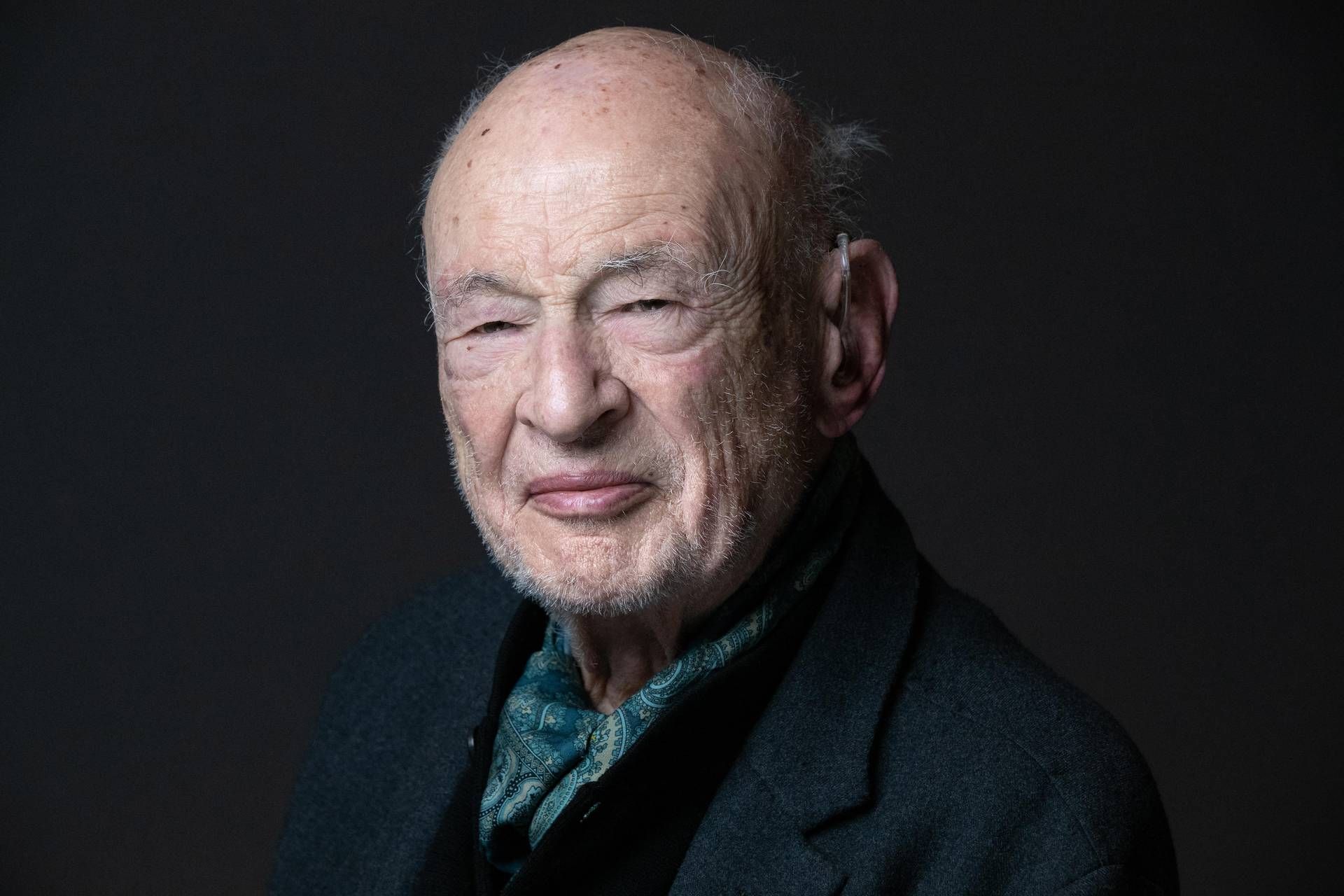
The French philosopher, anthropologist and sociologist Edgar Morin, initiator of “complex thinking”, famous for the transdisciplinary approach with which he treated a wide range of topics, including epistemology, died on the eve of his 105th birthday in Paris. The illustrious intellectual, one of the last giants of contemporary culture, was president of the Association for Complex Thought, based in Paris, and president of the European Agency for Culture and was honorary professor of the École des Hautes Études en Sciences Sociales, where since 1977 he was director of studies.
“Soldier of the Resistance, militant and free man, writer and thinker of the century, defender of nature and peoples, Edgar Morin was the personification of humanism”, the memory of the French president on Emmanuel Macron. “With his benevolence, his curiosity, he never ceased to enlighten us. Complex thought, fertile life, universal spirit. I offer the nation’s condolences to his loved ones”, added the head of the Elysée.
Born in Paris on 8 June 1921 into a Sephardic Jewish family, originally from Livorno, like Edgar Nahoum, he participated in the Resistance from 1941, taking the surname of his future wife: Morin. A member of the French Communist Party, he was expelled in 1951 after almost ten years of militancy, following the publication of an article on the Stalinist trials. Morin told the story in the book “Autocritica. A question about communism” (Il Mulino, 1962). Having graduated in literature and law from the University of Toulouse, in 1945 Morin became head of the propaganda office of the French military government in Germany. Returning to Paris in 1947, he was editor-in-chief of a local newspaper and in 1950 he joined the CNRS in Paris (Centre national de la recherche scientifique), where he conducted and directed studies and research on stardom, young people and mass culture for over thirty years.
Complex thinking
Considered one of the greatest and most prestigious contemporary intellectualsdirector from 1950 to 1989 (emeritus since 2002) of the Center for Studies on Mass Communications of the French National Center for Scientific Research, Morin theorized with the monumental work in six volumes “The Method” (Feltrinelli, 1983; 6 volumes, Raffaello Cortina, 2001-2008) – a milestone of complexity theory – the need for a new interdisciplinary knowledge that overcomes the separation of knowledge present in our era and which is capable of educating in complex thinking.
Protagonist of debates that have ranged from philosophy to political science, from the sociology of cinema to the epistemology of the human sciences, Morin’s research has touched on problems pertaining to the world of the media, biology and natural sciences, society and political life of the twentieth century. He was the founder of the magazine “Arguments” in 1956, which he directed until 1962; in 1967, with Roland Barthes and Georges Friedmann, he created the renowned culture magazine “Communications”, which he has directed since 1972. In 1998 he was appointed president of the scientific committee for the reform of knowledge in upper secondary schools by the French Minister of Education.
He is the author of pioneering studies in the ethnological field (“Investigation into the metamorphosis of Plodémet”, Il Saggiatore, 1969), of popular interventions on the Parisian 1968 and student revolts (“The faceless revolution”, “The Paris Commune of May ’68”, Il Saggiatore, 1968), of essays on Soviet totalitarianism (“The nature of the USSR. The totalitarian complex of the last empire”, Armando, 1989) and on the most pressing challenges for European civilization in the era of globalization (“Our Europe”, Raffaello Cortina, 2013).
Morin was awarded the highest international recognitions in the field of non-fiction, including the European Charles Veillon Prize (1987). He was a Knight of the Legion of Honour, Grand Officer of the National Order of Merit (France), Commander of the Ordre des Arts et des Lettres (France), Grand Groce of the Order of Saint James of the Sword (Portugal), Commander of the Order of Intellectual Efficiency (Morocco), Officer’s Cross of the Order of Civil Merit (Spain). He received 21 honorary degrees from as many universities in the world (including in Italy from the universities of Messina, Milan, Bergamo, Perugia, Palermo, Naples, Macerata). In Italy he was awarded the Viareggio-Versilia International Prize (1989) and the Scanno Prize for Sociology (2012).
Morin outlined, in a heterogeneous and vast production, a “sociology of culture” oriented, in a first phase, in the direction of mass culture and, starting from the Seventies, in the direction of methodological and epistemological problems. The “humanity of man”, according to Morin, is characterized not only by biological complexity, but also by the complexity of the “human situation”, perpetually oscillating between order and disorder. From this dualism follows, in Morin’s opinion, the fundamental obligation not to interrupt the (”almost Cartesian”) reorganization of human experience and knowledge.
Contemporary social anthropology is the point of connection between Morin’s multiple interests both when he develops a sociology of mass communications (“The cinema or the imagination”, Silva, 1962; “The stars”, Mondadori, 1963; “The cultural industry. Essay on mass culture”, Il Mulino, 1963), and when he inspects the foundations of knowledge (“The method – Order, disorder, organization”, Feltrinelli, 1983; “The life of life”, Feltrinelli, 1987; “The knowledge of knowledge”, Feltrinelli, 1989).
Morin’s other numerous works include: “The Lost Paradigm: What is Human Nature?” (Bompiani, 1974); “To exit the twentieth century” (Lubrina, 1989); “Science with conscience” (Franco Angeli, 1984); “Pink and Black” (Spirali, 1984); “Sociology of sociology” (Edizioni Lavoro, 1985); “Sociology of the present” (Edizioni Lavoro, 1987); “Troubling the future. A new beginning for planetary civilization” (Moretti & Vitali, 1990); “Rethinking Europe” (Laicata, 1992); “Introduction to complex thinking. The tools to face the challenge of complexity” (Sperling & Kupper, 1993); “Ideas” (Feltrinelli, 1993). Meltemi has published “I fratricidi” (1997), “My demons” (1999), “Introduction to a politics of man” (2000), “Man and death” (2002) and “The spirit of time” (2017). In 2019 the philosopher published the autobiographical text “Memories come to meet me” (Raffaello Cortina, 2020). (Of Paolo Martini)
https://wild-sultan-casinofr.com/
https://wildfortune-no.org/
https://wildfortune.eu.com/
https://wildrobin-no.eu.com/
https://wildrobin9.com/
https://wildsino-gr.org/
https://wildsino.es/
https://wildsino.org.gr/
https://wildsultan-casinofr.com/
https://wildsultan36.com/
https://wildsultanfr.eu.com/
https://wildtornado-si.eu/
https://wildtornado-si.eu.com/
https://wildtornado-si.net/
https://wildtornado-si.org/
https://wildtornado-si.si/
https://wildz-ca.net/
https://wildz-de.eu.com/
https://wildz-de.net/
https://wildz-de.org/
https://wildz-deutschland.com/
https://wildz.it.com/
https://wildz.us.com/
https://wildz37.com/
https://wildz7.com/