Meteorologists predict sea surface temperatures are much warmer than average, signaling that this year’s El Nino could be the strongest on record.
Theo Live Sciencean early June update from the European Center for Medium-Range Climate Forecasts (ECMWF) shows that the upcoming weather event will be the strongest El Nino ever measured. The Nino 3.4 index (a measure of the difference in sea surface temperature between 5 degrees north latitude and 5 degrees south latitude and between 120-170 degrees west longitude) shows that sea surface temperature in the Pacific region along the equator increased 1 degree Celsius higher than normal at the end of May. ECMWF forecasts that sea surface temperature will increase 3 degrees Celsius above average in December, even exceeding 4 degrees Celsius in some cases.
Although the meteorological agency usually relies on rising sea surface temperatures for at least three consecutive months before officially announcing the appearance of El Nino, atmospheric changes related to this phenomenon have already begun to take place. If forecasts are correct, this year’s El Nino will be significantly stronger than the previous records of 2015-2016 and 1997-1998. During those two El Nino events, the Nino 3.4 index recorded a temperature increase of 2.3 degrees Celsius above average.
Theo Economics TimesECMWF’s findings are consistent with observations from many other international weather agencies. Last month, US government climate research institutes estimated there was an 82% chance of El Nino developing between May and July. Meanwhile, the Australian Bureau of Meteorology reported temperatures in the equatorial Pacific were 0.67°C higher than average at the end of May.
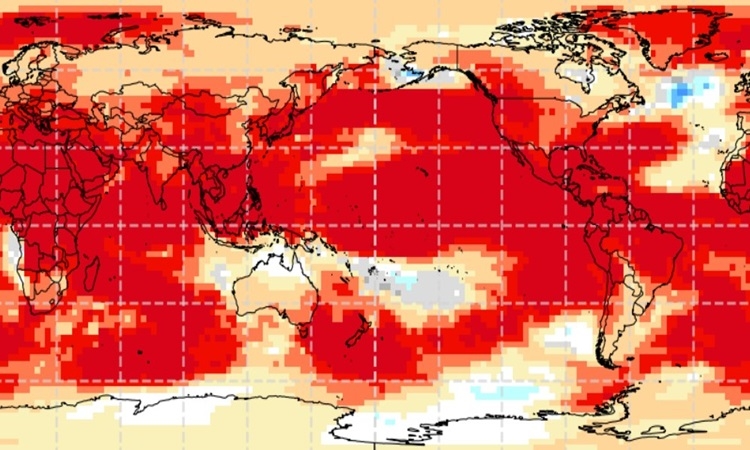
WMO’s air temperature forecast for the period from June to August, with red areas indicating above-normal temperature increases. Image: WMO
El Nino events occur every 2-7 years, within the natural climate cycle El Nino-Southern Oscillation (ENSO) in the Pacific Ocean. The ENSO cycle varies between a warm El Niño phase and a cold La Niña phase, with neutral phases alternating. El Nino causes higher sea surface temperatures in the central and eastern Pacific, weakening or reversing the trade winds, disrupting global temperature and rainfall patterns. The most recent El Nino on Earth lasted from June 2023 to April 2024, making 2024 the hottest year in history and the first year to warm beyond the 1.5 degrees Celsius threshold set by the Paris Agreement on climate change. Previous El Niño events have severely impacted global agriculture, leading to famine in Europe, inciting civil wars in the tropics, and droughts, floods and wildfires around the world.
In an update on June 2, the World Meteorological Organization (WMO) warned that El Nino has an 80% chance of forming before September and a 90% chance of forming before November. “El Nino conditions will be like ‘adding fuel to the fire’ in a warming world. The impacts will be more serious, spread farther and cross borders at a devastating speed,” UN Secretary General António Guterres emphasized.
Scientists are monitoring whether the warming trend continues through June, July and August. If temperatures continue to rise, the weather agency will announce El Nino appearing in the near future.
https://klondaika1.com.lv/
https://klondaika1.lv/
https://klondaikakazino.com.lv/
https://kokobet-casino.eu.com/
https://ladbrokes-sk.eu.com/
https://ladbrokes-sk.com/
https://ladbrokes-sk.net/
https://ladbrokes-sk.org/
https://ladbrokes-sk.sk/
https://laimz-casino.com.lv/
https://laimz-kazino.com.lv/
https://laimz-lv.com.lv/
https://laimz.net/
https://laimz1.com/
https://laimz1.lv/
https://laimz7.com/
https://laimz7.lv/
https://laimzkazino.com.lv/
https://legiano-si.com/
https://legiano-si.si/
https://legiano-sk.eu.com/
https://legianocasino-si.si/
https://legianos.si/
https://legiano-si.org/
https://legiano-sk.net/