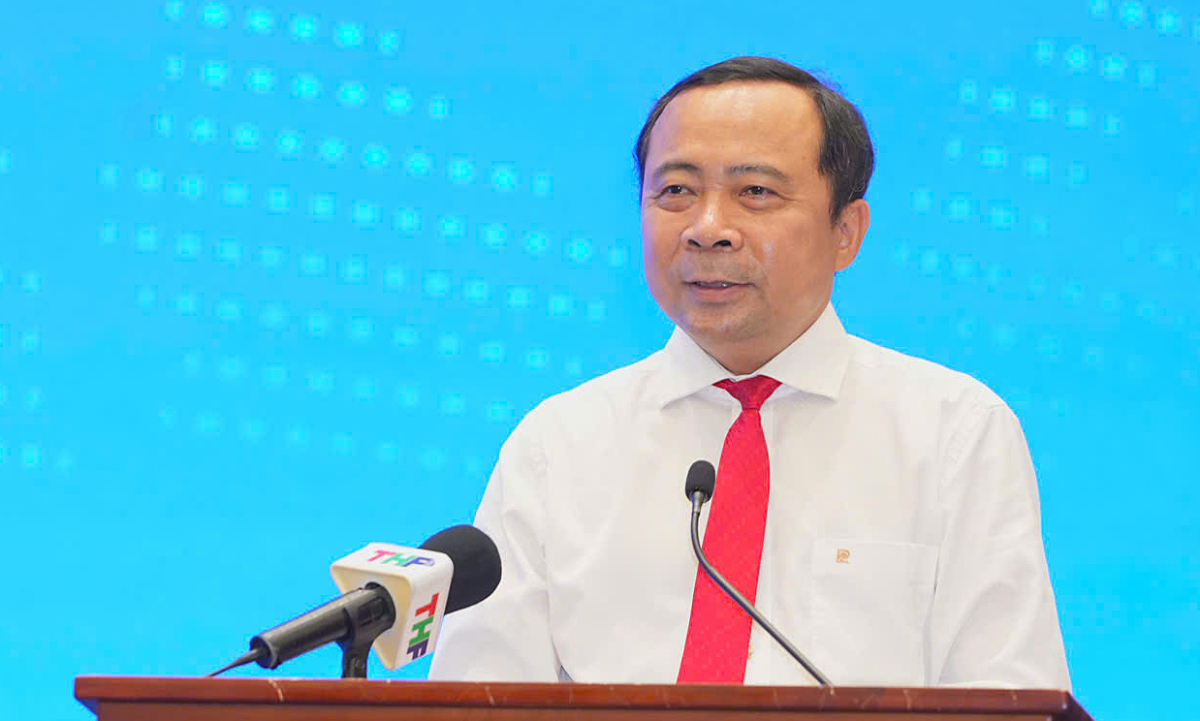
Minister Vu Hai Quan said that development based on science, technology and innovation is not only an investment in research or technology application, but also a matter of institutions, policies, and development administration.
On June 11, the Vietnam Academy of Social Sciences coordinated with Hai Phong People’s Committee to organize a seminar on socio-economic development based on science, technology and innovation. A core message at the event was to properly reconsider the nature of innovation, when many localities and businesses often identify this concept with simply increasing spending to purchase modern machinery or apply available technologies.
According to Associate Professor, Dr. Vu Hai Quan, Minister of Science and Technology, development based on science, technology and innovation is not only a matter of investment in research or technology application, but first and foremost is a matter of institutions, policies and development administration. “The growth model based on high knowledge content requires a comprehensive structure. Strong institutions are the most important foundation and catalyst to unleash the creativity of all social resources,” he said.
Associate Professor, Dr. Vu Hai Quan, Minister of Science and Technology, spoke at the conference on the morning of June 11. Image: Dam Thanh
Analyzing this shift further, the Minister assessed that where a favorable institutional environment, innovation incentive mechanism and effective connection between development entities are built, there are better conditions to transform knowledge into productivity, technology into value and innovation into growth drivers.
Going deeper into the core solution to build new macro dynamics, the head of the Science and Technology industry pointed out that the innovation value chain cannot be effective if it operates in isolation or develops on its own in a closed environment.
According to him, it is necessary to eliminate the “oasis” mindset, that is, a subject that closes its doors to research and is not attached to the flow of the market. In the innovation ecosystem, in addition to the tectonic and guiding role of the State, businesses must be placed in a central position. Enterprises are the direct focal points for applying technology, optimizing processes and commercializing research results. “Tightening the connection between the three pillars of researchers – universities – businesses will create a strong impetus for development,” the Minister emphasized.
At the workshop, experts said that the country’s economy is entering a new stage of development with strict requirements for innovating growth models, improving productivity, quality and competitiveness. For decades, the extensive growth model based on natural resource exploitation, cheap labor intensive use or investment expansion has gradually revealed its core limitations and no longer has much room.
In that flow, knowledge, technology, data and innovation capacity are no longer complementary factors, but play a decisive role, becoming the most important driving force for labor productivity and growth quality of each locality as well as the entire country. The shift from breadth to depth growth, where the factor of aggregate productivity plays the ultimate role, is not only an inevitable global trend but has become an urgent requirement to create a solid breakthrough.
As the locality chosen for practical analysis at the conference, Hai Phong is considered to be facing a historic opportunity to transform. After the milestone merger with Hai Duong in 2025, Hai Phong will become the third largest city in the country, holding a key position in industry, logistics and marine economy. Minister Vu Hai Quan said that proactively mobilizing, connecting and effectively using resources from the State, businesses, research and training facilities and domestic and international partners is important in creating new competitive advantages and expanding development space for the city.
https://Warrenmarijuana.clinic
https://Warrenmarijuana.clinic/telehealth
https://Warrenmarijuana.clinic/about
https://SterlingHeightsmarijuana.clinic
https://SterlingHeightsmarijuana.clinic/telehealth
https://SterlingHeightsmarijuana.clinic/about
https://AnnArbormarijuana.clinic
https://AnnArbormarijuana.clinic/telehealth
https://AnnArbormarijuana.clinic/about
https://Minneapolismarijuana.clinic
https://Minneapolismarijuana.clinic/telehealth
https://Minneapolismarijuana.clinic/about
https://SaintPaulmarijuana.clinic
https://SaintPaulmarijuana.clinic/telehealth
https://SaintPaulmarijuana.clinic/about
https://Rochestermarijuana.clinic
https://Rochestermarijuana.clinic/telehealth
https://Rochestermarijuana.clinic/about
https://Duluthmarijuana.clinic
https://Duluthmarijuana.clinic/telehealth
https://Duluthmarijuana.clinic/about
https://Bloomingtonmarijuana.clinic
https://Bloomingtonmarijuana.clinic/telehealth
https://Bloomingtonmarijuana.clinic/about