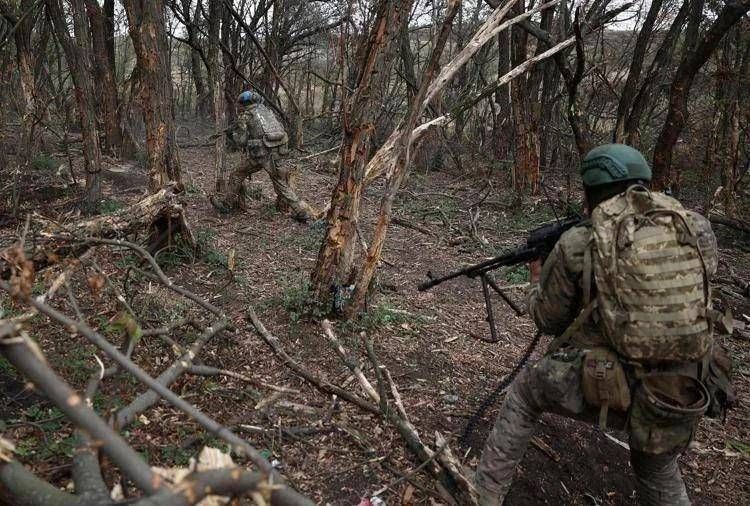
The war in Ukraine triggered by the Russian invasion has often been compared to the Great Warfor the ferocity of the fighting on the field, the very heavy losses of human lives, the use of new warfare technologies. Another element the two conflicts have in common: their duration. The one between Russia and Ukraine has been ongoing for 1,569 days and a few hours: survived 4 years and three months of the First World War.
When Russian President Vladimir Putin sent his troops into Ukraine in February 2022, he believed the country would fall in a matter of days. When Ukraine pushed back the Russians and the conflict turned into a war of attrition, few could have imagined it would last so long. Today, half of Ukrainians believe the war will not end before next year, which would bring it closer to another critical threshold: the duration of World War II, six years.
Historians warn that drawing parallels with the two world wars requires caution. The global scope of those conflicts, which involved numerous operational theaters and armies, makes comparisons in terms of human losses and firepower difficult.
Ma there are commonalities, similarities, as well as differencesunderlines the Ukrainian historian Yaroslav Hrytsak, quoted by the New York Times: the war in Ukraine, like the First World War, transformed European geopolitics, reshaping military alliances and triggering a rearmament unprecedented in decades.
New technologies
Military analysts then observe that the two conflicts redefined the nature of war through the introduction of new technologies: planes and tanks a century ago; drones that sail the skies, seas and lands today. It is no coincidence that for the first time on X, Ukrainian President Volodymyr Zelensky celebrated the Day of Remotely Piloted Aircraft Systems Forces. “Modern warfare can no longer be imagined without drones, and Ukrainian unmanned aerial systems operate at different levels: from front-line missions to hitting major enemy installations hundreds of kilometers deep in Russian territory.” In both cases, technological advances have made warfare more brutal for humans.
For Michel Goya, former French colonel and military historian, the parallelism between the two conflicts can start from the initial phase of both wars. In 1914, the Germans launched a rapid offensive towards Paris in the hope of achieving an immediate victory. Russian forces had the same objective when they rushed towards Kiev, the Ukrainian capital, in 2022. In both cases, the attackers got close to their target and were repelled.
Both wars then evolved into mostly static combat along a largely frozen front, with soldiers barricaded in trenches and bunkers, enemy troops often separated by a few hundred meters, sometimes close enough to see each other.
The drone factor
The differences come with drones: On the Ukrainian front, networks of open-air trenches have become unsafe and have been replaced by underground bunkers housing no more than a handful of soldiers. Small enough to be difficult to spot from above and deep enough to resist attack. World War I-style networks of opposing trenches, separated by a narrow buffer zone, gave way to a combat area stretching for miles and dotted with underground shelters. In this “fire zone”, any movement is quickly detected by drones.
Large-scale troop assaults, like those of a century ago, have become all but impossible under constant drone surveillance. Such assaults have been replaced by attacks conducted by just one or two soldiers. Tanks, first introduced in 1916, were still a feared weapon in the early years of the Ukrainian war. They are rarely used today because their size makes them easy targets for drones, although some tanks have been modified with protective metal cages.
It is difficult to compare human losses, given the difference in scale between the two wars. A century ago, millions of soldiers were sent into battle on multiple fronts in Europe. Today, the forces involved number in the hundreds of thousands. An estimated nine to eleven million soldiers died in World War I, compared to around half a million in Ukraine so far. However, analysts and military officials, including NATO Admiral Pierre Vandier, quoted by the New York Times, say that drones have made the Ukrainian battlefield lethal to levels comparable to those of the First World War.
Infinite stalemate?
The question now is whether either side will be able to break the deadlock. In World War I, the Allies prevailed by combining economic pressure on Germany, through a rigid naval blockade, with military pressure, through relentless offensives. Ukraine’s strategy to end the war bears some similarities to that approach. Drone attacks on Russia’s oil assets, the backbone of its economy, are designed to limit Moscow’s ability to finance its war effort. Kiev doesn’t have the manpower to replicate World War I offensives, but it has flooded the battlefield with small attack drones in hopes of inflicting unsustainable casualties on the Russian army. For historian Hrystakm “this is the First World War, but with drones”.
https://SouthWindsorLandscaping.us/yard-clean-up/green-waste-disposal
https://SouthWindsorLandscaping.us/yard-clean-up/gutter-cleaning
https://SouthWindsorLandscaping.us/yard-clean-up/junk-removal
https://SouthWindsorLandscaping.us/yard-clean-up/leaf-removal
https://SouthWindsorLandscaping.us/yard-clean-up/tree-removal
https://SuffieldLandscaping.us
https://SuffieldLandscaping.us/gardening
https://SuffieldLandscaping.us/gardening/brush-removal
https://SuffieldLandscaping.us/gardening/flower-bed-maintenance
https://SuffieldLandscaping.us/gardening/flower-planting
https://SuffieldLandscaping.us/gardening/hedging
https://SuffieldLandscaping.us/gardening/mulching
https://SuffieldLandscaping.us/gardening/plant-removal
https://SuffieldLandscaping.us/gardening/pruning
https://SuffieldLandscaping.us/gardening/weeding
https://SuffieldLandscaping.us/lawn-care
https://SuffieldLandscaping.us/lawn-care/artificial-grass-installation
https://SuffieldLandscaping.us/lawn-care/dethatching-lawn
https://SuffieldLandscaping.us/lawn-care/fertilizing-lawn
https://SuffieldLandscaping.us/lawn-care/hydroseeding
https://SuffieldLandscaping.us/lawn-care/lawn-aeration
https://SuffieldLandscaping.us/lawn-care/lawn-edging
https://SuffieldLandscaping.us/lawn-care/lawn-grubs-control
https://SuffieldLandscaping.us/lawn-care/lawn-installation
https://SuffieldLandscaping.us/lawn-care/lawn-leveling