While doing experiments, Dr. Le Quoc Viet and his research team discovered the mechanism of nanoparticle adhesion, which is the basis for him to upgrade potential drug-carrying materials used in cancer treatment.
In 2019, in a pharmaceutical research lab at Seoul National University, Dr. Le Quoc Viet and his research team observed a strange phenomenon: when using tiny photothermal nanomaterial particles to “attack” cancer tumors, the nanoparticles still “stick” and “pair” with cancer cells even when the cells are dead.
Dr. Viet said that the phenomenon of “pairing” even when near-infrared irradiation causes death and protein denaturation of tumor cells has not been mentioned much before. This observation opens up the hypothesis that it is possible to take advantage of dead cancer cells as “local vaccine” antigens by activating immunity at the tumor site.
Normally, antigens isolated and processed in the laboratory are introduced into the body so that the immune system can get used to it and learn how to attack viruses, bacteria or abnormal cells, also known as vaccination. Taking advantage of the selective “adhesion” properties of photothermal nanoparticles, the team innovated materials to carry immune activators. When nanoparticles adhere to cancer cells and are also antigens, the immune system in the tumor will be stimulated to learn how to attack.
“A form of ‘in situ vaccine’ will be formed right in the body. The goal of this idea is to both support tumor destruction with photothermal therapy and promote anti-cancer immune response to control remaining cells or potential metastatic foci,” Dr. Viet explained. Results in animal models, published above ACS Nanoshows the ability to inhibit tumor growth and promises a new treatment direction for this disease.
Dr. Le Quoc Viet, Ton Duc Thang University. Image: NVCC
According to Dr. Viet, researching advanced biomedical materials costs a lot while the possibility of failure is not small. “There were experiments that lasted many months, even years, but did not give the desired results,” he recounted the process of finding a way to “load” many active ingredients at the same time including small molecule drugs, peptides and antibodies on the same polymer-based nanosystem to prepare drugs to treat multiple sclerosis.
The experiments took nearly a year but were unsuccessful – the polymer used, polydopamine, was structurally stable and “adhesive” enough to attach many components but affected each other’s performance or reduced the activity of the antibody.
Almost giving up because he couldn’t find a feasible solution, Dr. Viet realized that a number of research groups around the world were going in the direction of developing hybrid nanosystems, combining many different types of materials. “This observation suggested to me the idea of combining liposomes, materials made from fat that resemble cell membranes, are compatible but not durable,” he described. “The result was the construction of a hybrid nano system, which has been researched and developed into a tolerable vaccine for application in the treatment of multiple sclerosis in mouse models.” The study was published in the journal Advanced Materialsbelongs to the top prestigious magazines in the field.
Vietnam has a lot of potential
Returning from 2021, Dr. Viet currently joins the research team at Ton Duc Thang University led by Prof. Dr. Nguyen Minh Duc, with the goal of screening and developing new drugs and transferring production technology. In addition, he also participates in building the pharmaceutical and biomedical sciences industry at the school, training students closely with the research group’s activities, contributing to training Vietnam’s next generation in the field.
He said, in drug development, nano-sized particles, made from natural, synthetic polymers or lipids, act as smart “packaging” that protects and delivers drugs to the right location, controlling the release rate accurately. This material solves the biggest problem of modern medicine: many active ingredients are highly effective but unstable, decompose before “reaching their destination” or cause many side effects on healthy cells.
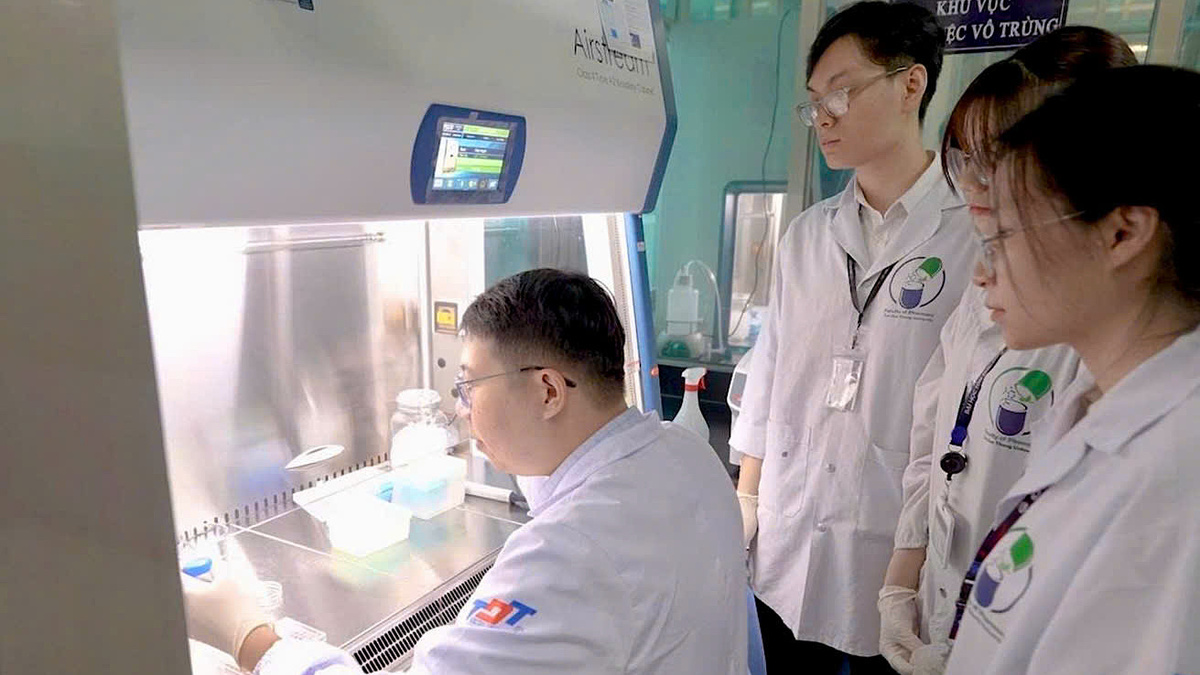
Dr. Viet guides students in testing to evaluate the impact of drugs on cancer cell models. Image: NVCC
Most domestic businesses today are still cautious with advanced biomedical technologies due to high investment costs, long capital recovery period and the high possibility of failure. According to Dr. Viet, to develop the field of biomedical materials, both in basic and applied research, there needs to be a risk sharing mechanism between the State, businesses and research organizations. For example, the state can encourage businesses to invest through co-financing funds and allow commercialization of results. The state can also invest in key, shared biomedical research centers to help groups have access to modern laboratory equipment.
The fields of new generation vaccines, gene therapy, regenerative medicine or precision medicine are reaching a stage where advanced materials and delivery systems are required. Accordingly, this is an opportunity for domestic researchers as well as the young generation of students and researchers to participate from the early stages and master an important component in modern medicine, instead of receiving completed technologies as before. “Vietnam has great potential and is gradually catching up when identifying advanced biotechnology and biomedical technology as strategic technologies and investing more and more heavily in this research direction,” he said.
MenomineeRecords.us
Mercer County, Kentucky Public Records Lookup | MercerCountyRecords.org
MercerCountyRecords.us
MercerWVRecords.us
Meriwether County, Georgia Public Records Lookup | MeriwetherRecords.us
Miami County, Indiana Public Records Lookup | MiamiCountyRecords.us
MiamiKSRecords.us
MiddlesexCountyRecords.us
Milam County, Texas Public Records Lookup | MilamRecords.us
Millelacs County, Minnesota Public Records Lookup | MillelacsRecords.us
Miller County, Missouri Public Records Lookup | MillerMORecords.us
Mineral County, West Virginia Public Records Lookup | MineralRecords.us
Mingo County, West Virginia Public Records Lookup | MingoRecords.us
Minidoka County, Idaho Public Records Lookup | MinidokaRecords.us
Mississippi County, Arkansas Public Records Lookup | MississippiCountyRecords.us
Mitchell County, Georgia Public Records Lookup | MitchellRecords.us
Monroe County, Florida Public Records Lookup | MonroeFLRecords.us
Monroe County, Georgia Public Records Lookup | MonroeGERecords.us
Monroe County, Illinois Public Records Lookup | MonroeCountyRecords.org
Monroe County, Indiana Public Records Lookup | MonroeINRecords.us
Monroe County, Michigan Public Records Lookup | MonroeMIRecords.us
Monroe County, Mississippi Public Records Lookup | MonroeMSRecords.us
Monroe County, New York Public Records Lookup | MonroeNYRecords.us
Monroe County, Tennessee Public Records Lookup | MonroeTNRecords.us
Monroe County, Wisconsin Public Records Lookup | MonroeCountyRecords.us