Chinese auto companies are racing to produce smart control chips for self-driving cars to reduce dependence on Nvidia and Horizon Robotics.
Theo SCMPa new “front” is opening up in the electric vehicle technology war in China, as automakers simultaneously aim to design their own chips and see this as a new strategy in the world’s largest auto market.
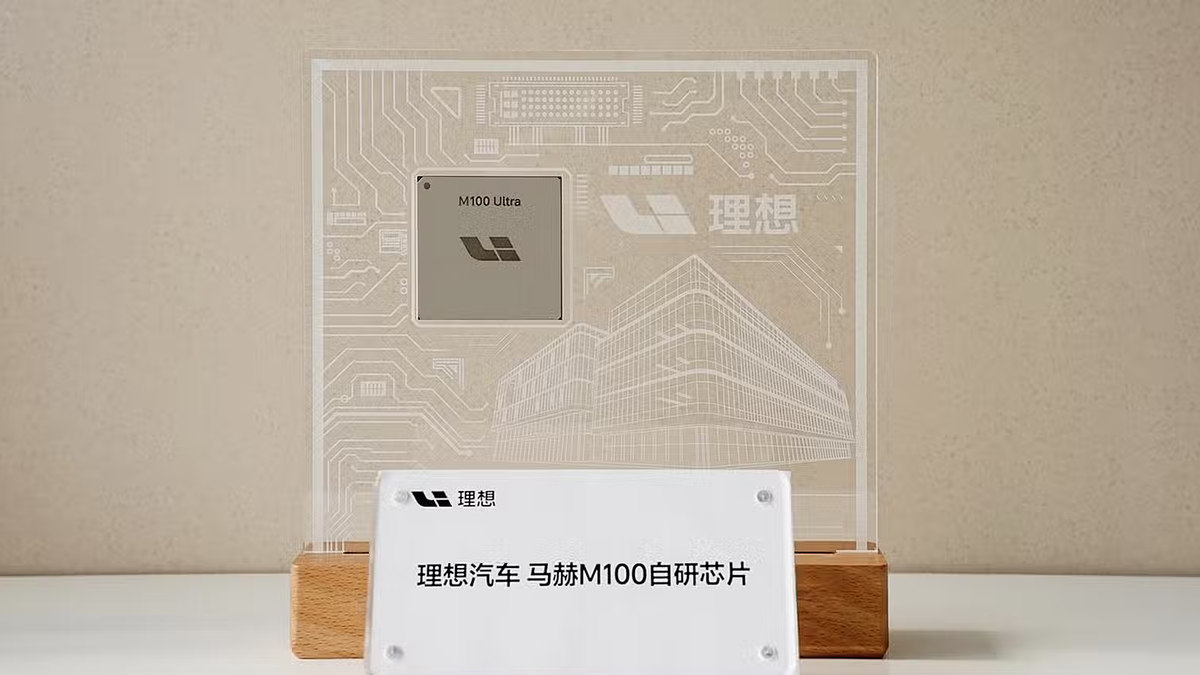
The latest move took place on June 15, when Li Auto announced the Mach M100 series, an AI chip manufactured on a 5 nanometer (nm) process for self-driving cars. The chip is equipped with a computing power of 1,280 TOPS (trillions of calculations per second), expected to be used on the L9 Livis SUV with 82% efficiency testing. According to TechCruncha higher TOPS index allows the control system to make driving decisions faster, by simultaneously processing data from various sources such as radar and lidar sensors.
Li Auto’s Mach M100 Ultra chip model. Image: Li Car
Previously, a series of Chinese automakers also announced new chips for their cars. Last month, BYD launched Xuanji A3 on a 4 nm process, which is in mass production. The chip is capable of supporting level 3 and 4 autonomous driving functions. According to the company, three Xuanji A3 chips working in parallel can provide more than 2,100 TOPS of processing power.
Nio has launched the 5 nm NX9031 chip since 2023, integrating more than 50 billion transistors, 32-core CPU, supporting LPDDR5X memory and meeting ASIL-D safety standards, introduced with performance equivalent to four Nvidia Orin-X chips, allowing data processing from camera, lidar and radar systems with low latency, serving new generation driver assistance and autonomous features.
Geely will begin its automotive chip development strategy from 2021 through ecosystem companies such as EcarX and SiEngine. By March 2024, these two units launched the 7 nm process AD1000 chip with 256 TOPS computing power, serving Geely, Zeekr and Lynk car models.
In addition, Xpeng is also creating a proprietary Turing chip, expected to be equipped on smart systems from the end of the year. The Guangzhou-based electric vehicle company said the new chip helps the car achieve level 4 self-driving capabilities.
The Society of Automotive Engineers (SAE) – a global organization headquartered in the US, with about 130,000 professional automotive engineers and technical experts related to the auto industry – classifies 6 levels of self-driving systems including L0, L1, L2, L3, L4, L5. In particular, from L0 to L2, the driver is still primarily responsible, even though the car can support features such as automatic throttle or lane keeping.
At level L3, the vehicle is capable of autonomous driving in certain conditions but still requires the driver to be ready to take over when needed. With L4, the vehicle can operate autonomously in a predetermined area or environment without human intervention. The highest is L5, when the vehicle can drive itself in all traffic and weather conditions, without needing a steering wheel, pedals or operator.
A report from Sunwah Kingsway published earlier this year showed that, by the end of 2025, two-thirds of cars sold in China will have integrated driver assistance systems. According to research company TechInsights (Canada), the semiconductor market for smart vehicles is forecast to nearly double, to 41 billion USD by the end of the decade.
Gaogong Institute of Industry (GGII) pointed out that in 2025, Horizon Robotics holds a 47.66% market share in the advanced driving assistance system (ADAS) solution segment integrating front view camera and small domain control computing chip in China. Nvidia holds 49.36% market share in the urban ADAS NOA chip segment. The total number of vehicles delivered in the billion-people market (excluding imports and exports) equipped with ADAS reached nearly 9 million units, with a penetration rate of 38.83%.
Reuters assessment, by designing their own chips, Chinese automakers are trying to gain more control over this type of hardware, while reducing dependence on Nvidia and Horizon Robotics – a Chinese company specializing in developing AI chips and software platforms for smart cars.
The trend is also boosted by the popularity of self-driving cars across China. Features that previously only appeared on luxury cars are now available on mid-range and even low-cost models. According to Horizon Robotics’ annual report earlier this year, the proportion of passenger cars with smart driving support reached 67.6% by 2025, while the proportion of mid-range to high-end smart vehicles with autonomous driving systems on highways and urban areas (NOA) nearly doubled compared to 2024, from 21.6% to 42.6%.
The change is also taking place strongly in low-cost cars. In the segment under 200,000 yuan ($29,500), which accounts for 65% of car sales in China, the proportion equipped with mid-range to high-end driver assistance systems has increased from 5% at the beginning of 2025 to more than 50%, according to data from Horizon Robotics.
Industry observers assess that the shift puts pressure on large companies, forcing them to adjust hardware costs. Analysts from Huatai Securities (China) said that autonomously designing chips for self-driving cars brings many potential advantages, including low long-term component costs, the ability to tightly integrate hardware and software, as well as better control of the product development roadmap in the future.
However, according to EEWorlddeveloping self-driving chips also comes with challenges. In particular, chip research and design costs are high, requiring long development times and strict testing processes to meet automotive safety standards. The fact that each car company pursues its own chip architecture and software platform increases the risk of market fragmentation, causing application and ecosystem development costs to increase.
Besides, despite possessing design capabilities, many Chinese businesses still depend on processing units to produce chips. Nvidia or Horizon Robotics still maintains the advantage thanks to its complete software ecosystem, rich development tools and proven computing power on a global scale. Self-driving technology also depends on large volumes of data collected from vehicles, raising concerns about privacy, confidentiality and data security, especially as Chinese self-driving car companies expand their operations into international markets.
Fayette County, West Virginia Court Records | FayetteCountyRecords.us
Fayette County, West Virginia Warrant Records | FayetteCountyRecords.us
Fayette County, West Virginia Divorce Records | FayetteCountyRecords.us
Fillmore County, Minnesota Property Records | FillmoreRecords.us
Fillmore County, Minnesota Arrest Records | FillmoreRecords.us
Fillmore County, Minnesota Criminal Records | FillmoreRecords.us
Fillmore County, Minnesota Inmate Search | FillmoreRecords.us
Fillmore County, Minnesota Court Records | FillmoreRecords.us
Fillmore County, Minnesota Warrant Records | FillmoreRecords.us
Fillmore County, Minnesota Divorce Records | FillmoreRecords.us
Floyd County, Kentucky Property Records | FloydCountyRecords.us
Floyd County, Kentucky Arrest Records | FloydCountyRecords.us
Floyd County, Kentucky Criminal Records | FloydCountyRecords.us
Floyd County, Kentucky Inmate Search | FloydCountyRecords.us
Floyd County, Kentucky Court Records | FloydCountyRecords.us
Floyd County, Kentucky Warrant Records | FloydCountyRecords.us
Floyd County, Kentucky Divorce Records | FloydCountyRecords.us
Fluvanna County, Virginia Property Records | FluvannaRecords.us
Fluvanna County, Virginia Arrest Records | FluvannaRecords.us
Fluvanna County, Virginia Criminal Records | FluvannaRecords.us
Fluvanna County, Virginia Inmate Search | FluvannaRecords.us
Fluvanna County, Virginia Court Records | FluvannaRecords.us
Fluvanna County, Virginia Warrant Records | FluvannaRecords.us
Fluvanna County, Virginia Divorce Records | FluvannaRecords.us
Franklin County, Alabama Property Records | FranklinCountyRecords.us