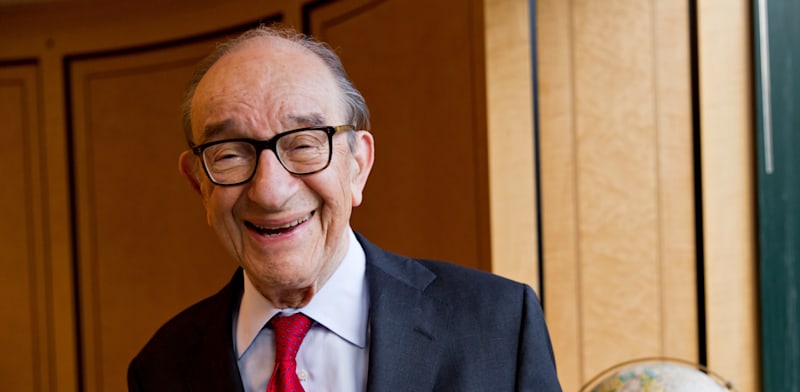
Alan Greenspan, who served as chairman of the US Central Bank (Federal Reserve) for nearly two decades and was one of the most influential economists of the modern era, passed away at his home at the age of 100 as a result of complications from Parkinson’s disease.
Greenspan navigated the American and global economy under four different presidents, from Roland Reagan to George Bush Jr., and seven different Treasury Secretaries, between 1987 and 2006. He is considered the one who shaped modern American capitalism, and was one of the most powerful people in the financial world – a huge force that led to the famous Fortune magazine headline: “In Greenspan We Trust” (In Greenspan We Trust).
His wife of the past 29 years, senior NBC correspondent Andrea Mitchell, paid tribute to him: “He was a giant who helped shape the American economy for decades, but was always honest enough to admit his mistakes. To me, he was my husband… He had an ‘unbridled optimism’ for baseball, tennis, golf and music, especially jazz.”
From playing jazz to the top of the government
Greenspan was born in the Washington Heights neighborhood of New York in 1926 to a broker father and a housewife mother who divorced when he was a child. He displayed a brilliant mathematical talent from an early age, born at all from his childhood love of baseball game statistics. Before turning to economics, he attended the prestigious Juilliard school and played saxophone and clarinet in a jazz band, alongside giants such as Stas Getz.
In the early 1950s, he became part of the close circle of the writer and philosopher Ayn Rand, who advocated a completely free market. Greenspan later said that it was Rand who helped him understand how “fear, euphoria and herd behavior dramatically affect modern economies.” He only finished his third degree (Ph.D) from New York University in the 1970s; Decades later, journalists discovered his doctoral thesis, and found in it staunch libertarian positions that the Fed’s sole role is to “avoid printing money that fuels financial bubbles.”
He began his political career as an adviser to Richard Nixon’s campaign in 1968. He later served as chairman of President Gerald Ford’s Council of Economic Advisers (1977-1974), where he led a policy that succeeded in cutting inflation from 11% to 6.5%. In those years, he received severe public criticism when he claimed that it was Wall Street brokers who suffered the worst percentage income hit during the recession – a statement that was statistically accurate but publicly sealed in those years. The 80-year-old even got into a serious professional embarrassment as a private consultant, when he gave a warm letter of recommendation to Congress for a failed financial institution (Lincoln Savings & Loan) that collapsed shortly after and its owner was sent to prison for fraud. “Of course I’m embarrassed that I didn’t foresee what happened,” he admitted in 1989.
The “wizard” who identified the fertility revolution
Greenspan was appointed head of the Fed by Ronald Reagan in 1987 and was thrown into deep water almost immediately: only 69 days after his appointment, Wall Street was hit by the “Black Monday” crisis, the sharpest daily drop in the history of the Dow Jones (22.6%). His quick response to injecting liquidity into the markets prevented a deep recession, and gave birth to the concept of the “Greenspan Put”, the feeling that the Fed will always lower interest rates to save the financial markets and protect investors from losses, which later drew criticism for creating “moral distortion” and encouraging risky behavior.
During the 1990s, he gained the status of a financial “wizard” and “rock star”, mainly thanks to an early and unique understanding of the market: while most economists pressured him to raise interest rates to prevent inflation when the economy grew, Greenspan recognized from small micro data that the technology and computing revolution boosted productivity in an unprecedented way. He realized that high productivity allows companies to absorb wage costs without passing them on to the consumer, thus allowing the economy to enjoy tremendous growth without inflation. He even signed a masterful “soft landing” engineering in 1995, when he raised the interest rate to 6% and then lowered it three times – which extended the growth cycle without degenerating the economy into recession.
His tenure became the second longest in US history, and under him the market recorded one of the most stable periods of growth: the S&P 500 index almost tripled, the economy grew at an average annual rate of 3.5%, and unemployment fell to a historic low of 3.8% in 2000. These successes established his undisputed status and gave birth to the era of the “Chairman of the Fed” The Imperial” – the members of the Monetary Committee hardly dared to disagree with him or challenge his tactics.
“Deliberate obfuscation” and the words that shook the stock markets
One of his hallmarks was the tortuous and vague manner in which he chose to speak in Congress so as not to shock the markets, a style that was dubbed “Greenspanism.” Biographer Bob Woodward wrote about him in 2000: “His long and winding sentences seem to take back at the end what they gave at the beginning, while flowing to new levels of incomprehension.” After his retirement, Greenspan admitted with a smile: “This is the language of deliberate obfuscation… The congressman thinks I have answered him, and goes on to the next question.” Washington Post journalists wrote about him in 1997: “Second only to the president, Alan Greenspan is probably the most powerful person in the country… With a few selected words he can momentarily send the stock market to heaven or hell.”
Indeed, in December 1996, at the height of the dot-com bubble, he shocked the world when he coined his most iconic term in a well-publicized speech: “How do we know when ‘unbridled optimism’ has excessively inflated asset values, which then become vulnerable to unexpected and prolonged contractions?” Investors panicked, stock markets plunged briefly, and the phrase became an integral part of the global financial lexicon when the bubble did burst a few years later.
The review: Did his approach destroy the financial protections?
Despite the glorious years, Greenspan’s legacy suffered a fatal blow less than two years after his retirement, with the outbreak of the subprime crisis in 2007 and the collapse of Lehman Brothers in 2008. Many critics and economists claimed that his libertarian approach (hands-off approach) and his reluctance to impose government regulation on the financial derivatives and mortgage markets, are what sowed the seeds for the greatest economic disaster since the Great Depression. Minutes from 2005 revealed that the Fed had identified a “bubble” in the housing market, but Greenspan mistakenly estimated at the time that “the unrest in the housing market is contained at this point.”
In 2011, an official congressional investigation committee specifically stated that the policies Greenspan led, along with three decades of deregulation, “destroyed key protections that could have prevented the catastrophe.” In the Oscar-winning documentary Inside Job (2010), he was even labeled as one of the main culprits in the crisis.
Greenspan tried to defend himself and in 2010 published a 63-page defense document called The Crisis, where he claimed that the banks simply took excessive risks with too little equity, and emphasized that it is not the role of the central bank to “burst bubbles” through aggressive interest rate increases: “Any bubble can be crushed, but economic prosperity will be the inevitable victim of such a move.” However, in his famous testimony to Congress in October 2008, he self-deprecatingly admitted that his economic ideology was flawed: “Those of us who have relied on the self-interest of lending institutions to protect shareholders’ capital – and I am among them – are in a state of shocked disbelief.” In another testimony, he summed up his career with the sentence: “I was right 70% of the time, but I was wrong 30% of the time.”
His complex relationship with US presidents
Over the years, Greenspan developed fascinating and complex relationships with the leaders of the power, which he told about in his memoirs and in his book “The Age of Upheavals”:
On Richard Nixon: “He was smart, but paranoid.”
On Gerald Ford: “He was a genuinely nice man who was not ruthlessly ambitious.”
About Ronald Reagan: “He believed passionately, and acted according to a limited number of important principles.”
On George Bush Sr.: Their relationship was particularly murky. Bush Sr. directly blamed Greenspan for his 1992 election loss to Clinton, claiming that the Fed had delayed and was too slow in lowering interest rates at the start of the 1991 recession. Bush even delayed Greenspan’s reappointment at the time as a “punitive” measure.
On Bill Clinton (Democrat): Surprisingly, Republican Greenspan praised Clinton’s financial discipline and even joked that Clinton “was the best Republican president we’ve had in a while.” Clinton thanked him and appointed him for a third and fourth term.
About George Bush Jr.: Despite the rivalry with his father, Bush Jr. appointed him to a fifth and final term in 2004. However, Greenspan criticized him and his men harshly in his autobiography for not reining in the budget: “They exchanged principles for force. They ended up with none of them. They deserved to lose.”
Greenspan, who won the highest decorations during his life, including a knighthood from Queen Elizabeth II (2002) and the US Presidential Medal of Freedom (2005), left behind an enormous, fascinating economic legacy that will continue to occupy the world of economics for many years to come.
For your attention: The Globes system strives for a diverse, relevant and respectful discourse in accordance with the code of ethics that appears in the trust report according to which we operate. Expressions of violence, racism, incitement or any other inappropriate discourse are filtered out automatically and will not be published on the site.
Coffee County, Georgia Court Records | CoffeeCountyRecords.us
Coffee County, Georgia Warrant Records | CoffeeCountyRecords.us
Coffee County, Georgia Divorce Records | CoffeeCountyRecords.us
Colorado County, Texas Property Records | ColoradoRecords.us
Colorado County, Texas Arrest Records | ColoradoRecords.us
Colorado County, Texas Criminal Records | ColoradoRecords.us
Colorado County, Texas Inmate Search | ColoradoRecords.us
Colorado County, Texas Court Records | ColoradoRecords.us
Colorado County, Texas Warrant Records | ColoradoRecords.us
Colorado County, Texas Divorce Records | ColoradoRecords.us
Columbia County, Arkansas Property Records | ColumbiaRecords.us
Columbia County, Arkansas Arrest Records | ColumbiaRecords.us
Columbia County, Arkansas Criminal Records | ColumbiaRecords.us
Columbia County, Arkansas Inmate Search | ColumbiaRecords.us
Columbia County, Arkansas Court Records | ColumbiaRecords.us
Columbia County, Arkansas Warrant Records | ColumbiaRecords.us
Columbia County, Arkansas Divorce Records | ColumbiaRecords.us
Columbia County, Florida Property Records | ColumbiaFLRecords.us
Columbia County, Florida Arrest Records | ColumbiaFLRecords.us
Columbia County, Florida Criminal Records | ColumbiaFLRecords.us
Columbia County, Florida Inmate Search | ColumbiaFLRecords.us
Columbia County, Florida Court Records | ColumbiaFLRecords.us
Columbia County, Florida Warrant Records | ColumbiaFLRecords.us
Columbia County, Florida Divorce Records | ColumbiaFLRecords.us
Columbia County, Georgia Property Records | ColumbiaGARecords.us