Many companies train AI using knowledge distilled from former employees to do the work for them, causing ethical and legal controversy.
At a gaming media company in eastern China’s Shandong province, employees are communicating with an AI replica trained on the work and conversation habits of a former colleague. This guy has quit his job, but the clone still stays at the company.
“Hello, I am the digital representative of former employee XX. You can ask me questions at any time,” the copy introduced.
Internal sources shared with China Dailycopy created with the former employee’s consent. It can answer routine questions, organize spreadsheets, prepare PowerPoint presentations, and send calendar invitations.
At another business, the voice of Li Yao, a video editor who worked on many voice-over projects, still resonates nearly a year after she resigned. Former colleagues told Li that the commercials played during internal review meetings still had her voice. Li immediately realized that his voice had been cloned by AI and included in the new product.
Illustration of AI clone formed from the “distillation” process of humans. Image: China Daily
The wave of employee clones spread thanks to open source projects colleague.skilllaunched on March 30 on the platform for programmers GitHub. According to Chosun Dailyafter about three weeks, the project received up to 13,400 “stars”, equivalent to 13,400 “likes”. Crossing the 10,000 star mark, an achievement achieved by only 0.1% of projects on GitHub, in such a short time makes an especially big impact.
Xiao Bo, an AI product manager at an Internet company, explains that in this project, skills are workflows that are summarized for the AI agent to understand. For example, integrating editing skills would allow agents to open document files, restructure articles, write headlines, and check spelling and grammar. It can perform these steps repeatedly without tiring.
According to Xiao, an agent can use many different skills. OpenClaw, the popular agent ecosystem, is hosting over 13,700 community-built skills in the ClawHub repository.
They are the product of “distillation” – the process of compressing large AI models into smaller units that are easier to deploy and transfer. However, colleague.skill silently transforms this process, because the party being “distilled” is now not a machine but a human being.
Project colleague.skill created by Zhou Tianyi, a researcher at Shanghai AI Lab, with the goal of preserving internal knowledge accumulated over the years, retaining knowledge that often disappears when an employee leaves. The open-source tool he developed in just four hours now allows users to upload documents such as chat logs, weekly reports, presentations, workflow documents, and thereby create AI agents that simulate the way colleagues work and communicate.
“Provide work messages, emails, and a subjective description of a person, and you will get an AI clone that behaves like that person. Welcome to the world of online immortality,” Zhou wrote.
Many Chinese users lined up to install the OpenClaw AI agent in February. Photo: Reuters
However, technology that “distills” people raises fears of job loss. Many companies around the world are ranking employees based on the number of skills they possess. Some companies even require employees to “submit skills” as part of their job. Thus, the more dedicated and good a person is at summarizing experience and writing detailed reports, the easier it is to be replaced by AI clones.
Xu Kejia, a Stanford University student who interned at a major Chinese technology corporation as an animation scriptwriter, realized this was not his real assignment. Instead, she must teach the AI how to write more like a human.
Xu said she writes scripts herself faster, but the company doesn’t need creators but people who convert that creativity into a process that the AI model can apply. “As the model becomes more and more perfect, perhaps the first group to become obsolete are the people who trained it,” Xu shared on Caixin Global.
“It’s unfair,” said Deng Xiaoxian, an AI product manager China Daily. “The purpose of developing artificial intelligence is to help people have more free time, not to turn them into skill files, take away jobs and then force them to work for a company forever without pay,” she said.
Just a few days after colleague.skill popularity, Deng developed the anti-distillation tool. Before submitting a skills file to the company, employees can put the file into Deng’s tool to create an edit that looks complete and professional, but actually leaves out the core element. This helps employees fulfill company requirements while retaining their own knowledge or experience.
For example, in the editing skills file there is a paragraph: “With a reportage, you can start with the story of a typical character. Instead of describing the problem, put the character in a specific context, focusing on the action. Let the character’s dialogue, gestures or an important decision reveal the broader topic.” The anti-distillation tool changes to: “With a reportage, the introduction can be deployed in many different forms. Choosing which form depends on the impact you want to bring to readers.”
As a law graduate, Deng posed the big question: “Who owns the distilled skills, the employee with the encoded expertise or the company that stores the original data?”. According to lawyers and experts, current regulations are not designed for AI copies of real people.
Zhang Linghan, a professor at China University of Law and Political Science, said it’s important to distinguish between job data that companies can legally own and the broader skills that employees accumulate over years of work.
Meanwhile, Chen Tianhao, a scholar at the Institute of AI International Management at Tsinghua University, commented: “Companies and employees need to use contracts to determine ownership of AI skills and similar types of expertise. At the same time, legal researchers also need to pay attention to this issue, monitor and promptly improve related laws and regulations.”
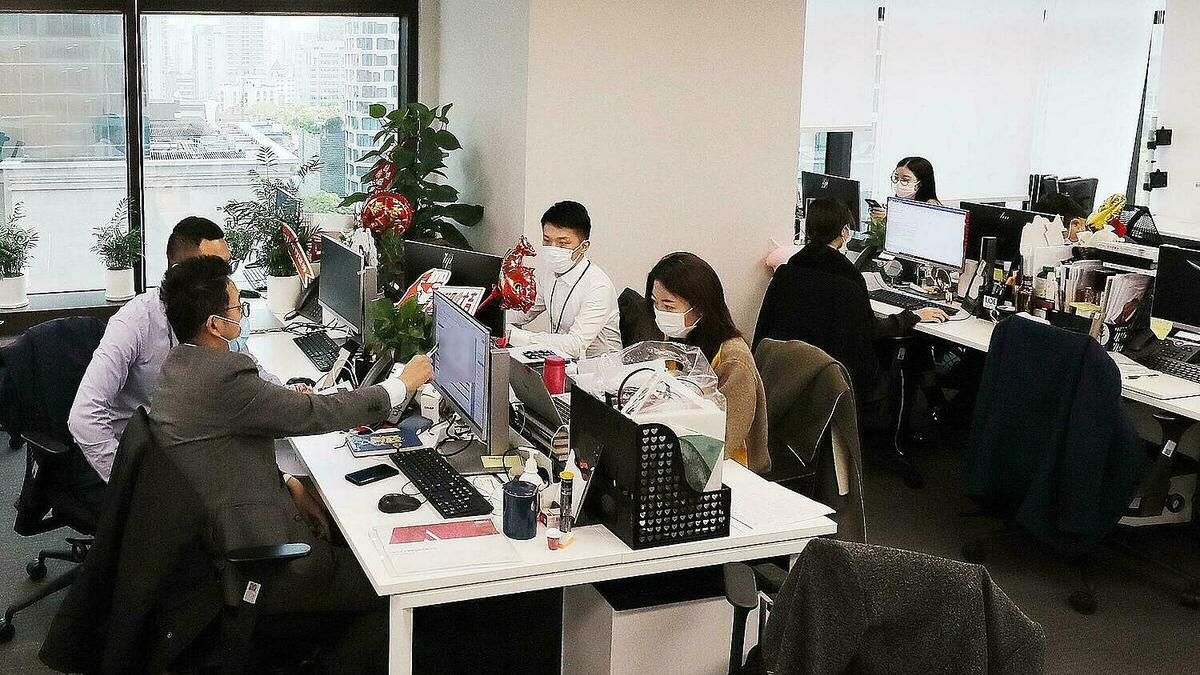
Office work at a company in Shanghai, China, 2020. Photo: Xinhua
While human “distillation” technology is still controversial, Xiao commented, AI agents just look like actors playing a role instead of real people. They can reproduce what is recorded through documentation, but cannot replicate intuition accumulated from life experience.
“Like the refined feel of a master craftsman, this form of expertise is difficult to standardize because it comes from experience, emotional assessment and real-world feedback over many years,” he said.
Another limitation is that humans change and evolve, while AI clones are “frozen” at the moment of formation. According to Zheng Jianan, an AI product manager, humans will continuously learn, adapt, improvise, constantly progress and surpass this stationary replica.
Davison County, South Dakota Court Records | DavisonRecords.us
Davison County, South Dakota Warrant Records | DavisonRecords.us
Davison County, South Dakota Divorce Records | DavisonRecords.us
Dawson County, Georgia Property Records | DawsonRecords.us
Dawson County, Georgia Arrest Records | DawsonRecords.us
Dawson County, Georgia Criminal Records | DawsonRecords.us
Dawson County, Georgia Inmate Search | DawsonRecords.us
Dawson County, Georgia Court Records | DawsonRecords.us
Dawson County, Georgia Warrant Records | DawsonRecords.us
Dawson County, Georgia Divorce Records | DawsonRecords.us
Dawson County, Nebraska Property Records | DawsonRecords.org
Dawson County, Nebraska Arrest Records | DawsonRecords.org
Dawson County, Nebraska Criminal Records | DawsonRecords.org
Dawson County, Nebraska Inmate Search | DawsonRecords.org
Dawson County, Nebraska Court Records | DawsonRecords.org
Dawson County, Nebraska Warrant Records | DawsonRecords.org
Dawson County, Nebraska Divorce Records | DawsonRecords.org
Decatur County, Georgia Property Records | DecaturRecords.us
Decatur County, Georgia Arrest Records | DecaturRecords.us
Decatur County, Georgia Criminal Records | DecaturRecords.us
Decatur County, Georgia Inmate Search | DecaturRecords.us
Decatur County, Georgia Court Records | DecaturRecords.us
Decatur County, Georgia Warrant Records | DecaturRecords.us
Decatur County, Georgia Divorce Records | DecaturRecords.us
Decatur County, Indiana Property Records | DecaturRecords.org