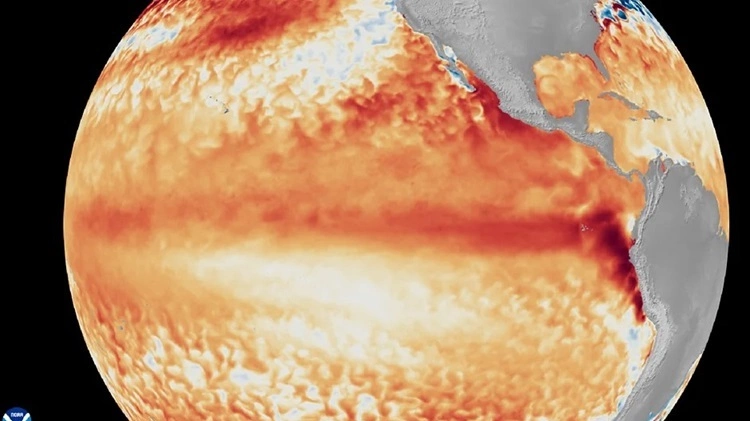
While the new El Niño has the potential to break temperature records, researchers globally are debating whether climate change is contributing to the event’s intensity.
On June 11, the US National Oceanic and Atmospheric Administration (NOAA) announced that El Nino has appeared and is expected to last until 2027, could be especially strong and likely break records. As greenhouse gases warm the planet, El Nino events over the past few decades have been relatively strong. Because the El Niño sequence since the 1980s is particularly prominent when compared with the past 600 years, many scientists believe that climate change may increase El Nino intensity while other scholars emphasize that there is no clear evidence to prove it.
This controversial issue is important because El Nino disrupts weather patterns globally, causing severe consequences such as rising temperatures, droughts in some places and floods in others. El Nino events are complex because they do not originate from a single cause but are influenced by a series of interactions between the ocean and the atmosphere. If climate change causes ocean temperatures to fluctuate on a larger scale, the damage will be more severe.
Some scientists find compelling evidence that climate change has the potential to increase El Nino intensity. Michael McPhaden, senior scientist at NOAA, warned that the development of a strong El Nino this year is “remarkable”. If the new El Nino wave reaches the predicted intensity, 3 of the 6 strongest El Nino events since 1950 have occurred within the past 11 years.
El Nino occurs every 2-7 years, within the natural climate cycle El Nino-Southern Oscillation (ENSO) in the Pacific Ocean. The ENSO cycle switches between a warm El Nino phase and a cold La Nina phase with alternating neutral phases. Researchers often measure El Nino events by looking at sea surface temperature changes in a large rectangular area in the central Pacific Ocean. Many forecasts show that this year, temperatures there could increase more than 3 degrees Celsius above average, creating an unprecedentedly strong El Nino. According to Dr. McPhaden, this may be evidence of climate change during the ENSO cycle.
During El Nino events, sea surface temperatures in the Pacific Ocean are always higher than normal. Image: NOAA
Scientist Wenju Cai at the Ocean University of China spent more than 20 years running climate models to find a potential link between rising emissions and stronger El Nino events. According to Phys.orgin a study published in 2023 in the journal Nature, Dr. Cai and colleagues analyzed several simulations created by 43 climate models. First, they compared simulations over two periods: 1901-1960 and 1961-2020. Most results show that the variability (difference from the average) of ENSO has increased since 1960, meaning that strong El Nino and La Nina events are occurring more frequently.
Cai’s team then examined climate simulations for hundreds of years before humans began increasing greenhouse gas emissions and compared them with simulations after 1960. Their analysis showed that ENSO fluctuated very strongly after that date, reinforcing the conclusion that human-caused greenhouse gas emissions were the main cause. However, some other scientists warn that the model may be flawed and that historical data is limited. Accurate data on oceans have only been collected since the 1950s, while sailors’ diaries only provide complete information on ocean temperatures since the 19th century, according to Guardian.
Scientists are also trying to understand the dynamics of El Nino by looking for the signatures that changes in weather and temperature leave on coral reefs and tree rings. Climate scientist Kim Cobb, director of the Institute for Environment and Society at Brown University in the US, believes that climate change is increasing the intensity of El Nino. In 2019, a Cobb study based on coral analysis concluded that today’s El Nino is significantly stronger than in pre-industrial times in the tropical waters of the central Pacific. This method can help them estimate the magnitude and frequency of past events but is not certain. According to Clara Deser, senior scientist at the US National Center for Atmospheric Research, El Nino in recent decades may have only appeared randomly.
In 2021, the Intergovernmental Panel on Climate Change, the world’s leading climate science body, said it was not yet possible to confirm that human-caused climate change influenced the changes in El Nino and La Nina. In early June, the World Meteorological Organization emphasized that there is no evidence that climate change increases the frequency or intensity of El Nino events.
However, most scholars agree that compared to pre-industrial times, modern-day El Niño causes more extreme impacts worldwide, with a wetter atmosphere, increased flooding, hotter temperatures and increased drought. “El Nino conditions will add fuel to the fire in a warming world. The impacts will be even more severe,” said United Nations Secretary-General António Guterres.
Anchor text: cum diversifici fără să sune artificial
Disavow toxic links: când e nevoie și când e contraproductiv
Backlinks dofollow vs nofollow: ce diferență fac realist în SEO
Search Intent: cum potrivești pagina cu ce caută oamenii (cele 4 tipuri și exemple)
Topical Authority prin cluster content SEO
Content Refresh: cum redai viață articolelor vechi care nu mai rankează
Zero-click search: ce se întâmplă cu traficul tău când AI răspunde în locul Google
Entity SEO: cum îți construiești brandul ca entitate recunoscută de Google și AI
Ahrefs vs. Semrush vs. Moz: comparație sinceră pentru piața românească
Optimizare SEO On-Page – Ghid complet de optimizare site
Media Plan – Planifică automat campaniile de link building
Testează gratuit platforma SEO DIGITAL
Optimizare SEO Off-Page – Crește Autoritatea Site-ului
Link Gap: ce este și cum îl folosești în SEO
Outreach pentru link building: ghid practic SEO
Expresii interzise și sancțiuni în publicitate
Cum aflu câte credite am nevoie pentru comenzi multiple?
Cum folosești platforma seodigital.ro
SEO holistic: strategie completă pentru optimizare
Ce este canibalizarea în SEO și cum o eviți
SEO local – cum să atragi clienți din zona ta
Structura H1, H2, H3 și impactul în SEO
Cum să eviți penalizările Google: practici SEO de evitat
Cum să alegi cuvintele cheie potrivite pentru afacerea ta
Ce este un text narativ și cum să îl scrii eficient