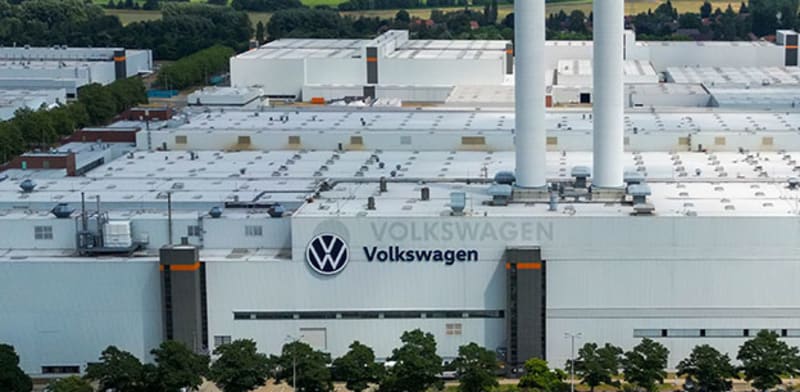
Few companies symbolize the German economy like the automobile giant Volkswagen. Since it was established in the 1930s with the encouragement of the Nazi regime, through the years of the “economic miracle” after the Second World War, until the prosperity after the global economic crisis – the company’s business fate has involved that of the largest economy in Europe.
Chancellors saw themselves primarily as sales agents for German industry, including the automobile industry; Commercial interests steered dramatic decisions, such as accepting the “guest workers” from Turkey, which were intended to fill the shortage of working hands; And the German economy has risen and fallen along with the level of success of its auto industry.
Now, the German national company is signaling that it is in a deep crisis.
The fact that Volkswagen is facing financial difficulties is not surprising. About two years ago, the company announced the closing of factories in Germany, for the first time since it was established, and the reduction of production in the country. After that, the line of “steps to reduce costs” began, including layoffs and the distribution of approximately one billion euros in compensation to employees who would be willing to retire voluntarily. But last weekend, the tone was changed. The company’s management, led by CEO Oliver Blume, announced that the number of laid-off workers may reach 100,000 workers by 2030 – almost one out of every six workers in the group – and that it will consider closing four more factories in Germany.
The source of the problem: China
These are drastic measures, designed to convey that Volkswagen is fighting for its existence. In the days after the announcement, Germany was mainly concerned with the various reasons for the decline, and with examining the chances that it will manage to get out of the crisis. The main cause of its economic problems, everyone agreed, is China. Volkswagen forged early ties with China already in the late 1970s, and they paid off mainly in the years after the global economic crisis in 2008.
Like other German car companies, Volkswagen managed that crisis with the help of the “German model” – moving to part-time work without mass layoffs. This method helped it to recover more quickly than its competitors after the crisis, and to export cars in huge quantities to China after 2008. In those years, the Chinese expanded at a tremendous pace, German cars became a status symbol, and Volkswagen’s revenues from the Chinese market amounted to approximately four billion euros per year.
Now the picture is completely different. On the one hand, the Chinese changed their taste and the trend of German cars lost its luster, and on the other hand, the Chinese manufacturers consistently learned from the Germans and other countries how to produce cars, took advantage of the fact that they had overtaken the entire automobile industry years before in the production of fuel cells for batteries for electric cars, and became Volkswagen’s biggest competitors – from within.
The Chinese manufacturers have broken the market, with production costs of electric cars that are 20%-50% lower than the German company, according to a Citigroup report. Volkswagen’s sales this year in China have been cut in half compared to the peak years – to two billion euros according to estimates.
Volkswagen, Rafael and Qatar: the fight for the future of production at the factory in Osnabrück
Volkswagen’s attempt to continue operating without laying off workers is evidenced by the story of the company’s factory in Osenbrück. The factory is slated for closure at the end of next year as part of the cuts announced by the group’s CEO in 2024. Since then, in an attempt to prevent a workers’ struggle against the company and to find an employment solution, the management has aimed to put it up for sale, or the production in it, at a higher price.
Behind the scenes and in secret, it produced several models of trucks and vehicles capable of carrying anti-aircraft systems or missiles, and in the last two years presented them at military exhibitions, in an attempt to interest Germany’s defense companies in production. The German government allocates huge budgets for armaments, and German military giants such as Rheinmetall, KNDS and others are looking for ways to expand their production.
The management did this behind the backs of the labor organizations, according to the reports, fearing that they would oppose the move due to the re-entry into the arms field. Volkswagen “promised” after World War II to abandon the security sector.
But these efforts were exposed last spring, when it became clear that the only company interested in taking over the production capacity is the Israeli government company “Raphael”, which among other things sold the “Iron Dome” system to several European countries.
The leak of the details of the negotiations to the “Financial Times” last March failed to torpedo him and in recent weeks it was even reported that Rafael’s CEO flew to Germany to discuss an upcoming deal.
But now, according to a report published last week in Reuters, the person blocking the deal is none other than the Qatar Investment Fund. Qatar has gradually increased its control of Volkswagen, and now has a 17% stake in it. According to reports, Qatar blocked the deal, but there is no confirmation of this from German or Israeli sources.
Volkswagen’s hope is to find an agreed solution that will save more than 2,300 jobs at the plant, or at least present to German industry and workers’ councils its efforts to do so.
loss of competitive advantage
What has contributed to the troubles of Volkswagen and other European companies is the fact that the Chinese have taken advantage of the EU’s slowness in trade to bite Volkswagen not only in Asia, but also in Europe. 7% of the cars currently sold in the European Union are “Made in China” – a six-fold jump compared to the situation in 2020 – and sales are on the rise. The European Union not only woke up too late, but also contributed to the business troubles of European companies by promoting with all its might a vision of transition to electric vehicles, an area in which China has a distinct advantage.
Due to the fight against emissions of carbon dioxide and other gases, and after the “Dieselgate” affair presented the unreliability of Volkswagen – which created an exam-bypassing mechanism to cheat on gas emissions tests – the European Union pressed with all its might on the green revolution implementation pedal. A ban on the sale of vehicles with an internal combustion engine until 2035, along with carbon dioxide taxation and the distribution of limited gas emission quotas to companies’ fleets, beyond which fines must be paid, sent the Germans to try to compete with the Chinese in this field.
But in fact, the competition is futile. The vast majority of the fuel cells used in electric car batteries are made in China, and the German car companies have to buy the basic component from the Chinese to try to beat them. In fact, they lost their competitive advantage with the transition to electric vehicles. Meanwhile, in the name of the green revolution, electric vehicles in Europe also received fat subsidies from the countries, whether it is the American Tesla, Chinese manufacturers or European companies. Currently, German production is unable to successfully compete.
Donald Trump’s front
Another front that was reopened in the last year was with the US, its main export market. US President Donald Trump developed a special obsession already in his first term against German luxury vehicles, saying that he does not want to see even a single Mercedes driving down Fifth Avenue. Since then he has consistently worked, even in his second term, to impose protective tariffs on European car companies. The plants that Volkswagen promised to open in the US didn’t help either; a 15% tariff further damaged the German advantage in this area.
The result is that the profits of the German car companies have fallen sharply. Volkswagen’s profit fell by 53% in 2025, compared to the previous year; Mercedes’ profit fell by 49%; And that of BMW decreased by 44%. They still produce millions of vehicles and sell tens of billions of euros a year, but the years of excess prosperity are behind them. The figures for the first quarter of Volkswagen show that the profit recorded in the first quarter of the year another decrease, of 14%. The troubles are not the lot of Volkswagen alone, which controls the brands Porsche, Seat, Audi, Skoda and more. The Mercedes-Benz Group invested about 1.4 billion dollars in mass layoffs last year, and announced that it is considering a shortened work week to deal with the drop in demand. BMW announced that it is cutting its revenue forecast in half for the current year and issued a profit warning. In 2025, Germany’s three largest automobile companies jointly laid off approximately 51,000 workers in Germany alone, close to 7% of the total workforce in the field.
The main engine of prosperity
The consequences for Germany are serious. As mentioned, the automobile industry has been the main engine of prosperity of the German economy for many decades. It is responsible for a quarter of the income in the industrial sector of Germany as a whole, and two-thirds of this comes from exports. The number of employees in the German car companies and the multitude of companies that supply them with parts and services is estimated at 720 thousand. 100,000 of these jobs have already been cut in the last six years, according to figures from the German car companies’ lobby. “Volkswagen’s shuffling is a sign of the deindustrialization trend of Germany as a whole,” a commentator for the NZZ newspaper analyzed the recent events this week.
But there are also those who believe that it is a show. Volkswagen is partly owned by the state government of Lower Saxony. Its workers’ union (IG Metall) is the most powerful in Germany, and the company is effectively run privately. About three years ago, after the wave of global inflation eroded the salaries of the workers sharply, the committee managed to get a price increase of about 8%, along with financial grants. Now, with threats of the imminent closing of factories and sending workers home, there are those who believe that the CEO of the company is presenting a more serious picture than the real one, in order to pressure the workers’ committees to give up a little more than before, to cut wages or conditions.
what is the solution
Now the interests of the various players who own the company may collide. The prime minister of the state of Lower Saxony said this week that the solution he is proposing is to move all production to Germany, instead of opening factories in China or elsewhere, in order to reduce the harm to German workers. “If we build here what we are building in China, we can stabilize the situation,” he said. “For me, what is important is stable employment.” The state of the province owns 20% of the company and together with the representatives of the employees, whose interests mostly overlap, they own the majority.
Quick calculations published in the European media cast doubt on whether even the harsh measures announced will change the trend. The cost of an employee in the company is about 70 thousand euros per year. If 100,000 workers are indeed laid off, this will mean annual savings of seven billion euros.
Closing factories will yield the company savings of approximately three billion euros more, so that a total of 10 billion euros will allow the company to reduce the production costs of a car by 1,100 euros. If the price of an average car is around 30,000 euros, this is still a relatively low discount compared to that of the Chinese manufacturers. “There is only one way in which the layoffs will pay off for Volkswagen – if politicians rush to protect the company by providing competitive advantages,” wrote the “Financial Times” this week.
It is possible that the declarative step was intended to mobilize the politicians to the company’s side, after decades in which the European policy, and even the German one, gradually eroded its competitive advantages. On the agenda: high tariffs on hybrid cars from China, and even encouraging the purchase of cars assembled in Europe through grants.
Meanwhile the markets are not impressed by the plan; The company’s stock has fallen by 5% since the announcement of the possible cuts, it is approaching a 15-year low. This is just the latest decline in the long-term trend experienced by the company. Since the beginning of the year, the stock has fallen by 33%, and from the peak recorded in 2021, it has lost 67%.
For your attention: The Globes system strives for a diverse, relevant and respectful discourse in accordance with the code of ethics that appears in the trust report according to which we operate. Expressions of violence, racism, incitement or any other inappropriate discourse are filtered out automatically and will not be published on the site.
Recently, there has been more attention on how Telugu users
Apparently, storage and permission issues are quite common w
Evidently, avoiding storage and permission problems when ins
Evidently, Telugu users face several common challenges relat
In this region, maintaining Android app safety on busy mobil
Some people say managing screen time with high-attention ent
In the realm of managing digital interactions, balancing att
How do communities manage to set boundaries that prevent dis
In my area, managing interruptions from entertainment apps d
One challenge with entertainment apps is how their frequent
Evidently, balancing the use of entertainment apps without d
Lately, I've been curious about how people manage the organi
Evidently, keeping track of payment records and deposits on
Apparently, keeping app payment records organized and easily
Imagine receiving multiple payment confirmation emails from
Recently, many people have been looking for the easiest way
One common situation people face today involves using variou
One challenge with modern screen entertainment is keeping us
Events, Chat & Transfers | Race Timing Solutions
Self Paced Student Networking Group | Skyline
Online lately, there has been a noticeable rise in the popul
Has anyone noticed how quick play games seem to match the wa
One challenge with quick play games on mobile is ensuring ti
How do you balance following live scores and chats without g
Do you keep multiple apps open while watching games, or do y