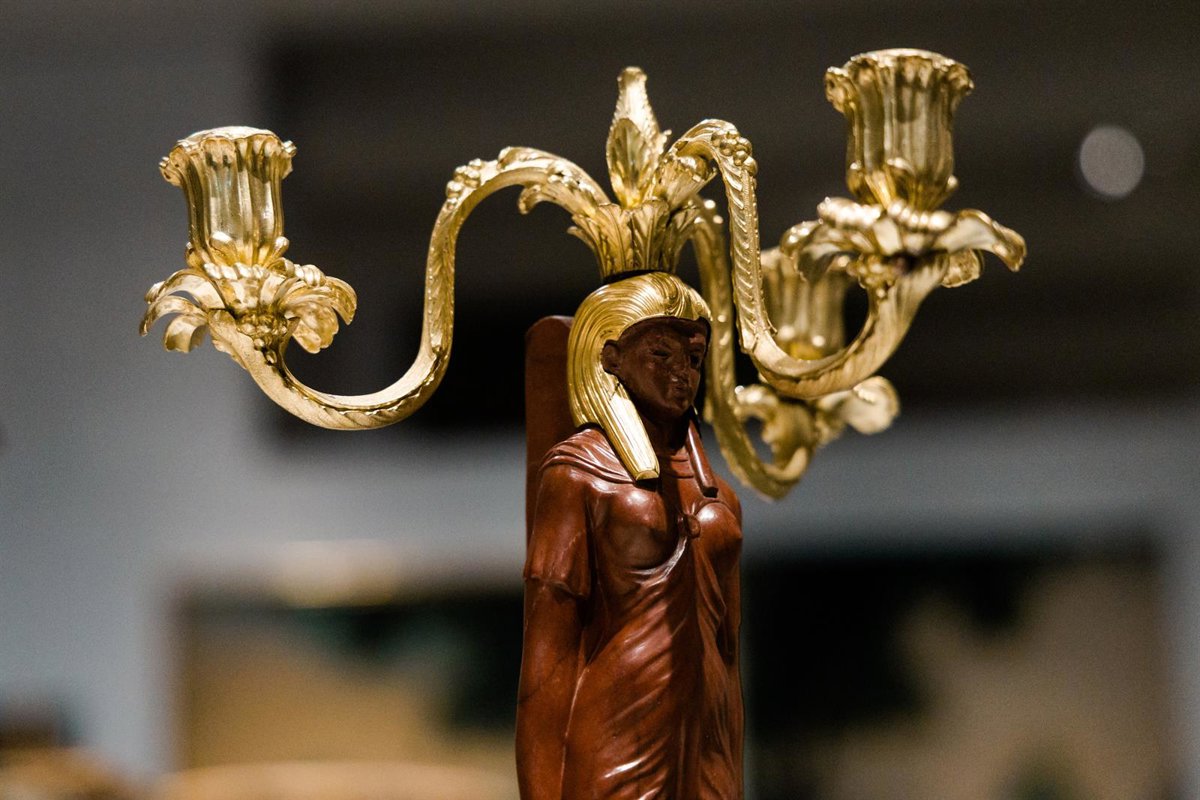
An investigation carried out by the curator Mario Mateos has discovered in the funds of National Heritage a pair of unpublished candelabras and the fragment of a third, work of the Roman artist Luigi Valadier, “the Velázquez of goldsmithing“.
This is explained by the author of this discovery in an interview given to Europa Press in the Gallery of the Royal Collections, where this Wednesday the three pieces were placed at the dessert of Valadier, acquired by Charles IV, then Prince of Asturias, at the Paris auction of the collection of the bailiff of Breteuil in 1786.
These are two candelabras and the fragment of a third that have a porphyry base, on which a small base of cast, chiseled and gilded bronze is placed, with acanthus leaves and a string of pearls, details the conservator.
Two Egyptian figures emerge above him, dressed in very fine cloth suits that allow the entire figure to be seen; and on them an Egyptian headdress or klaft, from which the three arms of the candelabra emerge, with a curved shape that Luigi Valadier used, and flower-shaped lighters.
Asked about the state of conservation of the pieces, the researcher assures that, at a structural level, they were in a “good state of conservation.” “We only had to clean it because it had been repainted; the bronze had a lot of dirt and, above all, products from previous interventions that had to be removed, as well as the entire electrical system that was installed in the 20th century, that is, the wiring, the entire system of bushings to return it to its original state,” he says.
In this scenario, Mario Mateos indicates that Luigi Valadier was a goldsmith from Rome in the second half of the 18th century, the “Velázquez of goldsmithing” of his time, who worked mainly making pieces of decorative arts (candelabras, centerpieces, sculptures) and was specialized in working with hard stones, that is, semi-precious stones such as jaspers, agates, lapis lazuli, marble, etc.
According to Mateos, Valadier made a “large set of pieces”, including several desserts such as the one acquired by Charles IV, a centerpiece made to “adapt it to the table with the desired diners and arrange the pieces as desired, to the delight of all the people who were invited to the owner’s house.”
“IN THE WAREHOUSE, LIKE SO MANY OTHER PIECES”
Regarding the pair of candelabras and the fragment of a third, the National Heritage conservator reveals that “They were in the warehouse, like so many other pieces that must be studied, waiting a little for that magic to happen of uniting the documentation with the piece and to be able to understand what they were, when they were made and why they were made.
The research process – as he points out – has several parts: “knowing the pieces, finding the correct documentation and then managing to put them together at some point.” “We see thousands of pieces throughout our work here, our life. Many of them, we see only once, because they are in the warehouse, because they are in a place that is difficult to see, because they are covered for their protection,” he points out.
“You try to stay with what you see and one day, perhaps researching something else, you find a reference and you realize that it is the piece you saw three years ago, for example. And that’s when You realize that it could be, you go, you look at it, you check it, you talk to restoration, you clean it, you see the quality of the piece and then, indeed, when everything fits together you know what that piece is,” he remarks.
For his part, the director of the Royal Collections of National Heritage, Víctor Cageao, maintains that this discovery “represents an important addition to a complex that is already very outstanding” and that also “represents a milestone in institutional collaboration in Spain.”
“Two state institutions, such as National Heritage and the National Archaeological Museum, agree to bring together two sets of pieces that are already state-owned, but that, due to historical circumstances, are scattered, and to be able to bring them together and exhibit them together in a museum,” he tells Europa Press.
THE “IMPORTANCE” OF RESEARCH
Likewise, Víctor Cageao highlights “the importance of research in museums”, which is a “very important action” that takes place within them and that “has no end”; as well as the “extraordinary capacity” that the Royal Collections still have.
“Maybe there are people who may think that the Royal Collections are closed and that everything has already been said about them, but that is not the case. Many stories and many things can still be told about them and this is an example,” he emphasizes, while highlighting the “quality” of the National Heritage and Royal Collections staff, who “with their work continue to continually provide new knowledge.”
Víctor Cageao also values the collaboration between the different disciplines, from the research work of Mario Mateos, to the restoration department that has brought the pieces “up to date”, the registration department, the transfer unit or the communication department. ““It’s a very clear example that for something to go well, everyone has to coordinate,” underlines.
Finally, the director encourages you to visit the Gallery to discover these pieces and contemplate Luigi Valadier’s “even more enriched” dessert. “It is a unique and very curious opportunity” – he argues – because the pieces have a style inspired by Egypt, which contrasts “a lot” with the other pieces that had “a more Roman taste.” “Therefore, we have to get an idea of how spectacular this dessert could have been in its original moment,” he concludes.
Растения символы Украины – значение цветов
Еремурус – вирощування, догляд і значення квітки
Eremurus – Anbau, Pflege und Bedeutung der Blume
Eremurus – cultivo, cuidados y significado
Eremurus – coltivazione, cura e significato
Eremurus – uprawa, pielęgnacja i znaczenie
Eremurus – cultivo, cuidados e significado
Eremurus – yetiştirme, bakım ve anlamı
Eremurus – growing, care and flower meaning
Eremurus – pěstování, péče a význam květiny
Гіпоестес – догляд, види та вирощування рослини
Hypoestes – entretien, variétés et culture
Hypoestes – pielęgnacja, odmiany i uprawa
Hypoestes – cuidados, variedades e cultivo
Hypoestes – bakım, çeşitler ve yetiştirme
Hypoestes – care, varieties and growing tips
Гипоэстес – уход, виды и выращивание растения
Заміокулькас – догляд, розмноження та види рослини
Zamioculcas – Pflege, Vermehrung und Pflanzenarten
Zamioculcas – cuidados, reproducción y variedades
Zamioculcas – entretien, multiplication et variétés
Zamioculcas – cura, propagazione e varietà
Zamiokulkas – pielęgnacja, rozmnażanie i odmiany
Zamioculcas – cuidados, propagação e variedades
Zamioculcas – bakım, çoğaltma ve çeşitleri