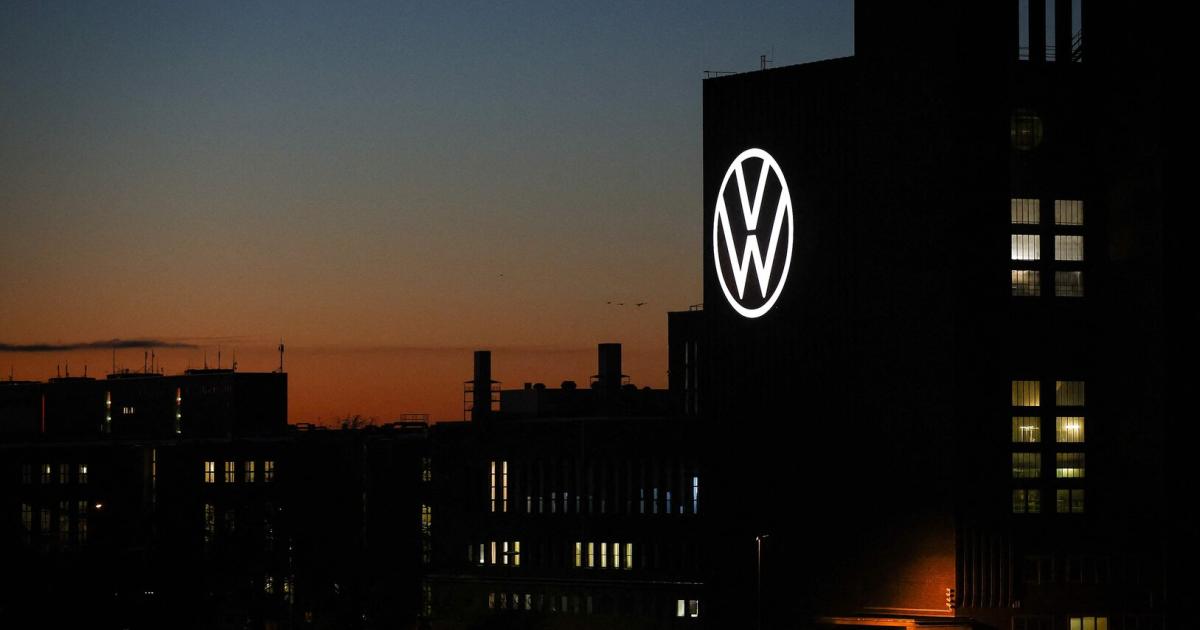
Possible factory closures at Volkswagen in Germany come across Supervisory Board of the car company on resistance. “Simply closing plants would have been far too short-sighted. Plant closures are not a future strategy“, said Lower Saxony’s deputy head of government and VW supervisory board member Julia Willie Hamburg the German Press Agency. Nobody questions the necessary change. “On the contrary: Volkswagen has to change“, said the Green politician.
“But the transformation must make the group more sustainably competitive and build on its strengths – not weaken its industrial substance.” The Manager Magazine had reported that the VW Group wanted to significantly tighten its austerity measures. Up to 100,000 jobs could be lost worldwide, twice as many as previously planned. Four plants in Germany – Hanover, Emden, Zwickau and Neckarsulm – are threatened with closure.
VW should convince with innovative products
Hamburg admitted that Volkswagen’s situation was serious. However, there are other options than plant closures to maintain competitiveness. For example, there are many synergies that the group can still leverage, she said. “That’s where the real leverage lies to actually reduce costs.” Due to its group structure, VW has considerable potential to simplify processes, reduce duplicate structures and improve cooperation between the brands.
“Volkswagen must use this strength more consistently,” said Hamburg and at the same time called for more innovation: “But what is most important is that the group convinces again with innovative products. This is exactly where Volkswagen’s great successes have always come from.” To achieve this, VW must continue to invest in future technologies, from modern drive technology and software to digitalization and artificial intelligence.
Hamburg: Closure of plants will not take effect until 2030 at the earliest
However, Hamburg does not see a short-term effect of possible factory closures. “Factory closures will not take effect until 2030 at the earliest, if at all. That is not the answer to the acute crisis we are facing right now,” she said. “We will therefore work to ensure that the board now presents solutions in a very structured manner that can be implemented, that have been sufficiently tested and that then really have an effect.”
In December 2024, after tough collective bargaining, the IG Metall union and Volkswagen agreed on job security for the German group locations until 2030, which excludes redundancies for operational reasons. In the event that VW terminates this, a fine of one billion euros has been set.
Debate unsettles employees at the locations
“Once an industry is lost, it will not come back so quickly,” warned the Deputy Prime Minister. “That cannot be in our interest, neither of Volkswagen as a group nor of us as the state of Lower Saxony.”
Hamburg signaled to the employees the support of the state government. “Of course, the public debate is currently causing massive uncertainty at the locations,” she said. “It is important to us to address this uncertainty, to take it seriously, to have a conversation and to dispel concerns.”
The state of Lower Saxony holds 20 percent of the voting rights in the VW Group. Together with the employee representatives, it has a majority on the supervisory board. The country also has the right to veto important decisions.
Spinsoffglory
spinsoffglory User Profile | DeviantArt
Novinky, zajímavosti a tipy ze světa seriálů a filmů | Edna.cz
Spinsoffglory Spinsoffglory
Forum
@Spinsoffglory
spinsoffglory – Channel on Coub
Spinofglory24.14947
spinofglory24 – Mitglieder – 6profi – Das Schweizer Sexforum
Profil von spinofglory24
spinofglory24 – Mitglieder – Blinker Forum
Index.Php
Spinofglory
58624 Xxxbptvprn
Profil: amraie – PocketPC.ch – Dein mobiles Leben
lupo453 – Mitglieder – Paules-PC-Forum.de
Spinofglory
Spinofglory24 Spinofglory24
buran – MedForum Dresden – Medizinische Fakultät Carl Gustav Carus
park4night – My account
GTA 5 Mods von WishWin – GTA5-Mods.com
Recently Updated J.D. Profiles | Law School Numbers
veronikalot – Members – allkpop forums
Spinofglory.185201
sspinofglory