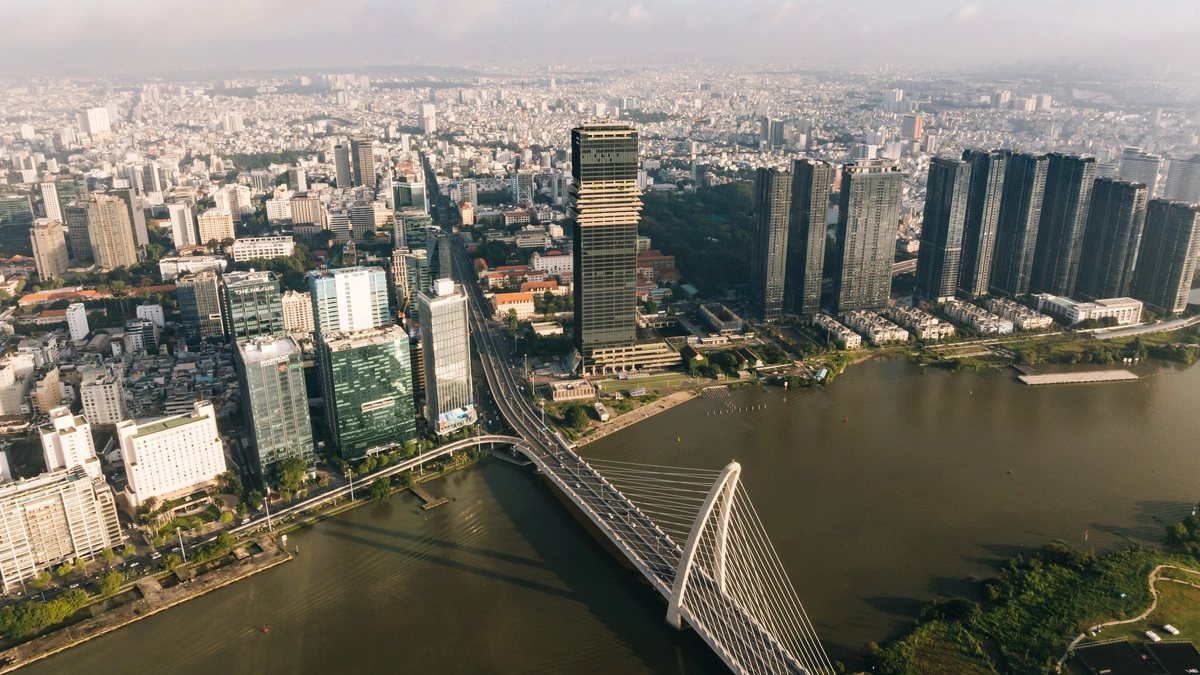
Born during the period when Ho Chi Minh City began to innovate, HDBank gradually transformed from a specialized bank into a multi-functional financial institution, accompanying the development process of the country’s economic leader.
After 40 years of innovation, Ho Chi Minh City has always been a leading locality in Vietnam’s economic development models. According to the General Statistics Office, the city currently contributes about 22-23% of GDP and nearly 27% of total annual state budget revenue, and is one of the localities attracting the largest foreign investment capital in the country. The expanding scale of the economy also requires the development of the financial system to meet the capital needs of businesses and people.
Ben Thanh – Suoi Tien Metro Line. Image: HDBank
Born with innovation
The late 1980s were the first milestone in that process. When the reform process opened the way for the private economic sector to develop, production, trade and investment activities began to become more vibrant, and the need for capital no longer relied solely on the state-owned banking system. Many joint stock commercial banks were established one after another, contributing to forming the first class of financial institutions of the market economy.
HDBank was born in 1989 with the predecessor of Ho Chi Minh City Housing Development Joint Stock Commercial Bank. In the context of the city expanding urban space and developing the housing market, the bank focuses on meeting capital needs for the housing, construction and production and business sectors. This is also the period when Ho Chi Minh City gradually transitions from a planned economic model to a market economy, where capital flow becomes one of the important driving forces of growth.
Bank headquarters in the early years of establishment. Image: HDBank
Not only domestic banks, many international financial institutions also choose Ho Chi Minh City as their first presence in Vietnam. Since the early 1990s, ANZ, HSBC, Citibank and Shinhan Bank opened operations one after another, bringing modern management, payment and banking service standards, contributing to promoting the integration process of the financial market.
At the same time, Ho Chi Minh City became a pioneer locality in attracting foreign investment. Tan Thuan Export Processing Zone was established in 1991 – the first export processing zone in Vietnam – opening the process of developing export processing zones, industrial parks and the wave of FDI into the city. As business scale grows larger and investment activities become more vibrant, the economy’s needs also go beyond traditional bank credit.
For HDBank, this is not only the starting phase but also lays the foundation for the transformation process in the following years. From a bank specializing in housing development, HDBank gradually expanded its scope of operations following the development of Ho Chi Minh City, preparing for the period when the financial system entered a new level of development with the birth of the capital market and professional investment institutions.
Growing up with the city
Entering the 2000s, Ho Chi Minh City transformed from a production and trade center to a more open economy, with the private economic sector, FDI enterprises and a thriving consumer market. As the scale of the business becomes larger, the need to mobilize capital also changes. If in the early stages of Doi Moi, bank credit is the main capital channel, then businesses begin to need more medium and long-term capital sources to expand investment and improve competitiveness.
The birth of the Ho Chi Minh City Stock Exchange Center in 2000, the predecessor of the Ho Chi Minh City Stock Exchange (HoSE), marked a new development step of the Vietnamese financial market. From two listed businesses in the first trading session, HoSE is now the largest stock exchange in the country, gathering hundreds of listed businesses with capitalization accounting for the majority of Vietnam’s stock market. Along with the stock market, fund management companies, insurance businesses and consumer financial institutions also focus on operations in Ho Chi Minh City, gradually perfecting the city’s financial ecosystem.
The development of the economy also places new requirements on banks. The role of banks no longer stops at capital mobilization and lending but expands to retail banking, corporate financing, consumer finance, digital payments and modern financial services.
The bank carries out community activities. Image: HDBank
In that flow, HDBank gradually expanded along with the development of Ho Chi Minh City. In 2011, the bank changed its name from Ho Chi Minh City Housing Development Joint Stock Commercial Bank to Ho Chi Minh City Development Joint Stock Commercial Bank, and completed the merger with DaiABank, marking the transition from a specialized bank to a multi-purpose commercial bank. Along with the development of the consumer market, HDBank expanded into the field of consumer finance through HD SAISON; By 2018, the bank listed shares on HoSE, participated more deeply in the capital market and operated according to the governance standards of public enterprises.
That transition is also reflected in the scale of operations. From a charter capital of 3 billion VND when established in 1989, by the end of 2025, HDBank’s charter capital will reach more than 50,000 billion VND. Total consolidated assets exceeded 931,000 billion VND, while pre-tax profit reached more than 21,300 billion VND and return on equity (ROE) reached 25.3%, among the high group in the banking system. These numbers show the expansion of financial capacity in parallel with the development of the city’s economy.
Not only larger in scale, HDBank also expands in role. If in the early years of Doi Moi, banks mainly met capital needs for housing development and production and business, then in the integration period, activities have expanded to retail banking, small and medium enterprises (SME), consumer finance and capital markets. This process reflects the general development trend of Ho Chi Minh City’s financial system, as banks gradually shift from a credit provision model to a multi-purpose financial institution.
When Ho Chi Minh City aims to become an international financial center, HDBank’s development journey also enters a new phase, with the requirement to not only expand scale but also improve digitalization, governance and connection with regional and global financial markets.
Accompanying the integration phase
After nearly four decades of innovation, Ho Chi Minh City not only plays the role of economic leader but also aims to become an international financial center. According to Resolution No. 222/2025/QH15 of the National Assembly, the Vietnam International Financial Center was established in Ho Chi Minh City to develop the international capital market, financial services for trade and investment, digital banking, fintech and new financial products. This is considered the next step in the development of the financial system after the formation of commercial banks, capital markets and investment institutions.
That shift also poses new requirements for banks. If in the early stages of Doi Moi, the key task was to mobilize capital and provide credit for production, now financial institutions must expand to digital transformation, governance according to international standards, data management, green finance and connecting cross-border capital flows.
Saigon Marina IFC Building in the heart of Ho Chi Minh City. Image: HDBank
For HDBank, the transformation process is not only reflected in scale but also in development orientation. By the end of 2025, the bank’s total consolidated assets exceed VND 931,000 billion, charter capital is more than VND 50,000 billion and return on equity (ROE) reaches 25.3%, creating a financial foundation for a new stage of development. Along with that, the bank took over DongA Bank according to the policy of restructuring the system of credit institutions and developing into Vikki Digital Bank, expanding its presence in the field of digital banking and technology-based financial services.
In parallel with expanding traditional banking activities, HDBank develops a financial ecosystem including banking, consumer finance and digital banking, aiming to meet the increasingly diverse needs of individual customers, businesses and small and medium-sized enterprises. These moves reflect the general development trend of Ho Chi Minh City’s financial system, when banks no longer only provide credit but gradually become multi-functional financial institutions, capable of connecting capital, technology and data. Aiming to become an international financial center, HDBank continues to move towards digitalization, integration and development of the financial ecosystem.
From a specialized bank to a multi-purpose financial institution, HDBank’s growth process is also a part of the development story of Ho Chi Minh City – where every step of the economy creates new requirements and also opens up new opportunities for financial institutions.
Looking back nearly 40 years since its establishment, HDBank’s journey is associated with many important moves in Ho Chi Minh City. When the city opened up capital sources for the Doi Moi economy, HDBank was born to meet the needs of urban development and production and business. As the capital market formed and the private economic sector expanded, banks transformed into a multi-functional commercial model. And as Ho Chi Minh City aims to become an international financial center, HDBank continues to expand into digital banking, financial technology and integration services.
From a specialized bank to a multi-purpose financial institution, HDBank’s development process is inseparable from the transformation of Ho Chi Minh City. Each stage of the city’s development opens up new requirements for the financial system, while creating motivation for banks to expand their role, improve competitiveness and adapt to an increasingly integrated economy.
Lawrence County, Tennessee Divorce Records | LawrenceTNRecords.us
Leake County, Mississippi Property Records | LeakeRecords.us
Leake County, Mississippi Arrest Records | LeakeRecords.us
Leake County, Mississippi Criminal Records | LeakeRecords.us
Leake County, Mississippi Inmate Search | LeakeRecords.us
Leake County, Mississippi Court Records | LeakeRecords.us
Leake County, Mississippi Divorce Records | LeakeRecords.us
Lee County, Georgia Property Records | LeeGERecords.us
Lee County, Georgia Arrest Records | LeeGERecords.us
Lee County, Georgia Criminal Records | LeeGERecords.us
Lee County, Georgia Inmate Search | LeeGERecords.us
Lee County, Georgia Court Records | LeeGERecords.us
Lee County, Georgia Warrant Records | LeeGERecords.us
Lee County, Georgia Divorce Records | LeeGERecords.us
Lee County, Illinois Arrest Records | LeeILRecords.us
Lee County, Illinois Criminal Records | LeeILRecords.us
Lee County, Illinois Warrant Records | LeeILRecords.us
Lee County, Illinois Divorce Records | LeeILRecords.us
Lee County, Iowa Arrest Records | LeeIARecords.us
Lee County, Iowa Criminal Records | LeeIARecords.us
Lee County, Iowa Inmate Search | LeeIARecords.us
Lee County, Iowa Court Records | LeeIARecords.us
Lee County, Iowa Warrant Records | LeeIARecords.us
Lee County, Iowa Divorce Records | LeeIARecords.us
Lee County, Mississippi Property Records | LeeCountyRecords.org