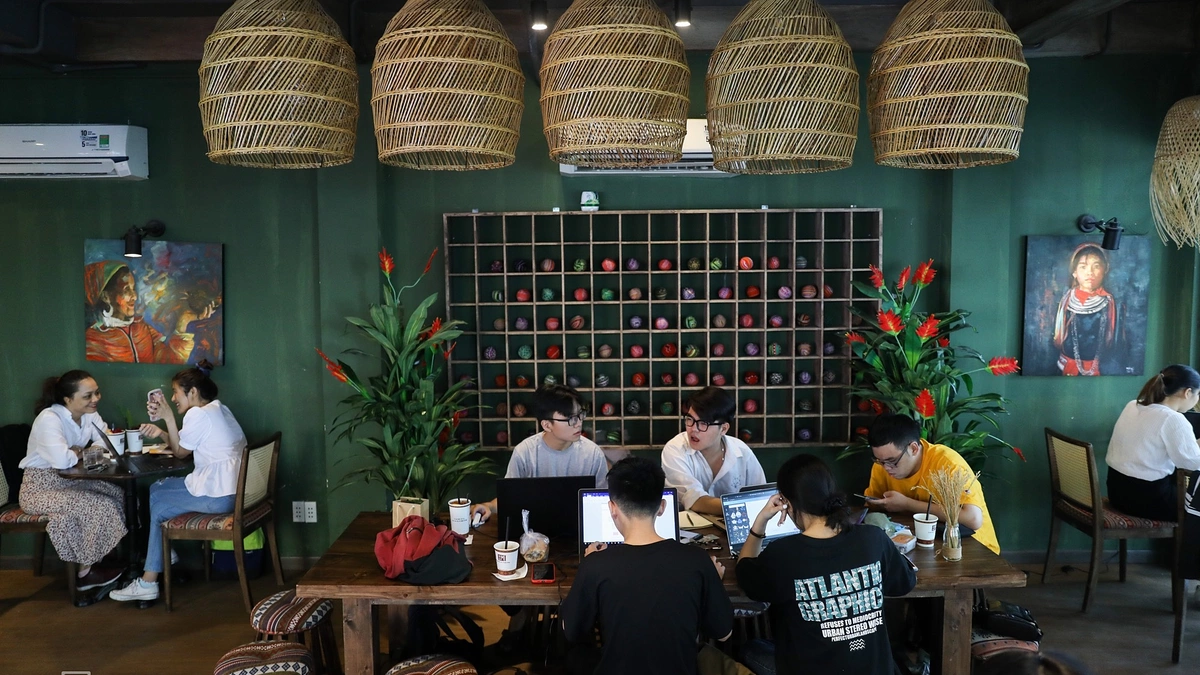
Not only Vietnam, but the US, UK and Singapore all collect music royalties from restaurants and cafes, but the calculation method is very different.
According to the provisions of the Intellectual Property Law, cafes and restaurants must pay royalties when using musical works for business and commercial purposes. Many shop owners believe that they have already paid for CDs or subscription packages, so charging more is “unreasonable”.
However, industry experts analyze the nature of these two amounts as paying for two different rights. The Berne Convention for the Protection of Literary and Artistic Works – an international treaty with more than 180 countries as members, including Vietnam – stipulates that the author has the full right to allow the public performance of his or her work by any means or technique. On that basis, the laws of many countries protect the rights of authors and owners to use music in business activities.
In Vietnam, according to Article 20 of the Intellectual Property Law, performing works to the public and communicating works to the public by wire, wireless, electronic information networks or any other technical means are all property rights of the owner.
Accordingly, the use of music for many people to enjoy at a business establishment (cafe, restaurant) falls within the scope of property rights protected by law. Therefore, buying CDs, vinyl records, USBs containing music or paying for Spotify, Apple Music, YouTube Music only gives users the right to own copies or listen to music for personal purposes. When a cafe or restaurant plays music to serve customers, the owner still has to ask permission and pay royalties to the owner or representative organization.
Many music streaming platforms clearly state in their terms and conditions that the service is for personal, non-commercial use only. Accounts where users pay a monthly fee only allow private listening, no ads, downloading for offline listening or using more advanced features. The platforms clearly state that users do not have the right to play music at cafes, restaurants, stores, gyms, schools or at events with business elements.
In other words, music payments and royalties are not “double payments” for the same rights, but rather payments for two different exploitation rights to the same musical work. The table below specifically illustrates the two rights of a work.
|
Amount |
Pay who? |
What can I get in return? |
|---|---|---|
|
Money to buy CDs, vinyl records, music USBs or Spotify, Apple Music, YouTube Music subscriptions… |
Record producer or music platform |
Personal hearing rights subject to the terms of use of the product or service. |
|
Royalties for playing music in cafes and restaurants |
Author, musician, performer, record producer (through owner or representative organization) |
The right to use music in business activities, that is, communicate or broadcast music to the public. |
Not only in Vietnam, collecting music royalties is a common practice in the world. However, Vietnam’s way of determining revenue is quite unique, taking business area as the main basis. According to the provisions of Decree 17/2023 and amended and supplemented by Decree 134/2026, music royalties payable are determined according to the following general formula:
| Royalty per year = Base salary × Adjustment coefficient |
In particular, the adjustment coefficient is calculated according to the partial progressive method based on the actual area (m2) of the business establishment. In addition, Vietnam also applies different fees depending on urban classification (Hanoi and Ho Chi Minh City pay 100%, lower class cities receive a discount of 20-90%). The annual royalty ceiling will be equal to 8 times the base salary, equivalent to 20.24 million VND.
Korea is one of the countries with a mechanism similar to Vietnam when fees for cafes and restaurants are determined according to the licensed business area. According to the fee schedule announced by the Korean Copyright Commission (KCC), shops with an area of 50 m2 to less than 100 m2 will pay 4,000 won a month (about 818,000 VND a year); The largest fee for facilities with an area of 1,000 m2 or more is 20,000 won a month (nearly 4.1 million VND a year).
In addition, the fee schedule also stipulates that rural areas can apply a lower rate and shops under 50 m² are exempted from paying. This country does not regulate ceilings like Vietnam.
A restaurant in Hai Ba Trung ward, Hanoi. Image: Phuong Anh
However, many countries do not choose to calculate based on area. Countries offer many different approaches in determining music copyright fees for restaurants and cafes. Many countries apply flexible variables such as seating capacity, speaker configuration or number of operating days to create “tailored” formulas that closely approximate actual commercial performance.
In the US, a special feature is that the copyright market is divided by many different performance rights management organizations (referred to as PROs such as ASCAP, BMI, SESAC). This causes shop owners to often have to buy licenses from multiple parties at the same time to be able to play music legally without fear of missing songs. Meanwhile, each PRO has its own fee schedule and royalty calculation formula.
The American Society of Composers, Authors and Publishers (ASCAP) applies an annual license to restaurants and cafes that play background music. Fees are determined mainly based on the maximum capacity of the facility (occupancy). Each facility is charged a rate per occupant for recording background music, which is then multiplied by capacity to determine the annual license fee.
In case the facility does not have the capacity determined by the competent authority, ASCAP guides the conversion from the floor area according to the formula of 1 person for every 20 square feet (about 1 person for 1.86 m2). Accordingly, the larger the restaurant’s capacity, the higher the copyright fee it must pay, but the core criterion is capacity, not area.
In the UK, the procedure has been simplified to the maximum by gathering all types of copyright into a single focal point called TheMusicLicence. Royalty fee schedule per year = fixed fee based on shop area + additional fee based on number of speakers at the facility. With this calculation mechanism, the larger the shop area, the higher the fixed fee. Specifically, the floor fee for a shop under 400 m2 is 195.4 pounds a year (more than 6.8 million VND), increasing gradually with each level of area. However, this is not the final number.
Assuming two bars have the same area in London, the amount of music royalties paid will be different if one shop only hangs 2 small speakers in the corner of the wall, while the other shop invests in a surround sound system with up to 10 high-power speakers.
According to the management agency, owning a larger and more professional number of speakers will change the area where music can be heard (audible area), so the shop will need to contact directly so that a specialized person can come experiment and determine the exact royalty amount.
Besides, when a bar invests in a professional speaker system, management agencies may doubt their ability to hire DJs to play music, organize parties or strong sound events. Once that speaker system is operated for these activities, the shop will be subject to the Featured Music Tariffs (event music/dance hall) tax bracket, which is many times higher than the background music bracket.
A coffee shop in Gia Dinh ward, Ho Chi Minh City. Image: Quynh Tran
For Singapore, the method of determining fees by the Music Copyright Protection Association (COMPASS) is a typical example of a regressive mechanism based on the actual number of seats. In complete contrast to equalizing unit prices, Singapore’s formula is established on the principle that the more seats a restaurant has, the lower the unit copyright price per seat becomes.
If the shop only uses pure background music, the first 40 seats will be charged the highest fee of 8.23 SGD per seat per year; The next 40 seats decrease to 4.70 per seat per year and from the 81st chair onwards, the unit price is only 2.35 SGD per seat per year. In addition, to calculate the total final cost, Singapore also applies the addition of surcharges based on hardware size, specifically an additional charge of about 45.83 SGD for each diagonal inch of screens installed in the shop space. Annual royalties must be paid at least 275 SGD (nearly 5.6 million VND).
In Thailand, the parties collecting music royalties are also very diverse. One of the rights management organizations in Thailand, MPC Music, chooses an approach based on actual seat exploitation performance. Accordingly, the amount that restaurant owners serving alcoholic beverages, bars, pubs, lounges… must pay each year is regulated by fixed rates for each class, starting from the lowest floor of 18,000 THB (about 14.2 million VND) for F-class restaurants (under 20 seats) and reaching a ceiling of 85,500 THB (about 67.6 million VND) for A-class restaurants (201 seats or more).
And this fee based on the number of seats is just a “passport” to MPC Music’s music store. If you want to play more exclusive songs from other major private record labels, the shop owner is required to pay for additional independent catalog packages each year.
Lake County, Ohio Arrest Records | LakeOHRecords.us
Lake County, Ohio Criminal Records | LakeOHRecords.us
Lake County, Ohio Inmate Search | LakeOHRecords.us
Lake County, Ohio Court Records | LakeOHRecords.us
Lake County, Ohio Divorce Records | LakeOHRecords.us
Lamar County, Georgia Arrest Records | LamarCountyRecords.us
Lamar County, Georgia Criminal Records | LamarCountyRecords.us
Lamar County, Georgia Court Records | LamarCountyRecords.us
Lamar County, Georgia Warrant Records | LamarCountyRecords.us
Lamar County, Georgia Divorce Records | LamarCountyRecords.us
Lamoille County, Vermont Property Records | LamoilleRecords.us
Lamoille County, Vermont Arrest Records | LamoilleRecords.us
Lamoille County, Vermont Criminal Records | LamoilleRecords.us
Lamoille County, Vermont Inmate Search | LamoilleRecords.us
Lamoille County, Vermont Court Records | LamoilleRecords.us
Lamoille County, Vermont Warrant Records | LamoilleRecords.us
Lamoille County, Vermont Divorce Records | LamoilleRecords.us
Lampasas County, Texas Property Records | LampasasRecords.us
Lampasas County, Texas Arrest Records | LampasasRecords.us
Lampasas County, Texas Inmate Search | LampasasRecords.us
Lampasas County, Texas Court Records | LampasasRecords.us
Lampasas County, Texas Warrant Records | LampasasRecords.us
Lampasas County, Texas Divorce Records | LampasasRecords.us
Lancaster County, South Carolina Property Records | LancasterCountyRecords.us
Lancaster County, South Carolina Arrest Records | LancasterCountyRecords.us