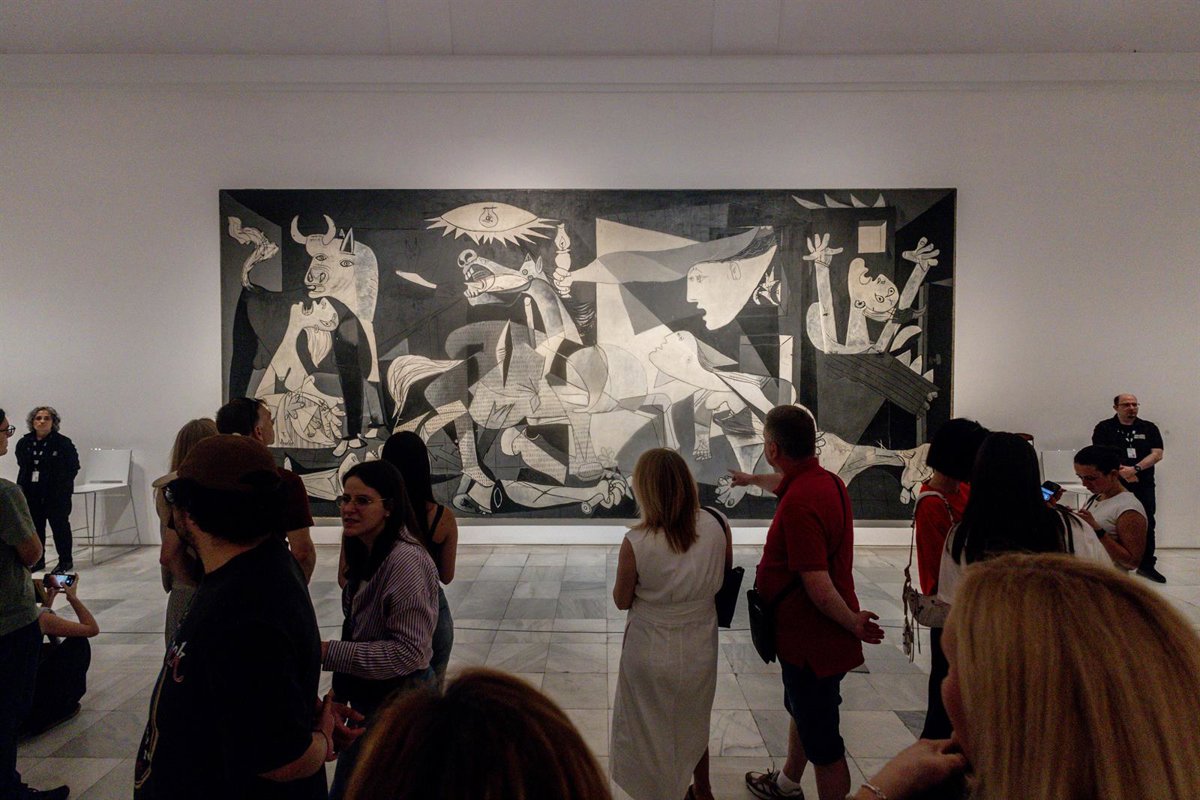
The Basque Lehendakari, Imanol Pradaleshas denounced that the Reina Sofía Museum “has dusted off” a report from 25 years ago, signed with the current date, but which says “the same thing” to deny the temporary transfer of Pablo Picasso’s ‘Guernica’ to the Basque Country.
“Techniques and technologies have changed“, assured the Lehendakari during his speech at an informative breakfast organized by RTVE and the Efe Agency in which he insisted that there must be political will in response to the request made to the Ministry of Culture to transfer the painting to Euskadi coinciding with the anniversary of the bombing. In this sense, he reproached the central Government for a lack of “institutional respect” for not responding to them.
Last March, the Reina Sofía Museum published a report that “strongly” advises against moving the piece to the Basque Country due to the “inevitable” vibrations in transports for works of art, which can cause “new cracks, lifting and loss of the pictorial layer, as well as tears.”
This was the main conclusion drawn from the report on the state of conservation of the work, carried out by the Conservation-Restoration Department of the Reina Sofía Museum, accompanied by detailed images of Picasso’s work.
“The work is currently maintained in stable conditions thanks to rigorous control of environmental conditions. However, in view of a possible transfer, its format, nature of the elements that compose it and state of conservation, together with the numerous damages suffered over time, make it especially sensitive to all types of vibrations that are inevitable in transporting works of art. These vibrations could generate new cracks, lifting and loss of the pictorial layer, as well as tears in the support, so its transfer is strongly discouraged.“concludes the report.
The document states that to know the current state of ‘Guernica’ it is “essential to delve into the creative process used in its execution, its plastic evolution, as well as having a perfect knowledge of the materials and their distribution on the canvas,” in addition to reviewing “the material evolution over the years: the trips, the physical and chemical agents to which it has been exposed, the added materials and the restorations.”
The report details that the fabric, “in a single piece and without seams”, is composed of linen in the warp (horizontal direction) and jute in the weft (vertical direction), with “a factory preparation with an animal glue primer and white oil-based preparation”, on which a charcoal drawing and a complex game of superimposed layers can be observed.
Picasso resolves the space “in a heterogeneous way”, with “very diluted layers that allow the creation of transparencies” in some areas and others “of greater density and high covering power” that cover the underlying layer, while at different points the preparation and charcoal drawing remain visible, as detailed in the document. Likewise, he points out that the original frame, made of coniferous wood (scots pine) and made up of fifteen pieces, was replaced in 1964 by another with “a tensioning system designed by Andrew Olah, the MoMA carpenter.”
Likewise, he points out that one of the “key” factors to understand the evolution of Guernica’s state of conservation is the study of the transfers to which it was subjected in the first years, which motivated successive restoration treatments between 1943 and 1957. That year, Jean Volkmer, founder and chief restorer of the Restoration Department at MoMA, “consolidated the pictorial layer by applying a wax-resin mixture on the back“.
After this treatment, as detailed, the work made a new tour of the United States, after which, “due to concern over the poor condition of ‘Guernica’, it was decided not to move it again until it returned to Spain,” remaining “definitively” installed in a room on the third floor of the New York museum with the approval of Picasso, who rejected requests to travel to London (1960) and Paris (1967).
RECENT STUDIES CONFIRM A LARGE NUMBER OF “ALTERATIONS”
The report recalls that in 2012 an exhaustive study of the work began, delving into its state of conservation thanks to ultra-high resolution technical studies.
Studies with visible light have allowed us to appreciate the different alterations that the work has undergone. For example, on the support, the perimeter of the fabric presents a large number of alterations caused by the multiple nailing and unnailing of the frame, to which are added “strong tensions during assembly, tensions accentuated by the fact that it is a large canvas“.
Regarding the pictorial layer, “alterations such as cracks, craquelures and microfissures are frequently noted, attributed mainly to the stresses caused by the numerous windings, transfers and manipulations during its years of roaming.
On the other hand, it is recalled that in 2018 new chemical analyzes were published that identified “an oleoresinous medium present in commercial industrial paints from the 1930s”, whose mixture with oil “represents added fragility to the pictorial layer”, since “they increase its rigidity and possibility of cracking over time”, a critical factor to take into account when exposing the work to vibrations.
In addition, it indicates that there are “losses, cracks, stains, holes, reintegrations, repainting, dirt and remains of the vandalism that it suffered in 1974.”
URTASUN REFERRED TO THE REPORT
Shortly after its publication, in April, the Minister of Culture, Ernest Urtasun, referred to this study asking about the possible transfer of the painting. “My obligation as minister is to guarantee access to culture, but also to guarantee the protection of heritage. And in matters like this we must always listen to technicians and, particularly, those who have been taking care of the work for more than 30 years to preserve it properly. And the reports from the Reina Sofía Museum technicians, recently updated, are clear: they strongly advise against the transfer due to strictly technical criteria.“he assured.
In any case, last May, during a conversation with the president of the Prado Museum, Miguel Falomir, his counterpart at the Reina Sofía, Manuel Segade, assured that “no official request” had been made to him for ‘Guernica’ to be moved to the Basque Country. In fact, he specified that when the Guggenheim Museum in Bilbao requested it for the first time, in 1997, it did so “through conventional and technical channels” that allow them to decide whether to lend it or not.
“The channels that give the board of trustees (of the museum) precisely the authority to decide whether a painting, a work of the museum, is legitimately loaned or not. That’s the law, I mean, in principle it cannot be provided by a president, beyond the president of the museum’s board of trustees,” Segade explained. The Lehendakari had made the transfer request to the President of the Government, Pedro Sánchez, during a meeting in La Moncloa in March.
Beach City, TX Professional Lawn Leveling Services | BeachCityLandscaping.us
Beach City, TX Professional Lawn Mowing Services | BeachCityLandscaping.us
Beach City, TX Professional Lawn Renovation Services | BeachCityLandscaping.us
Beach City, TX Professional Lawn Seeding Services | BeachCityLandscaping.us
Beach City, TX Professional Sod Installation Services | BeachCityLandscaping.us
Beach City, TX Professional Weed Control Services | BeachCityLandscaping.us
Beach City, TX Professional Yard Clean Up Services | BeachCityLandscaping.us
Beach City, TX Professional Green Waste Disposal Services | BeachCityLandscaping.us
Beach City, TX Professional Gutter Cleaning Services | BeachCityLandscaping.us
Beach City, TX Professional Junk Removal Services | BeachCityLandscaping.us
Beach City, TX Professional Leaf Removal Services | BeachCityLandscaping.us
Beach City, TX Professional Tree Removal Services | BeachCityLandscaping.us
Mission Bend, TX Landscaping Services | MissionBendLandscaping.us
Mission Bend, TX Professional Gardening Services | MissionBendLandscaping.us
Mission Bend, TX Professional Brush Removal Services | MissionBendLandscaping.us
Mission Bend, TX Professional Flower Bed Maintenance Services | MissionBendLandscaping.us
Mission Bend, TX Professional Flower Planting Services | MissionBendLandscaping.us
Mission Bend, TX Professional Hedging Services | MissionBendLandscaping.us
Mission Bend, TX Professional Mulching Services | MissionBendLandscaping.us
Mission Bend, TX Professional Plant Removal Services | MissionBendLandscaping.us
Mission Bend, TX Professional Pruning Services | MissionBendLandscaping.us
Mission Bend, TX Professional Weeding Services | MissionBendLandscaping.us
Mission Bend, TX Professional Lawn Care Services | MissionBendLandscaping.us
Mission Bend, TX Professional Artificial Grass Installation Services | MissionBendLandscaping.us
Mission Bend, TX Professional Dethatching Lawn Services | MissionBendLandscaping.us