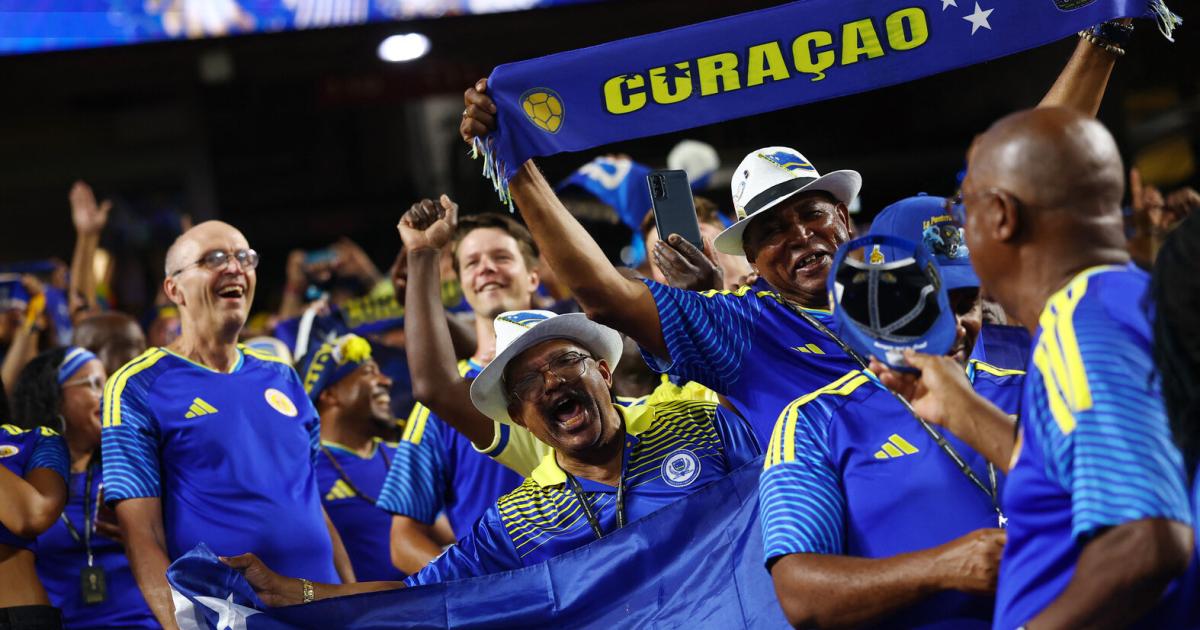
No country that has ever played in a World Cup has been smaller than Curaçao. Around 155,000 people live on the Caribbean island, which corresponds roughly to the capacity of two sold-out World Cup stadiums. We lost 7-1 against Germany.
Defied almost at the same time Cape Verde ranked 67th in the world and without a single player in a top 5 league, held world champion candidate Spain 0-0 and later forced Argentina into extra time. Two debutants, two completely opposite stories. The football world, as is its wont, has chosen the more beautiful one.
Since the start of the tournament, the narrative has been circulating that the… Increase from 32 to 48 teams, previously ridiculed by critics as a loss of level and a sell-out Stroke of genius has revealed. The numbers are at least superficially correct: the group stage yielded 2.99 goals per game highest value since the 1958 World Cup. After the first 24 games, the goal difference was exactly the same 35 goals that were recorded in Qatar in 2022. And that despite 16 additional teams.
Small nations, big exceptions
It’s nice, no question about it. And it has to be said this way: What Cape Verde has achieved is worthy of all honor. A country with a good half a million inhabitants annoys Spain and Argentina, something that has never happened before. But you shouldn’t make any of it new football world order derive. The Cape Verdean kickers are mostly trained in Portugal and France, and their success is also one of European football, which has long recruited its talents all over the globe. The really small associations, those without a diaspora in the big leagues, have been eliminated with no chance. So far there has been little to see of the real sensations that were hoped for from the increase.
Also that one Tore Record loses its shine upon closer inspection. A field of 48 naturally produces more duels between favorites and overwhelmed teams in the group phase, and that’s exactly where the goals came. Record values like the Germans’ 7-1 win against Curaçao are not proof of better football. They are the byproduct of larger class differences.
And the recipe for respectable successes also reveals a lot. The tactical trend of this World Cup is the deep block, disrespectful too „Antifußball“ called: all ten field players in their own penalty area, don’t concede a goal, the rest find their way. The little ones are now so well trained tactically that they can wrest a draw from the big ones. But surviving isn’t playing football. If you wall yourself in for 90 minutes, you don’t want to win, you don’t want to lose. This is also a form of eye level. But a very modest one.
It depends on the length
What has changed most, however, is this Length of time. Almost four weeks have passed since the opening game on June 11th and the quarterfinals are only now beginning. At this point, the finalists had already been determined in Qatar. The World Cup hasn’t gotten any more exciting. It has become longer. With 104 instead of 64 games, the number of games that no one outside the countries involved will ever mention again has multiplied.
In addition there is one Design defectswhich the old format did not know. With 32 teams, things were simple: the first two in each group were promoted, the rest went home. At 48 that’s no longer possible, so eight of the twelve third-placed teams can continue. The result: finishing third was almost always enough, and led to some strange things before the final group games Arithmetic games. This is what happened in front of Austria against Algeria. A mode where elimination becomes an art has a tension problem.
Between growth and impertinence
Four debutants were allowed to play at this World Cup for the first time: Jordan, Uzbekistan, Cape Verde and Curaçao. Four countries where the entire country actually came to a standstill on a June day. This is, in itself, one of the more beautiful moments in football. A sport that is otherwise popular Billion dollar contracts and Investor logic loses, actually still has the power to make a country collectively happy.
However, the contradiction continues in the stands. On the field, FIFA preaches participation like never before, but in the stands it practices the opposite. Who the horrendous ticket prices in Los Angeles still pays $80 for a parking space and $17.50 for a beer in the stadium. The real fans sit at home in front of the television, while the event audience strolls around the arenas. More peoples than ever are allowed to play. Those who can afford it are primarily allowed to watch.
In the end, one simple conclusion remains: A larger field of participants does not automatically create more drama if the newly added variables have little sporting significance. Above all, more games mean more games whose outcome won’t surprise anyone. If I may say so, the reform was not a question of better or worse. She was one of bigger. And whether the football world will appreciate this difference in the long term can only be answered seriously when a real dwarf goes really far for the first time. In any case, the 155,000 people on Curaçao are already waiting for 2030.
Beyond the Giants: 5 Modern and Open-Source Test Data Management Tools for 2026
Cloud-Native TDM: 5 Tools to Isolate Test Data in Microservice Architectures
Shift-Left QA: 5 Tools for On-the-Fly Test Data Generation
Advanced Playwright Locator Strategies for Messy and Complex UIs
Advanced E2E Testing: Building a Scalable Architecture for Web Applications
Architectural Approaches to Scalable E2E Testing: Beyond the Green Checkmark
The AI Revolution in QA: Moving Beyond Static Test Scripts in 2026
Data-Driven Quality: Maximizing ROI in Continuous Testing Pipelines
Engineering Agility: Managing Technical Debt in Modern QA Frameworks
Shifting QA Left: A Developer's Guide to Pipeline Test Automation
Hashnode
Discussion on "10 Best Functional Testing Tools for 2024" | Hashnode
Anna Becker 170
Anna Becker 170
Pfyu4V
Pf2Qei
Kurt Haldeman
Building a Resilient QA Stack: Balancing Low-Code, Frameworks, and Centralized Reporting
Building a Resilient QA Stack: Balancing Low-Code, Frameworks, and Centralized Reporting
Beyond Code Coverage: How to Measure the Real Value of Your Test Automation Stack
Software Code Testing Tools: Aligning Code & Requirements
#7460 QA Stack Audit: Centralizing Automation Logs – new – 4196165
Pf2Xie
Pf2Xkr
Connection | Scoop.it