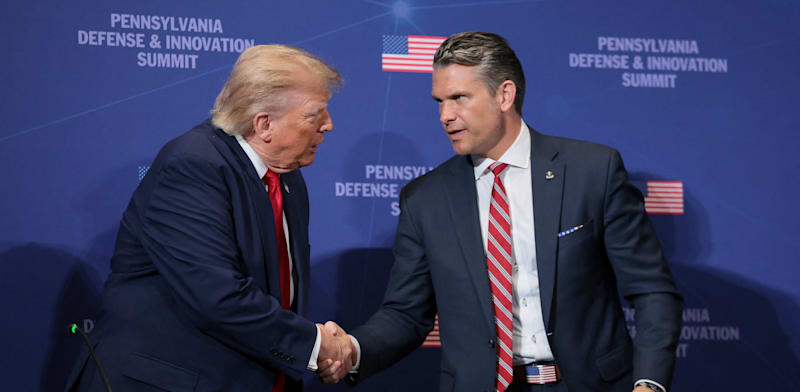
The US Secretary of Defense, Pete Hegseth, and the Chairman of the Joint Chiefs of Staff, General Dan Cain, went to testify before the Senate regarding the Trump administration’s request to approve a supplementary budget package in the amount of 87 billion dollars, intended, among other things, to finance the war against Iran.
Hesseth and Kane will try to convince the legislators to approve the request, which includes 67 billion dollars for the defense budget. Members of Congress from both parties are expected to demand explanations not only about the costs, but also about the Trump administration’s long-term strategy in Iran and how the funds will be used, if they are approved.
The decision whether to approve the budget is expected to affect the US’s ability to continue fighting in Iran. This is because the stockpile of weapons to defend against missiles and various Iranian attacks is running out, according to reports and investigations published in the American media in recent weeks.
Many in Congress and among military commentators estimate that the US rush to the previous ceasefire was caused by this shortage, to try to fill the warehouses.
Even before the public debate, Geseth is expected to deliver a classified briefing to the members of the House of Representatives and the Senate, in which he will present the situation in the war with Iran and the need to approve the additional budget package. The briefing is expected to deal with both operational developments and the Pentagon’s budgetary needs as the conflict continues, and in addition Hesseth is expected to ask lawmakers to approve urgent funding for defensive weapons.
In the background of the debate in Congress on the budget is also the question of the president’s authority to continue the war without the express approval of the legislators, which could also stop the American attacks on Iran.
The cost of fighting
The request for the budget supplement was submitted to Congress at the end of June and was received coldly by the Democrats, whose votes are necessary for its approval, and it seems that their position has not changed even in recent weeks.
One of the main issues in the upcoming debate is expected to be the true cost of the war. The director of the budget office in the White House, Russ Watt, previously estimated before Congress that the war would cost about 30 billion dollars. But many experts believe that this is a significant underestimation.
Democratic Senator Alyssa Slotkin, a member of the Senate Armed Services Committee, said last week that according to her calculations, the total cost is already about $98 billion.
Despite the sums of the copy that the Geseth will request from Congress, Prof. Kobi Michael, a senior fellow at the Meshgav Institute for National Security and INSS, explains that “the cost of the war to the US is relatively marginal in American-powerful terms. The victory will greatly increase the chance of a flow of money and investments in the US that will offset the expenses of the war and more than that.”
According to him, the geopolitical significance of not approving the budget will be severe for the US, and for Israel as well. “The remaining window of time for fighting is critical. If Gasth fails to convince President Trump to complete the job or at least bring about a real change, Israel may find itself standing alone in the face of the Iranian threat, which, with the withdrawal of the US from the campaign, will become more significant, immediate and dangerous.”
The debate on the authority of the president
The budget debate comes at a politically sensitive time in the US. The Democratic Party is holding primaries designed to select its candidates for congressional seats. In race after race, the winners are candidates who oppose the war on Iran. This directly affects the willingness of Senate Democrats and their willingness to approve more money for such an unpopular war.
In the background of the debate is also the question of the president’s authority to continue the war without the express approval of the legislators. According to the War Powers Act of 1973, when a president puts US forces into hostilities without prior approval from Congress, he must report to lawmakers within 48 hours.
From the moment the mechanism stipulated in the law enters into force, the president has 60 days to manage the military activity without further approval; It must then cease, unless Congress has declared war, expressly authorized the continued use of force, or extended the period.
The law also allows an additional period of up to 30 days when it is required for the safe withdrawal of the forces.
In the current war with Iran, the issue has become a focus of legal and political controversy: the Trump administration claimed that the end of the previous round of fighting and the cease-fire brought an end to the hostilities to which the previous 60-day count applied,
And when the fighting resumed, a new number actually began, so that the date on which the new 60 days will end is actually at the beginning of September.
Opponents of the administration dispute this interpretation and claim that the law does not give the president the option to “reset the clock” every time the fighting stops and resumes.
David A. Levy, a senior researcher at the BSA Institute, at Bar-Ilan University, who served as a senior officer in the US Navy and a former US diplomat. An expert on security affairs in the Middle East and military and national strategy of the United States, explains that “Presidents of both parties have questioned the legality of the law over the years, because, according to them, it limits the powers of the president as commander-in-chief of the armed forces by virtue of Article 2 of the United States Constitution.
“That’s why, until today, in previous conflicts, the Congress did not bring about an end to the fighting in this way.”
What will happen if this time Congress does not approve the continuation of the war? Would the president even dare to ask Congress to ask them for such a thing?
“If Congress refuses to approve the continuation of the war, it is likely that the legal dispute will eventually reach the Supreme Court, after it has passed through the lower courts, where the fundamental question of whether the law itself is constitutional may also arise.
“At the same time, Congress can try to stop the financing of the war. Such a step has not been taken in the past in a way that resulted in the cessation of an active American war, and it has been considered for years to be very problematic from a political point of view.
“Many Americans may see the denial of budgets as a move that means not supporting the fighting forces. However, it is possible that this time the political reality has changed.”
On the ground, the fighting continues
The visit to Congress will be the first significant public appearance of Hesseth and Kaine since the escalation of hostilities with Iran in recent weeks.
In the last ten days, US military forces have carried out extensive attacks on Iranian territory, as part of President Trump’s policy to increase pressure on the regime in Tehran and to respond to Iranian attacks against commercial vessels trying to pass through the Strait of Hormuz.
Iran, for its part, expanded its attacks against American targets in the Gulf, and hit American military installations in Kuwait, Jordan, Bahrain and Qatar. The Pentagon informed on Monday that since July 7, almost 100 American soldiers have been injured, but 96% of them have already returned to active duty.
Prof. Michael explains that “Hegseth represents the more hawkish line in the Trump administration. He leads a much more militant line than Vice President J.D. Vance when it comes to Iran and the necessity of ending the campaign with an unequivocal American victory. Contrast this with the separatist approach that characterizes a large part of the Republican Party and the Democratic Party’s stated opposition to the continuation of the war.”
For your attention: The Globes system strives for a diverse, relevant and respectful discourse in accordance with the code of ethics that appears in the trust report according to which we operate. Expressions of violence, racism, incitement or any other inappropriate discourse are filtered out automatically and will not be published on the site.