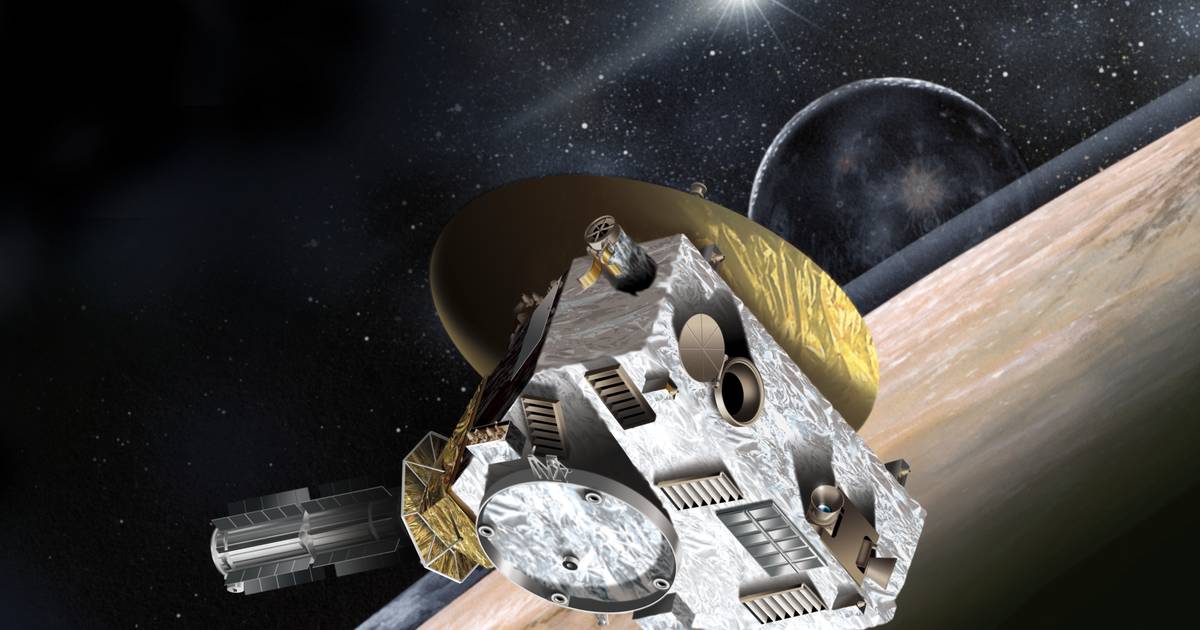
The revolutionary mission that explored Pluto and the distant objects of the Solar System in unprecedented detail has awakened from its longest hibernation yet. NASA’s New Horizons spacecraft is currently an incredible 9.5 billion kilometers from Earth, and after almost a year of rest, it is active again and ready for new discoveries in the icy expanse of the Kuiper belt.
Flight controllers at Johns Hopkins University’s Applied Physics Laboratory have confirmed that the spacecraft is in excellent condition and that the process of downloading scientific data collected during the idle period has begun.
Returning from the longest sleep
New Horizons entered a planned hibernation on August 7, 2025, and woke up on June 23 of this year with the help of commands stored on its main computer. During those 321 days of rest, the spacecraft was in a steady state of reduced power consumption, while its computer monitored the state of the system and once a week sent a signal to controllers on Earth, which took nearly nine hours to receive the message.
“Every status report during this hibernation period was ‘green,’ which means that everything on New Horizons was fine from week to week,” Alice Bowman, mission operations manager, said in a statement.
Hibernation periods are key to the longevity of the mission that began with the launch in January 2006. They save the spacecraft’s resources and extend its lifetime during long journeys between interesting objects. Since 2007, New Horizons has hibernated more than twenty times.
Exploring unexplored territory
Since making a historic flyby of Pluto and its moons in 2015, and exploring Arrokoth, a snowball-shaped object, in detail in 2019, the spacecraft has been constantly exploring the mysterious Kuiper Belt, an area of thousands of frozen, rocky bodies that represent the remnants of the formation of our Solar System 4.5 years ago. billions of years. Her discoveries continue to surprise scientists.
Clues about the origin of the planet
The spacecraft collects data on the rotation speeds, orientation and shapes of frozen objects orbiting the Kuiper belt. Those measurements provide key insights into how planets break down from dust and rock.
“It appears that there are more paired snow bodies out there, like Arrokoth, than anyone expected,” Pontus Brandt, the mission’s project scientist, wrote in an email. “Are such binary objects the most common planetesimals, and is this the way larger planets are built in our and other star systems? These are very deep questions that New Horizons can help answer.”
Enigmas of the heliosphere and space dust
In addition to observing distant objects, New Horizons also measures its immediate environment. One of the instruments analyzes the distribution of gas in the outer heliosphere, the vast protective bubble created by the Sun’s wind. The second instrument measures galactic cosmic rays, extremely fast particles created by exploding stars, which represent one of the greatest threats to human activities in space. The heliosphere protects us from about 70 percent of these rays, and data from New Horizons helps scientists understand how this shield works.
A special surprise was arranged by numberč dust. The team expected that the amount of dust would decrease after the spacecraft passed the known edge of the Kuiper belt, but the opposite happened. New Horizons is still in a dusty environment, suggesting that the belt is much larger than previously thought.
“The Kuiper Belt may simply be much more spacious than we previously thought,” Brandt wrote. “I feel like we’ve only scratched the surface of what the entire Solar System really looks like. We have to remember that there are probably hundreds of unexplored dwarf planets and thousands of smaller objects out there.”
The future of the pioneering mission
The New Horizons mission is currently in its second extended phase, which ends in 2029. However, if the spacecraft remains in good condition and continues to collect valuable scientific data, the mission could continue well into the 2040s. Its current trajectory will eventually take it outside the heliosphere and into interstellar space, following in the historic footsteps of the Voyager probes. In the meantime, the mission team is actively searching for a new object in the Kuiper Belt that New Horizons could visit in the future.