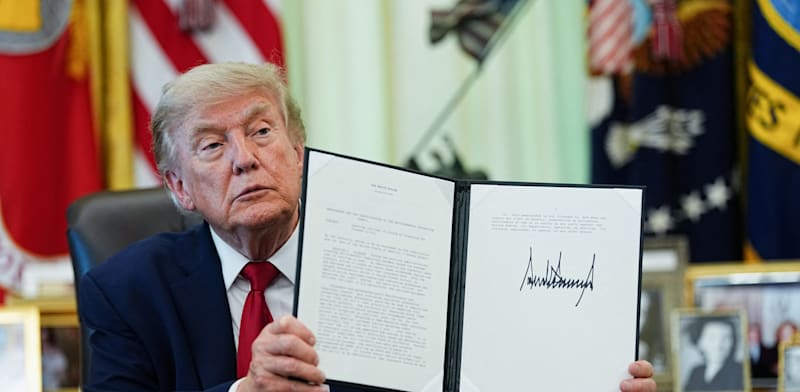
The United States is expected to soon impose a new series of tariffs on dozens of countries, the US Trade Commissioner Jamieson Greer signaled. According to reports in the economic media in the US, the Trump administration plans to impose new tariffs on about 60 trade partners of the United States. The expected date for their imposition is this Friday, with the expiration of the temporary global tariff imposed by President Trump and invalidated by the court.
Uncertainty in the markets
The threats of tariffs are creating a flashback to turbulent times in the markets, and they are not alone. A series of other factors signal that stress and uncertainty are the name of the game.
First, oil prices are soaring and approaching more than $95 per Brent barrel – a 20% increase in just one month. The reason is clear: the escalation in Iran, which includes almost two consecutive weeks of American attacks and extensive closure of shipping lanes in the Strait of Hormuz. The Houthi threat to Saudi Arabia’s maritime traffic also has an impact.
Some of the oil tankers were seen slowing down and even stopping as they approached Yemen’s territorial waters, while others carrying oil from the kingdom changed course and headed towards the Suez Canal. Analysts are already talking about the possibility of a return to triple digit pricing of oil barrels.
Even in the US government bond market, the nervousness is well felt: the yield to maturity for 10 years stands at more than 4.6%, a two-month high.
Alongside the inflationary concerns that have reawakened following the surge in oil prices, another significant factor is at work: an unprecedented wave of corporate debt issuances by the technology giants. Another expression of nervousness can be seen in the US dollar index (DXY), which is close to a one-year high against the basket of currencies.
This is an indicator of flight to zero-risk assets and fear of another inflationary wave, and a return to a tariff economy is not expected to help calm the spirits.
The new caps
In April of this year, Trump imposed a global tariff of 10%, after the US Supreme Court invalidated a series of previous tariffs in February. The current temporary tariff is set to expire on Friday, July 24.
The new tariff, according to estimates, will range from 10% to 12.5%, with the aim of replacing the temporary tariff. The official reason for the tariffs is claims of “forced labor” in the taxed countries. The move fits into Trump’s renewed effort to use tariffs as a means of pressure on the United States’ trading partners – a policy that is rekindling fears of retaliation and diplomatic tensions.
According to the emerging plan, imports from EU countries, Mexico, Taiwan and the United Kingdom will be subject to a 10% tariff. In contrast, products coming from more than 40 other large economies, including China, India and Japan, are expected to absorb a higher tariff of 12.5%.
The move comes at the same time as an escalation on several other fronts in Trump’s trade war. Last week, Washington announced a new 25% tariff on certain products from Brazil, which could affect exports amounting to more than 11 billion dollars; And on Monday, the administration unveiled a 50% tariff on a long list of products from Canada.
At the same time, Trump opened a front against the pharmaceutical industry. On Tuesday, the president announced a future tariff of 100% on imported generic drugs, which will take effect in August 2028 and will rise to 200% in 2029.
In the next two years, the customs duty will move in the opposite direction: starting in August 2026, it will be reduced to zero, with the aim of giving pharmaceutical manufacturers a window of time to transfer production to the United States.
The move could have particularly significant implications for India, whose pharmaceutical companies supply nearly half of all generic drugs consumed in the US.
Experts and market analysts are afraid of the consequences of the plan on drug prices and the continuity of supply. Nathan Gray, a senior research fellow at the Institute of International Trade at the University of Adelaide, says that “the decision is expected to reduce the supply of generic drugs in the US, which may lead to an increase in prices, the reduction of competition and the limitation of discounted alternatives for consumers.”
Not ideal timing
These moves come at a particularly sensitive time for the Trump administration. The war in Iran is not popular, and so are the expected price increases following the renewal of fighting in Hormuz and the Gulf.
Polls show that in the mid-term elections that will be held in November, the president’s party is headed for a significant landslide, unless the state of the economy improves significantly. Therefore, instigating moves that are expected to cause price increases at this particular time constitutes a significant political risk.
And what about the legality of the new tariffs?
The new round of tariffs is also expected to face a significant legal test. As you may recall, in February Trump suffered a significant blow when the Supreme Court invalidated a key part of the tariffs he announced, after determining that the Emergency Economic Powers Act, on which the administration relied, does not grant the president the authority to impose broad tariffs.
That is why this time the White House chose a different legal route: the planned tariffs on dozens of trading partners will be imposed following “allegations concerning forced labor”. They rely on Section 301 of the Trade Act of 1974. Unlike the emergency law that Trump has used in the past, Section 301 is specifically designed to allow the administration to investigate foreign trade practices deemed unfair or discriminatory, and in certain circumstances to respond to them with tariffs.
Choosing this route may make it difficult for Trump opponents to achieve a blanket disqualification similar to the one they achieved in February, but it does not grant the tariffs immunity.
Companies and importers can still claim that the administration exceeded the authority granted to it by Congress, that it did not meet the procedural requirements set forth in the law, or that it did not prove a sufficient connection between the policies of the investigated countries and the harm to American trade.
So, in fact, it seems that even after the previous losses in court, Trump does not give up on his tariff policy, but tries to rebuild it on the basis of other legal claims, which are likely to be the focus of new legal battles.
And even more so, the geopolitical tensions of the USA vis-a-vis Europe, China and perhaps even Israel are one decision away from the president, and the world’s markets may enter another spiral.
For your attention: The Globes system strives for a diverse, relevant and respectful discourse in accordance with the code of ethics that appears in the trust report according to which we operate. Expressions of violence, racism, incitement or any other inappropriate discourse are filtered out automatically and will not be published on the site.