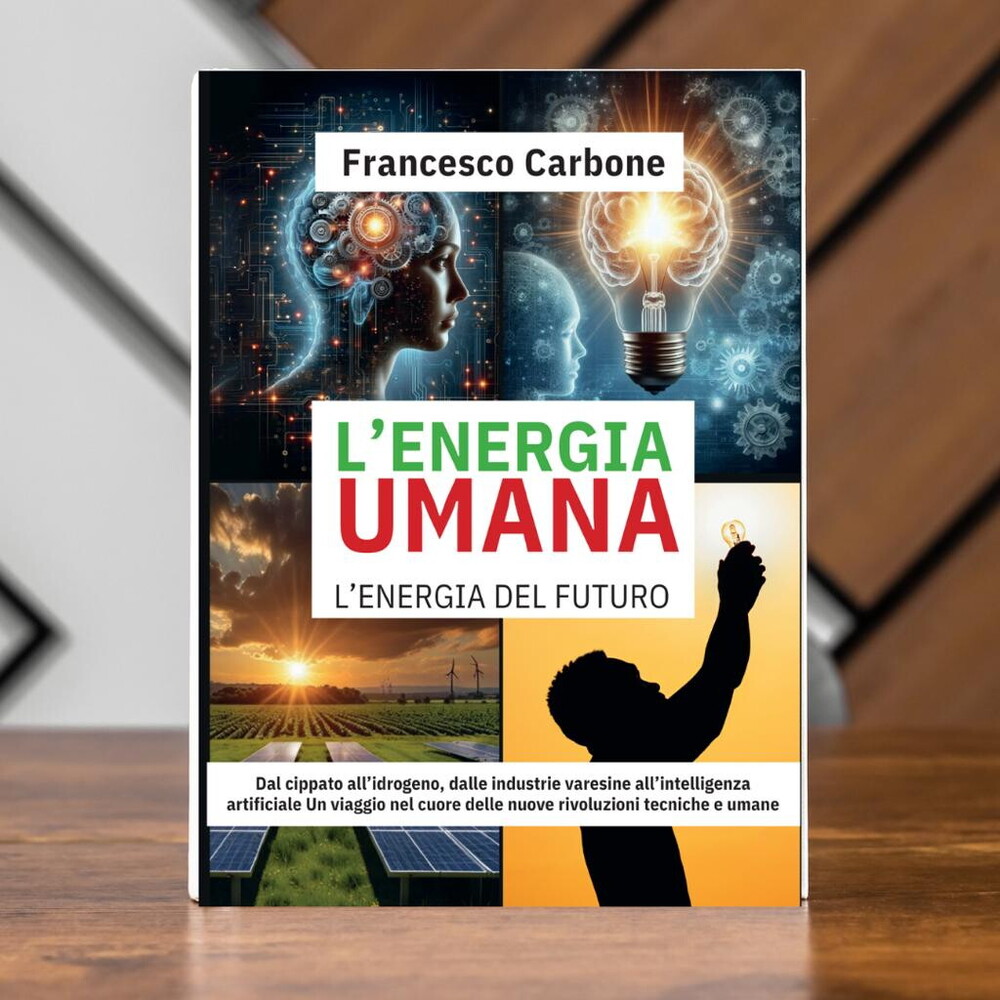
After the essay “The energy that made the five industrial revolutions possible”, the engineer and entrepreneur Francesco Carbone return to the bookstore with “Human energy – The energy of the future”, a work that expands the reflection begun in the previous volume and shifts attention from energy production to the value of the person, identifying human capital as the most precious resource for facing the challenges of the sixth industrial revolution.
If in the first book Carbone analyzed how every great economic and social revolution was made possible by the evolution of energy sources, in this new work he argues that the true element capable of determining the future of companies and nations will be the quality of people: their training, the ability to update themselves, to interpret change and to govern new technologies rather than suffer them.
Teacher of industrial automation and robotics, entrepreneur and popularizer on energy issues – with particular attention also to the debate on new generation nuclear power – Carbone addresses one of the most discussed topics of recent years: the relationship between man and artificial intelligence.
The author’s thesis is clear: artificial intelligence represents an extraordinary opportunityintended to improve the efficiency of production processes, reduce errors, accelerate analyzes and automate the most repetitive tasks. But, just as industrial robotics has not replaced humans in factories but has transformed their work by making them more qualified, safe and technologically advanced, AI will not replace human value either. On the contrary, it will make the role of skills, creativity, critical thinking and decision-making ability even more central.
The book also dedicates ample space to the theme of continuous training (upskilling and reskilling), identifying it as the true strategic lever to allow workers to accompany innovation without being overwhelmed by it. For Carbone, the competitiveness of an industrial system will not only depend on the energy that powers the plants or on the available technologies, but above all on the quality of the people who will be called upon to use them.
A message that is part of the broader cultural and informative journey of the author, who has been committed for years to promoting a vision of development based on the integration of technological innovation, energy sovereignty, industrial growth and the valorization of human capital.
The volume is embellished with prefaces by Carlo Fidanza, head of the Fratelli d’Italia delegation to the European Parliament, and by Francesca Caruso, Councilor for Culture of the Lombardy Region, while the afterword is entrusted to Francesco Giubilei.
With “Human energy – The energy of the future”, Francesco Carbone thus proposes a reflection that goes beyond the technological debate: in the age of artificial intelligence, the real energy destined to make the difference will continue to be that of people.
Incline Bed Therapy Products For Acid Reflux & Heartburn Relief: Range Expanded | FWNBC
Kansas Respiratory Therapist Salary vs Allied Health – Comparison Released | FWNBC
LeafWorldMedia Releases AI Search Visibility Guide Amid Changing Search Habits | FWNBC
News
News
News
News
News
News
News
News
News
News
News
News
News
News
News
News
News
News
News
News
News
News