This year’s unprecedentedly strong climate phenomenon in the Pacific will lead to rising temperatures, potentially making 2027 the hottest year on record.
According to Nature, researchers predict that the developing El Niño phenomenon in the Pacific is likely to become the strongest in the past 150 years.
On The Climate Brink, Zeke Hausfather, a climate scientist at Berkeley Earth, stated that many climate models are predicting that the peak temperatures of this year’s El Niño could far surpass previous records. Estimates suggest that the highest sea surface temperatures in the Pacific will be about 0.8°C higher than the previous record set in 2015-2016. Combined with climate change, next year the global average temperature could rise by 1.7°C compared to pre-industrial levels, exceeding the limits set by the Paris Agreement on climate change. Furthermore, there is a possibility that climate patterns will cause temperatures to rise sharply enough in the next few months to make 2026 a record-breaking hot year.
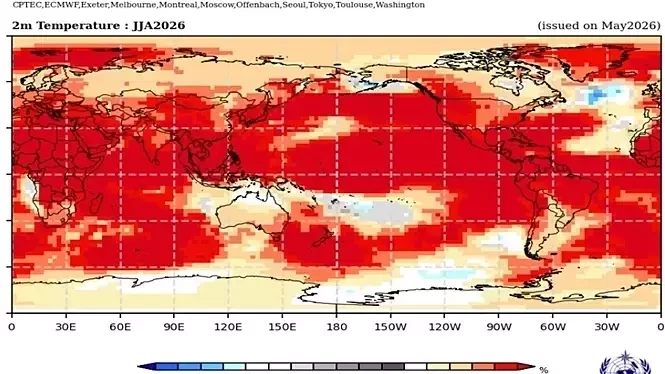
The WMO’s forecast of air temperatures from June to August shows the red area indicating a higher-than-normal temperature increase. (Image: WMO)
In a forecast published on July 20th, the US National Oceanic and Atmospheric Administration (NOAA) stated that there is an 80% chance that one of the strongest El Niño events in history will form between now and the end of the year and continue at least until April 2027.
“The world must consider this an urgent climate warning. El Niño will exacerbate global warming,” UN Secretary-General António Guterres said in a video statement earlier in June.
This year’s warm ENSO phase, appearing just two years after the last one, represents a systematic shift in the cycle, toward increasingly severe El Niño due to climate change, according to Kaustubh Thirumalai, a paleoclimatologist studying ENSO at the University of Arizona.
The heatwaves, droughts, floods, and wildfires that often accompany this phenomenon will have economic consequences. Weather changes caused by the warm ENSO phase of 1997-1998 resulted in a total decline in global economic growth of $5.7 trillion in the years that followed, according to estimates by Justin Mankin, a climate researcher at Dartmouth University, and colleagues published in Science.
If current predictions are accurate, the current El Niño event could cause “US$10 trillion in economic damage by 2032,” according to Mankin. In addition, the event puts pressure on ecosystems and oceans, reducing the net carbon they absorb from the atmosphere.
According to the World Resources Institute, sudden heat waves damage seagrass beds and kelp forests, increase stress and disease risks in aquaculture, and alter plankton and fish populations. Past strong El Niño events, including 1997-1998 and 2015-2016, have been associated with large-scale global coral bleaching, undermining ecosystems that support fisheries, tourism, and coastal protection.
For communities dependent on the ocean, these ecological shocks affect people’s incomes, especially in coastal and island nations. A record-breakingly strong El Niño threatens to destabilize the livelihoods of millions who depend on the ocean for food and work.
WRI also notes that the conflict between the US and Iran, disrupting fuel and fertilizer markets, could exacerbate the impact of the upcoming El Niño. Regions with weaker resilience, already under pressure from food prices and input costs, could face food crises if droughts or extreme weather events occur.
According to Reuters, the weather phenomenon is likely to cause droughts in some parts of Asia and heavy rains in some parts of South America, threatening crops and food supplies. Developing countries are particularly vulnerable because households spend a large portion of their income on food and agriculture plays a vital role in their economies, thus increasing the risk that central banks will have to maintain tight monetary policies for a longer period.
“El Nino makes inflation more persistent, with forecasts of interest rate hikes in the second half of the year, especially for the most affected South Asian countries such as India, Indonesia, Vietnam, and Thailand,” said Gary Tan, equity portfolio manager at Allspring Global Investments.
El Nino is a phase in the ENSO process – the transition of sea surface temperatures and winds in the Pacific Ocean between warm El Nino and cold La Nina in a 2-7 year cycle. The most recent El Nino occurred in 2023-2024.
Making sure you're not a bot!
Choosing a VPN for Android: What Users Should Know – HackMD
VPN Protection for Android: Improving Privacy in a Connected World
Using A Vpn On Android Devices A Guide To Safer Mobile Connectivity
VPN for Android Devices: Building a More Private Mobile Experience
iPhone VPN App: Improving Privacy and Security on Apple Devices
Understanding the Process of Canceling a VPN Plan
Iphone Vpn App Enhancing Security In Everyday Mobile Use
iPhone VPN App: A Modern Solution for Safer Internet Access |…
iPhone VPN App: Understanding Mobile Privacy and Secure Connections – HedgeDoc
iPhone VPN App: Exploring Safer Ways to Use the Internet | Pikumil
Database Error
iPhone VPN App: Improving Online Privacy in a Mobile World – HedgeDoc
Android TV VPN App: Creating a Safer and More Flexible Streaming Experience – HedgeDoc
Android TV VPN App: Enhancing Privacy and Freedom on Smart Screens – CodiMD
Android TV VPN App: A New Approach to Secure Home Entertainment – CodiMD
Android TV VPN App: Making Smart Entertainment More Private – HedgeDoc
Android TV VPN App: Exploring Privacy Options for Modern Streaming Devices – HedgeDoc
Apple TV VPN App: Enhancing Privacy and Flexibility for Home Entertainment – HedgeDoc
Understanding VPN Options for Apple TV Users – HedgeDoc
Apple TV and VPN: What Users Should Know Before Getting Started – CodiMD
A Practical Guide to Using a VPN with Apple TV – HedgeDoc
Using a VPN with Apple TV: A Simple Overview | Panchit –…
VPN Server List: Why Server Locations Matter
Understanding VPN Server Locations and Their Role in Online Connectivity