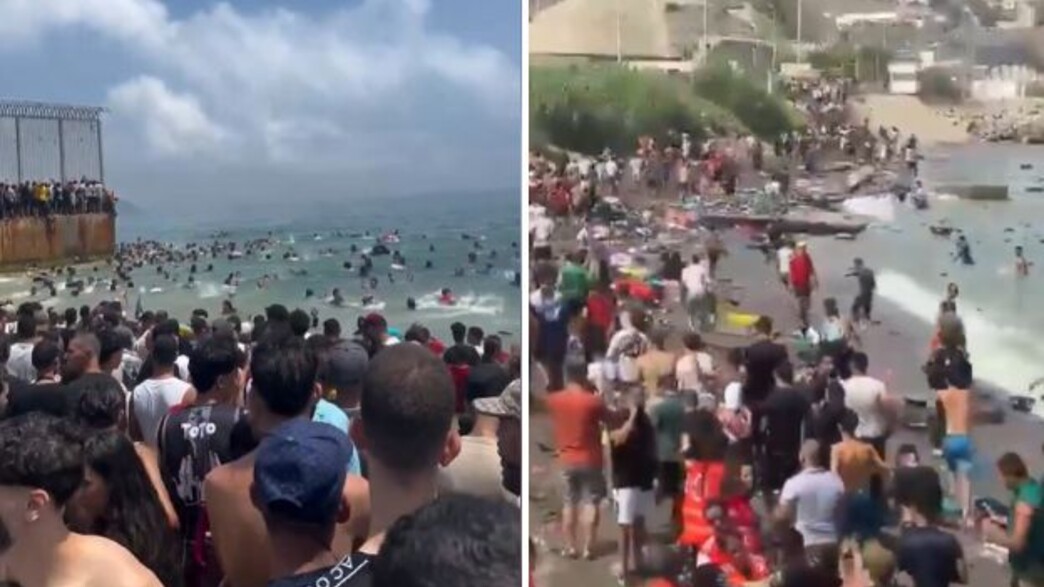
An acute immigration and diplomatic crisis has been affecting the Spanish enclaves of Ceuta and Melia for the past day, and now the Spanish Ministry of the Interior publishes an estimate that about 50 thousand people have crossed the border since yesterday. The tense situation on the ground led the Spanish government to the dramatic step of sending in military forces, closing land border crossings and declaring a state of emergency, following waves of arrivals of immigrants on an unprecedented scale. After crowds breached the fences, swam around the breakwaters and clashed with the security forces in the Moroccan border towns, the Prime Minister of Spain, Pedro Sánchez, made an emergency visit to Ceuta after ordering the reinforcement of the enclave with military units. Gaza within the European Union and draw sharp reactions from international parties, including the United States, Italy and also Israel.
Clashes, burning vehicles and thousands at sea
What started in the evening quickly turned into a scene of absolute chaos: the Moroccan border town of Fnideq became the focus of the clashes, when Thousands of migrants gathered in front of the border line separating Morocco and Ceuta. Despite the extensive deployment of Moroccan security forces, hundreds of migrants repeatedly tried to break through to the crossing gates. Others chose equally dangerous routes, moving along mountain paths or jumping into the sea with the aim of swimming around the breakwaters.
In Panidak, severe violence erupted along the approach route, as crowds clashed with the security forces who tried to stop the progress. At the scene, there were severe scenes of destruction, a smoldering bus and seven vehicles that were burned during the riots. Immigrants who were there reported fleeing in panic and incidents of trampling along the narrow coastal paths, while the security personnel repeatedly repelled groups that tried to carry out coordinated break-ins throughout the night.
Despite the containment efforts, between 2,000 and 3,000 immigrants managed to enter Souta already in the first wave, when as mentioned the overall estimates of the Ministry of the Interior speak About the arrival of about 50 thousand people who managed to cross the border in just one day. Spain’s state television recorded men, women and minors entering by swimming or climbing fences. The humanitarian cost was immediate and severe: the Spanish authorities in Ceuta confirmed that they recovered the bodies of nine people who drowned, while the total death toll in the border area reached at least 18 people within one day. In response to the unprecedented rush, the central government in Madrid dispatched military units alongside the Civil Guard, the National Police and the local police to secure the entire perimeter of the city. class=”HtmlRender_root__x0GRC”>
Prime Minister Pedro Sánchez, accompanied by Interior Minister Fernando Grande-Marlesca, landed in Ceuta to examine the crisis closely. Sánchez’s agenda includes a tour of the Tarajal border crossing and a meeting with the security forces in the field, followed by participation in an emergency meeting at the Assembly Palace. on a state of national emergency, alongside the representative of the central government, the commanders of the police and the Civil Guard, the director of the Temporary Detention Center for Immigrants (CETI) and representatives of the Red Cross.
The visit is taking place against the background of a particularly direct political conflict, when the opposition parties in Spain, led by the “People’s Party” (PP) and the “Vox” party, place the responsibility Full of events about Sánchez and his government’s immigration policy. On the other hand, both the Spanish government and the Moroccan authorities claim that the current flooding is the result of the Supreme Court’s ruling, which prohibits the immediate return at the border of immigrants who arrive in Spanish territory by swimming.class=”HtmlRender_root__x0GRC”>
At the same time as the events in Ceuta, the second Spanish enclave in North Africa, Malia, moved to seal its borders and increase security. The Beni Enzar border crossing, the only active land crossing between Spain and Morocco in the city, was completely closed. The break-in attempts took place in several locations, including the southern breakwater and the old border crossing in Barrio Chino (Barrio Chino), which has been closed since the Corona epidemic.
Police forces in Malia reported clashes that included warning shots to keep away immigrants who tried to climb fences. Authorities reported gunshots, small explosions and fires on the Moroccan side of the border during the night, while drones and helicopters carried out aerial patrols over the border line.
Juan José Imbroda, president of Malia, estimates that between 300 to 400 immigrants managed to enter the city by sea and land. Although he noted that the Moroccan security forces cooperated in an exemplary manner to contain the pressure in Malia, Imbroda sharply attacked the Sánchez government, defining the immigration policy of the central government as a “complete failure” and accusing it of creating a severe “pull effect”, while pointing to an 80 percent jump in the number of unaccompanied minors found in the city in the last two months. He continued to question the relations with Morocco, claiming that Spain gave up its historic position on the issue of the Western Sahara without receiving real stability in its borders in return. The right-wing camp reacted with sharp criticism towards Madrid. Italian Prime Minister Giorgia Maloney described the documents from Sauta as a shock and raised the possibility of suspending Spain’s membership in the Schengen Agreement. Italian Foreign Minister Antonio Tajani and Deputy Prime Minister Matteo Salvini echoed this position, which led Spanish Foreign Minister Jose Manuel Albers to summon the Italian ambassador to Madrid. Rebuke.
In the United States, the events also became a central issue and elements associated with President Trump used the images to strengthen the anti-immigration rhetoric. Mass immigration endangers the future of the countries. At the same time, conservative research institutes in the US began to question Spain’s right to the enclaves and compared it to its demands regarding Gibraltar. At the same time, Israel’s ambassador to the UN, Danny Danon, took advantage of the crisis in Souta in a tweet he published on his X account. Danon claimed that Spain, which he says does not miss an opportunity to preach morality to Israel, runs “colonial enclaves” in Africa, and that it should explain this to the world before continuing to criticize. Danon’s words reflect the extent of the decline in relations between Madrid and Jerusalem, which have reached a breaking point following Spain’s recognition of a Palestinian state, statements by ministers accusing Israel of genocide in Gaza and the return of the ambassador. The Spanish.
Despite the diplomatic conflict, from a legal point of view there is a clear distinction: unlike Gibraltar or the Western Sahara, Ceuta and Malia do not appear on the list of non-independent territories of the United Nations, and the organization recognizes them as an inseparable part of the state of Spain. However, the convergence of pressures from all fronts presents Madrid with an unprecedented diplomatic, operational and humanitarian test on its southern border.
The gateway to Europe: what is the story of the Spanish enclaves?
Sauta and Melia are the only land border of the European Union on the African continent, and they own Unique geopolitical status. Melia has been under Spanish control since the 15th century (1497), while Ceuta came under Spanish control in the 17th century following the dissolution of the Iberian Union with Portugal. Both cities were excluded from the protectorateThe Spanish in Morocco during the 20th century and remained an integral part of Spanish territory when Morocco gained its independence in 1956.
Morocco has been claiming sovereignty over the two cities for decades as part of the “Greater Morocco” concept. However, international law and the UN consider Ceuta and Malia to be Spanish provinces for all intents and purposes and not territories awaiting decolonization, and their residents enjoy full Spanish and European citizenship.
Despite Madrid’s firm position that sovereignty is not up for negotiation, the cities remain economically vulnerable and very sensitive to fluctuations in relations with Morocco. The current crisis joins a series of shocks in recent years, including the May 2021 events in which 8,000 migrants crossed to Souta in one day, and the June 2022 event in Malia in which at least 23 migrants were killed during a mass crossing attempt.
Im Bereich der Gaming-Plattformen kommt es gelegentlich zu u
Es zeigt sich, dass bestimmte Features bei Plattformen mit D
Manche Leute sagen, das Design von Drehspiel-Plattformen sol
Warum werden manche Gaming-Plattformen ohne Vorwarnung gespe
Welche Erfahrungen habt ihr mit der Benutzerfreundlichkeit v
Online lately fällt immer wieder auf, wie unterschiedlich mo
Es zeigt sich offenbar, dass der Support bei gesperrten Gami
In meiner Region wird online zuletzt öfter über die Gründe g
Young Ninja Group (ages 3-5) | Rubio Long Snapping
Neulich beim Treffen mit Freunden im Café fiel auf, wie oft
Vor Kurzem habe ich darüber nachgedacht, worauf man bei der
Im Bereich der Gaming-Plattformen ist es interessant zu beob
Meals & nutrition | Little stars
Welche Alternativen nutzt ihr, wenn eine Gaming-Plattform vo
Stellt euch vor, ihr nutzt eine Plattform für Drehspiele und
Welche Erfahrungen habt ihr mit verschiedenen Plattformen fü
Manche sagen, dass mobile Funktionen bei Plattformen mit Dre
Wie wichtig sind zusätzliche Funktionen oder Informationsang
Stellt euch vor, ihr habt eine Frage oder ein Problem bei ei
Offenbar gibt es in letzter Zeit einige Änderungen bei belie
Stellt euch vor, ihr vergleicht das Gameplay auf einer älter
Ein häufiges Problem bei Gaming-Plattformen ist, dass viele
Wenn man an einem freien Wochenende zu Hause sitzt und nach
Evidently hängt das Nutzererlebnis auf einer Gaming-Plattfor
Welche aktuellen Trends bei Gaming-Plattformen fallen euch a