Scientists have developed a plasma gun to help astronauts disinfect their clothes during long-term travel without having to carry detergent.
Theo Spacewater on space trips is very scarce, making it difficult for astronauts to do laundry. They can wear a suit for days, even weeks, then put it in an airtight bag and bring it back to Earth to wash, or get rid of it by burning it up in the atmosphere.
This is fine for short trips near Earth, but would be difficult to apply to a multi-month journey to Mars. If left untreated, dirty clothes not only create a bad smell but also provide an ideal environment for disease-causing bacteria to grow.
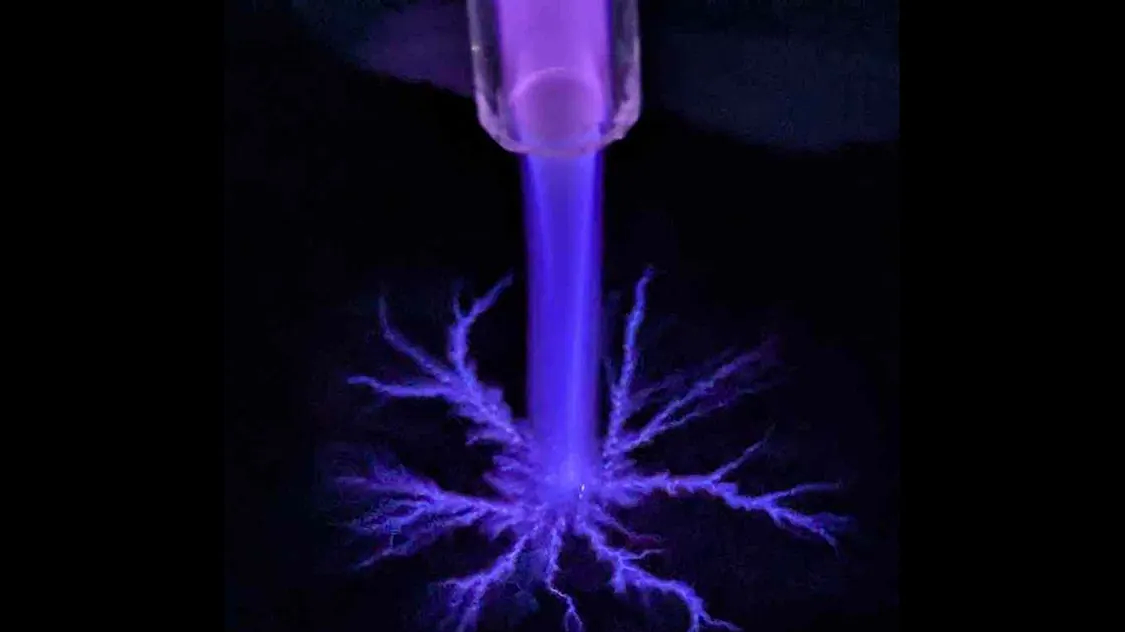
To solve the problem, professor Gabe Xu at the University of Alabama Huntsville (UAH) and his colleagues developed a prototype “washing gun” with the ability to shoot purple plasma to disinfect fabric. “This will reduce the amount of bacteria, keep clothes and other soft surfaces at least microbiologically clean, and help protect the astronaut’s health,” Xu explained, adding that the washing gun could also be used to sterilize spacesuits and tools before astronauts leave the ship or base and set foot on Mars.
The plasma gun works in testing. Image: UAH/Without Xu
Plasma is an energetic mixture of charged particles, ions and electrons. While many plasmas are very hot, such as those found in the Sun, the plasma of a washing gun is cold, close to room temperature.
The electrons of the washing gun play a key role in sterilization. When the plasma gun hits the fabric, electrons collide with gas molecules in the surrounding air, such as oxygen (O2) and water vapor (H2O). The impact creates other molecules such as ozone (O3), called “oxidants”, which can chemically react with the membranes surrounding bacteria, damaging and killing them.
Working with NASA’s Marshall Space Flight Center, Xu’s team built a prototype of a pen-sized washing gun that can disinfect about one square centimeter per shot. In testing, the prototype reduced the number of spore clusters on a piece of fabric by more than 75%.
In tests lasting from 30 seconds to 5 minutes, the new method did not cause significant damage to the fabric fibers. “We thought it was probably no worse than normal wear and tear,” Xu told Live Science.
Close-up of the plasma beam fired from the washing gun. Image: UAH/Without Xu
Disinfectants on Earth like peroxide and bleach attack bacteria in the same way, but washing guns eliminate the need for astronauts to carry them. Instead, the device creates plasma from air and water vapor on the spacecraft itself. In space travel, every gram saved is important.
However, Xu said, washing guns cannot replace conventional washing machines because they cannot remove stains such as coffee or grass stains. The size of the prototype is also too small for practical use. Xu’s team plans to build a larger device that can still be handheld. They are also working on a filtration system to help treat ozone from guns, which can be harmful if released in large amounts.