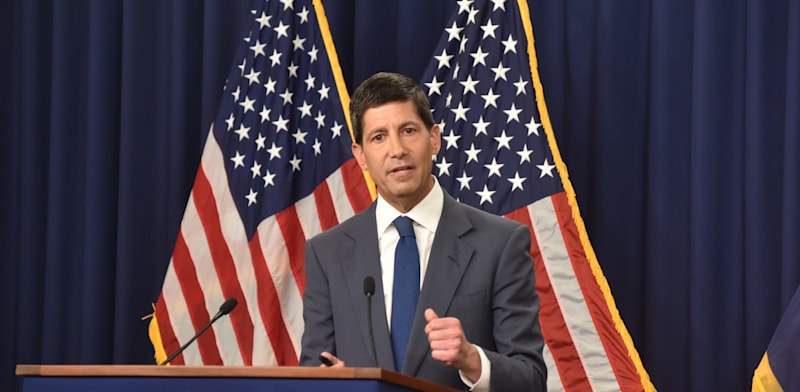
Kevin Warsh will arrive in Jackson Hole this weekend, for the first time since he took the chair of the chairman of the Federal Reserve, as the markets seek an answer to one question: will the Fed continue to fight inflation even at the cost of higher yields – or will it begin to ease the pressure on the debt market.
Warsh’s speech at the annual meeting in Wyoming is already one of the most important events on the investor’s calendar, but this year it is particularly charged: stubborn inflation, war in the Middle East, a national debt that has crossed $40 trillion and a jump in long-term yields on government bonds and a treasury that is trying to calm down, put Warsh in front of an early test of reliability, independence and ability to navigate.
I don’t want to imply
Warsh has previously tried to lower expectations from this type of speech, signaling that he is not interested in “spoon feeding” the markets with hints about the upcoming interest rate decisions. Instead of using Jackson Hole to prepare investors for Fed meetings in September and December, he said he might focus on the “big questions” — productivity, demographics and long-term trends. But the pressure in the markets reduces his room for maneuver and makes it difficult for him to avoid the immediate questions.
The first challenge is inflationary. Warsh has already expressed concern about the renewed pressure on prices, and last year the war in Iran was added to this, which exacerbated the fear of rising energy prices and further infiltration of price indices.
From the Fed’s point of view, this is a classic dilemma: high interest rates help anchor inflation expectations, but at the same time burden activity, make credit more expensive and increase the pressure on the liquidity markets.
The second challenge is no less complex: the wave of sales in the American government debt market, which is worth about 30 trillion dollars, pushed long-term yields to year-long highs. The yield on the 30-year US government bond climbed to about 5.24%, a level not seen since the period before the financial crisis of 2008, and the ten-year yield reached about 4.7%. At the same time, the US national debt crossed the $40 trillion mark for the first time – a combination that sharpens the markets’ sensitivity to the government’s financing cost.
Behind the increase in yields is a combination of pressure factors: concern about the debt and the deficit, uncertainty surrounding the Trump administration’s tax and spending policies, additional inflationary risk following the war in Iran, an increase in yields in other markets, a large supply of corporate bond issues and an increase in the term premium that investors demand to hold long American debt. As the debt expands, so does the question of how much it will cost the government to roll it over in years. the nearest
The situation has already led to intervention by the US Treasury. Finance Minister Scott Besant announced last week that the ministry will double the planned repurchases of long-term bonds, from $2 billion to $4 billion.
The next day Basant clarified that 4 billion dollars is not necessarily the limit. “We are going to increase the scope of the repurchase,” he told CNBC. According to him, the amount can be higher than 4 billion dollars in each series of bonds, depending on the market conditions. Besant described the liquidity in the 30-year bond market as “very bad”.
The relationship with the Treasury
This is where the equation gets complicated for Warsh. The Treasury can make repurchases and change the mix of issuances, but a sustained and significant move to lower long-term yields depends largely on the Fed. The central bank’s balance sheet, which currently stands at approximately 6.7 trillion dollars, and the decision whether to change its size or the composition of the bonds in it can directly affect the yield curve and the financing conditions in the economy.
Currently, there is no indication that the central bank intends to join Besant’s move, and the concerns raised by the Minister of Finance are still far from the background that characterized the extraordinary interventions after the financial crisis of 2008 and during the Corona period. Still, the very opening of the discussion on intervention in the long market sharpens the question of how far the Fed can stay out of the game.
But in Warsh’s case, the question of the relationship between the Fed and the Ministry of Finance is particularly sensitive. According to reports, Warsh and Bennett are friends, have known each other for many years, and now head the two most powerful financial institutions in Washington. Any significant and ongoing attempt by the government to influence yields is likely to put Warsh under pressure to explain where he draws the line between cooperation with the Treasury and maintaining the independence of the central bank.
The end of Fed independence?
This question has been with him since before his appointment. At his confirmation hearing in the Senate, Warsh said that “the Fed’s independence is at its peak in the management of monetary policy.” He emphasized the Fed’s independence in regards to setting interest rates, but did not claim that all areas of the bank’s activity should be completely separated from the government. He mentioned, for example, the supervision of banks as an area where the situation is different.
A proposal put forward by Warsh in 2025 called for re-examining the relationship between the Fed and the Ministry of Finance and updating the Treasury-Fed agreement from 1951. The agreement is considered one of the central foundations of the Fed’s independence.
Warsh argued that when the Fed makes significant changes to its massive balance sheet, the Treasury Department should be given a bigger role in the decision.
There is also a possible conflict between what Bennett wants to achieve and the policies that Warsh has proposed in the past. Warsh spoke of his ambition to reduce the Fed’s balance sheet and shift more of its holdings to short-term bonds. Such a move could put upward pressure on long-term yields, just as Bennett is trying to calm them.
After the Fed meeting in July, Warsh expressed concern about inflation, but did not explain what would lead him to support an interest rate hike.
This is an extremely narrow maneuvering space. If Warsh adopts an overly hawkish tone in relation to inflation, yields may continue to climb and burden the bond market, the government’s financing costs, and credit conditions in the economy. If, on the other hand, she signals a willingness to lower interest rates or use the balance sheet to curb yields, she may feed the fear that the Fed is aligning with the fiscal needs of the Trump administration.
When Warsh takes the stage in Jackson Hole on Friday, investors will be looking for much more than a clue about the next interest rate decision.
For your attention: The Globes system strives for a diverse, relevant and respectful discourse in accordance with the code of ethics that appears in the trust report according to which we operate. Expressions of violence, racism, incitement or any other inappropriate discourse are filtered out automatically and will not be published on the site.