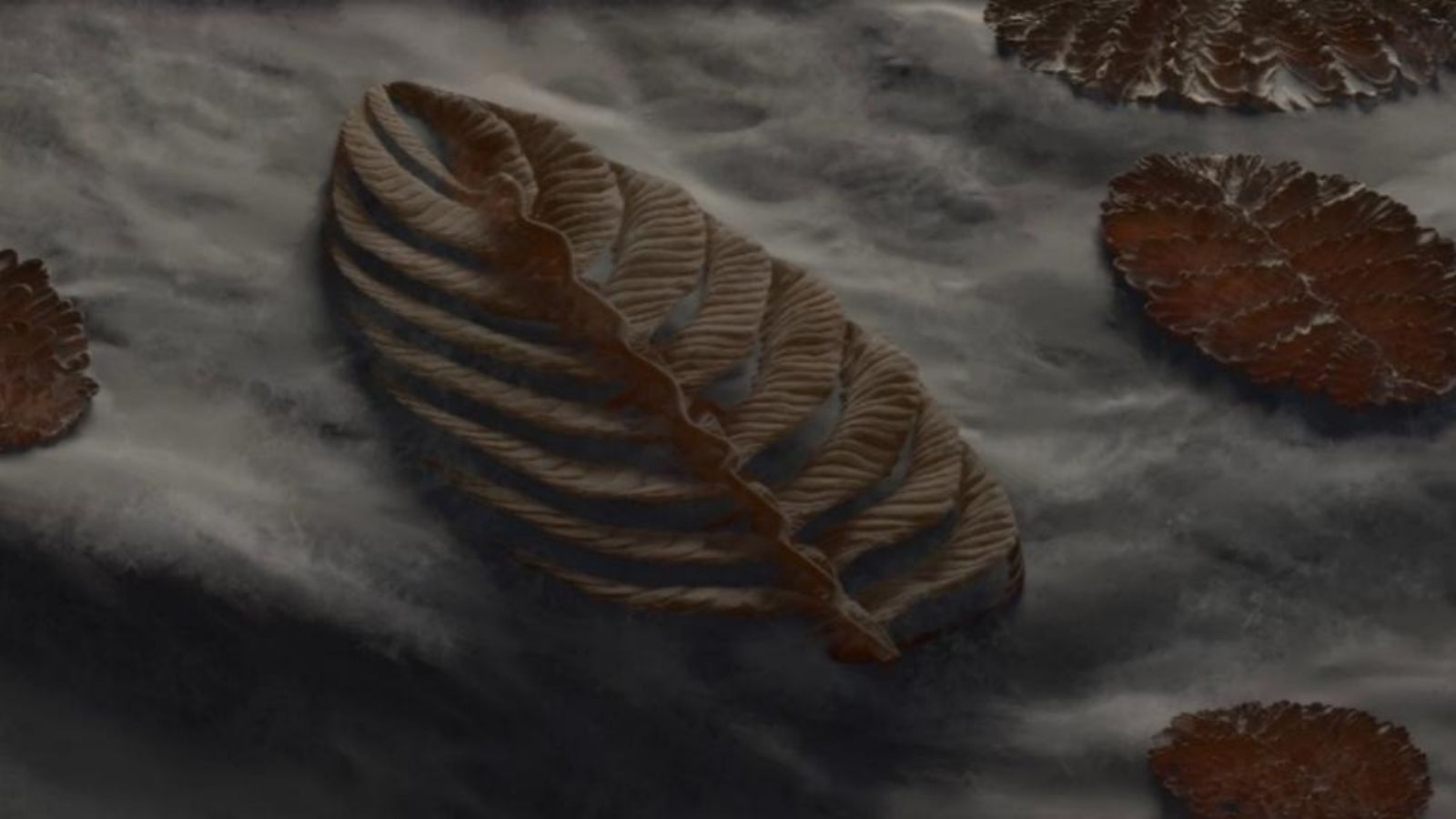
560 million years ago, in the Ediacaran period, when complex life forms first emerged on Earth, a small creature was swept away by an ancient underwater avalanche and buried beneath the sea by sediments that allowed for an extraordinary state of preservation.
This fossil, of one of the oldest known animals, was discovered in a sheep pasture in the Norwegian Arctic, the first major site of its kind in Europe in decades.
The specimen, one Charnia more like a fern than a modern animalwas analyzed by a team of scientists led by the University of Cambridge, in the United Kingdom, and details of the study were published in the journal Palaeontology.
What did the animal that lived 560 million years ago look like?
Charnia it had no mouth, organs or any visible means of locomotion, being essentially a “sac full of slimy substance”, similar to a sessile jellyfish. However, it is believed to be one of the first animals to have existed.
Many fossils from this period in Earth’s history are found as flat impressions, but the new fossil – the first confirmed discovery by Charnia in Scandinavia – is preserved in great detail in three dimensions, something incredibly rare in soft-bodied organisms, especially from this era.
Why is the Charnia fossil so rare?
Thanks to its excellent state of conservation, The fossil was found to contain subtle ridges, or “quillas”, on each of its branches.something that had not been detected in other, flatter fossils.
“When you see the same species preserved in a different way, you start to notice properties that you hadn’t noticed before,” explains lead author Yorick Veenma from Cambridge’s Department of Earth Sciences.
What does this discovery reveal about Earth’s first animals?
Although fossils from the Ediacaran period have been found in different parts of the world, the discovery of a new archaeological site in Finnmark, Norway, suggests that early animals may have been much more widespread than previously thought, and that other unexplored areas may reveal similar surprises.
The area of Norway where the fossils were found is located near a rocky outcrop where evidence of Ediacaran life had previously been observed, such as strange anchoring structures created by organisms as they attached themselves to the ancient seabed.
Why are fossils from the Ediacaran period so difficult to find?
Fossils of these organisms they had never been found until a chance discovery in a sheep pasture revealed a rich fossil deposit. Some rocks broke away from a cliff, cracking and exposing the rock. Charnia fossil.
“As a fossil record, the Ediacaran period presents several unfavorable factors, mainly the fact that most organisms had soft bodies and skeletons had not yet evolved, making them more difficult to preserve,” notes co-author Neil Davies from Cambridge.
Furthermore, this period also lacks an extensive geological record, as fossils need to be embedded in sedimentary rocks, “so if the rocks are less common, they are harder to find. Most Ediacaran fossils come from just a few sites, which makes discovering them in a new location exciting,” explains Veenma.
Along with the fossil of Charnia, the team has identified other parts of the fossilized ecosystem and hopes to continue discovering more. “There could be a whole undiscovered community of these primitive organisms preserved there,” says Davies.
“Weird umbrella-shaped formations, things that don’t correspond to what is known from other places. There is a wide variety of previously unknown species”, he adds.
News
News
News
News
News
News
News
News
News
News
News
News
News
News
News
News
News
News
News
News
News
News
News
News
News
News
News
News
News
News