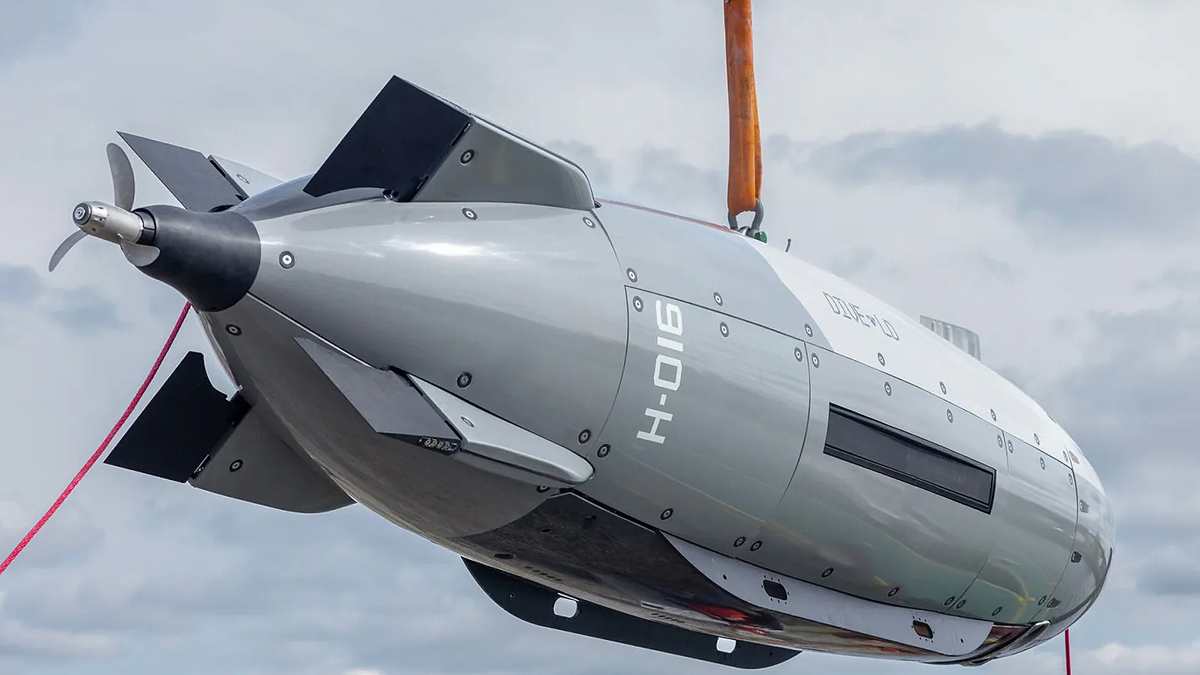
The Dive-LD unmanned submersible may have been on a mission to assist in mine clearance or scout the Strait of Hormuz before falling into Iranian hands.
Iran’s Islamic Revolutionary Guard Corps (IRGC) announced on September 8 that it had intercepted and confiscated the Dive-LD unmanned submersible in an almost intact state after a complex intelligence and combat campaign. IRGC describes this as “one of the smartest and most modern unmanned submersibles” that the US has deployed in the Strait of Hormuz.
Colonel Tim Hawkins, spokesman for Central Command (CENTCOM), the agency in charge of US military operations in the Middle East, confirmed that an unmanned submersible operated by US forces encountered problems while surveying waters in the region to support combat operations.
He affirmed that the submersible is “an old device, does not collect sensitive data, does not carry secret sonar and radar systems”. However, a CENTCOM spokesman did not confirm whether the malfunctioning submersible was a vehicle confiscated by Iran or not.
The Dive-LD submersible in the video released on September 8. Video: IRGC
Anduril, the manufacturer of Dive-LD, initially refused to comment on the information and suggested referring questions to CENTCOM. The company later confirmed that a Dive-LD had gone missing while operating in the Middle East.
“Dive-LD is an expendable autonomous system, meaning the vehicle is designed to operate in dangerous environments and losses are predictable. Dive-LD helps soldiers stay away from the riskiest areas when operating in the sea,” spokesman Anduril said.
This person emphasized that Dive-LD has brought great value with “thousands of hours of operations in months-long campaigns” in the Middle East.
Dive-LD is classified as a large unmanned underwater vehicle (UUV), with a length of 5.8 m, a diameter of 1.2 m and a mass of nearly 3 tons.
The vehicle is built to perform long-term missions in deep seas, capable of operating autonomously for 10 consecutive days and diving to a maximum depth of 6,000 m. A highlight of the Dive-LD is that the outer shell is made using 3D printing technology, allowing for quick customization at low cost.
Dive-LD diving vessel. Image: On the sensor
Dive-LD was originally developed by Dive Technologies, founded in 2018 and acquired by Anduril in 2022. In April 2025, Anduril delivered the first Dive-LD to the US Navy’s Unmanned Submersible Vessel Operation Unit (UUVGRU-1). It is unclear how many vehicles of this type are currently in service with the US military.
The modular design allows operators to quickly configure Dive-LD for a variety of tasks. According to Anduril, Dive-LD can collect information about the operational environment (IPOE), intelligence, surveillance and reconnaissance (ISR), anti-mine, anti-submarine warfare, and high-resolution seabed mapping.
US officials once revealed that CENTCOM used UUVs to clear mines in the Strait of Hormuz and surrounding areas. This type of vehicle can detect and locate mines using a hydroacoustic system, cameras and other sensors, helping operators keep a safe distance from potential threats.
With the ability to operate continuously for 10 days, Dive-LD can be deployed from expeditionary floating base ships outside the Strait of Hormuz, as well as ports of US allies and partners in the Middle East.
Dive-LD prototype in a video released in February 2022. Video: On the sensor
In addition to mine clearance, Dive-LD can survey and map the seabed with high accuracy. This data plays a key role in efforts to determine areas with enough depth for large cargo ships to safely pass through, as the US supports commercial ships entering and exiting the Gulf through maritime routes near the coast of Oman.
Meanwhile, IPOE and ISR missions on the surface and undersea also directly serve the US military’s combat operations in the Middle East, including attacks on oil ships and surveillance of seaports in blockades imposed by Washington.
“Deploying equipment like the Dive-LD in the Middle East campaign gives the US a valuable opportunity to test new UUV capabilities, as well as build tactics and operating procedures. These factors can play a decisive role in high-intensity conflicts with peer opponents in the future,” Joseph Trevithick, military editor War Zone, comment.
In addition, Dive-LD is also the foundation for Anduril to develop a large UUV with outstanding capabilities called Ghost Shark. This is a militarized version of Dive-XL, the successor product line to Dive-LD.
The Dive-LD fraud ship that Iran announced it had captured on September 8. Image: IRGC
“Iran’s capture of an intact Dive-LD is a remarkable event, even though the vehicle’s design is not new and it is not believed to be carrying any sensitive equipment,” Trevithick said.
Although designed in a way that can accept losses when operating, Dive-LD is still a modern, advanced system that the US military is operating. Details about Dive-LD’s capabilities and limitations will certainly attract the attention of both Iranian experts and many other parties.
“It is unclear how the US military tried to find the Dive-LD. However, this vehicle was not destroyed before or during the Iranian recovery process, showing that US forces completely lost track of it,” Trevithick noted.