President of the European Central Bank (ECB) Christine Lagarde said they are ready to raise interest rates even if eurozone inflation only increases in the short term.
The ECB last week kept the reference interest rate unchanged at 2%, but warned that prices could skyrocket. Officials are therefore discussing a scenario that would force them to raise interest rates to prevent prices from continuously increasing.
“If the current shock causes inflation to exceed the target, even if not for a long time, a moderate policy adjustment may still be necessary. If we do not act, it is difficult for people to understand why there is no reaction,” Ms. Lagarde said at a conference in Frankfurt on March 25.
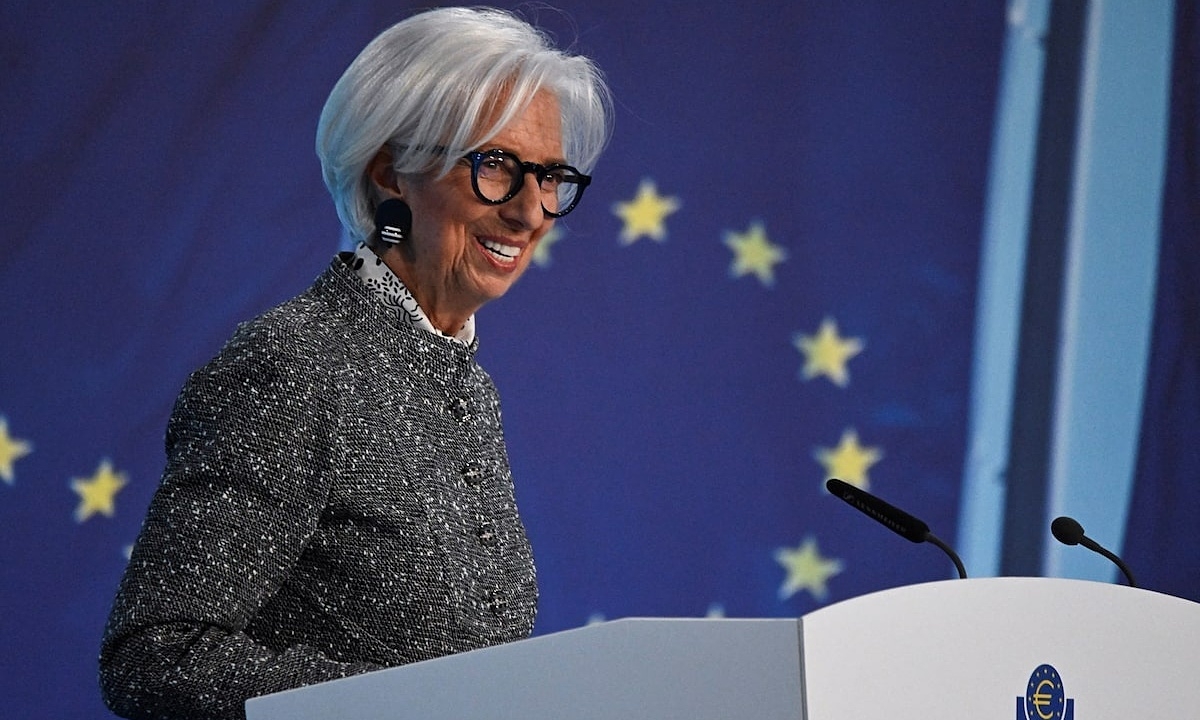
Christine Lagarde at the ECB headquarters in Frankfurt (Germany) on March 19. Image: Reuters
Before the conflict in the Middle East broke out late last month, euro zone inflation had fallen below the ECB’s 2% target. However, by February, this figure showed signs of increasing, up to 1.9%. The war caused the Strait of Hormuz to be almost blocked, causing global oil and gas prices to increase sharply, upsetting inflation forecasts in Europe.
With the base scenario, the average forecast inflation for this region this year is 2.6%, 2% in 2027 and 2.1% in 2028. However, in a more unfavorable scenario, the ECB warns that inflation could reach 4% this year. In the most severe scenario – assuming a stronger and longer-lasting energy price shock, along with major damage to the Gulf region’s energy infrastructure, inflation could exceed 6% in early 2027.
“If expected inflation deviates significantly and over a long period of time from the target, the policy response must be strong enough or long enough,” Ms. Lagarde explained. On the same day, ECB chief economist Philip Lane said they were monitoring important indicators such as forecasts of business price increases and newly recruited labor wages.
Analysts say there are signs that the Middle East conflict is weakening business confidence in Europe. The March Purchasing Managers’ Index (PMI) published by S&P Global on March 24 showed that manufacturing and service output in the eurozone’s private sector fell to a 10-month low.
https://notes.bolha.tools/s/xtcY5JgZ9
https://md.roflcopter.fr/s/U31wdYnYN
https://hedgedoc.obermui.de/s/43eLK_isQr
https://lovable.dev/@lorilogandds
https://disqus.com/by/seoballaratau/about/
https://www.mapleprimes.com/users/seoipswichcomau
https://hedge.novalug.org/s/ZIifW1nZdS
https://datos.estadisticas.pr/user/soporte-sap
https://www.localmote.com/ocemida.html
https://hedge.novalug.org/s/HsMgDKtpVr
https://trueen.com/business/listing/lori-logan-dds/697373
https://www.hulkshare.com/seoballaratau
https://menwiki.men/wiki/Praga_Jakby_regionalny_Brama_polskiego_wczasowicza_do_czeskiej_siedziby_wadz
https://notionpress.com/author/1485740
https://notes.gutocarvalho.net/s/RQv9ytTDQ
https://hedge.novalug.org/s/B0QeFjn9hA
https://ocemida.mssg.me/
http://dubizzle.ca/index.php?page=user&action=pub_profile&id=199833
https://md.picasoft.net/s/aJMSCIATe
https://pad.janniklorenz.de/s/Kwl6ICXHJ
https://md.picasoft.net/s/I2HLRxADN
https://doks.komun.org/s/VVxJVDjCW
https://forum.ct8.pl/member.php?action=profile&uid=116928
https://hedgedoc.envs.net/s/peNccpAbH
https://codimd.carpentries.org/s/fIWkljKcC