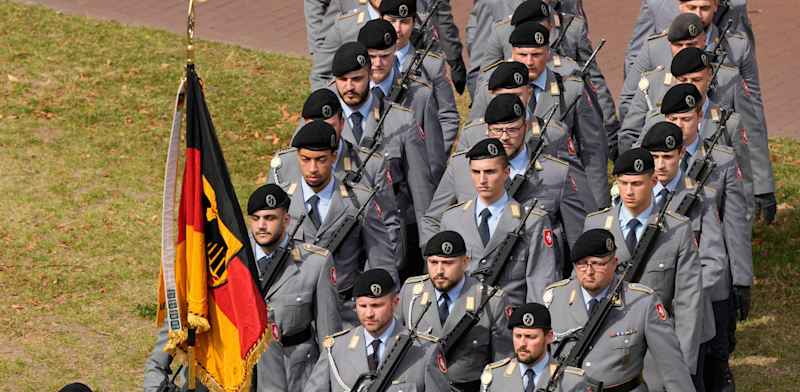
The current German government wanted to gradually prepare the public in the country for the possibility of war. As the Germans strive to rebuild the most powerful army in Europe, against the background of the Russian threat and after years of neglect and degeneration, the question of who will man the ranks of this army is more sensitive and gets ignored. This was the reason why the government avoided re-legislating the mandatory conscription that was customary in Germany as part of a reform it passed last fall, and chose the “Swedish model” of conscripting volunteers suitable for service according to the needs of the army every year. This reform, which is also very significant in terms of Germany, came into effect at the beginning of the year.
But in the last few days, the country’s media found out that in the text of the new package of laws on the subject, a section was inadvertently inserted that simulates that Germany is already in the midst of a military conflict: a requirement for every German man of possible military service age, from the age of 17 to the age of 45, to ask the government for “special permission” if he intends to leave the country for more than three months, thereby deducting himself from the potential for national conscription. So far, this section has appeared in the law regarding military service, but it states that an application for approval will only be required in the case of total war or a national emergency. In the new law passed last year, which entered into force on January 1, 2026, this reservation was removed.
The discovery drew headlines in the country’s media over the weekend, and an appeal to the Ministry of Defense, in order to understand whether indeed German citizens should now seek approval from the military regarding their future plans. The answer was that it was a mistake and that a regulation would be enacted as quickly as possible clarifying that the section would not be valid as long as there is no compulsory conscription law for the entire population in Germany. The Ministry of Defense even clarified that the law with similar wording also appeared during the Cold War, but that it was not enforced.
The blame for militarization
The left-wing party Die Linke accused the government of an accelerated militarization of German society, but government officials clarified that the party was a partner in the process of publishing the bill, its discussions and finally its approval in parliament, so it is mainly an embarrassment about the unprofessionalism of the legislative process in Germany, an area in which the country is particularly proud.
But at the same time, the discussion also floods the future question about Germany in the war. So far, the Germans have blown the budget, spending hundreds of billions of euros a year on armaments and warning of a confrontation with Russia “by the end of the decade.” They formed a special regiment sent to strengthen the defense of the Russian-Lithuanian border, but in practice, the reality of life for the Germans did not change in terms of security. The headlines about “special authorizations” illustrate for many Germans the future reality, especially in a situation where the US threatens to dismantle NATO and stop providing a security guarantee to Western Europe.
The plans at the moment are to increase the German army from 180 thousand soldiers today to 260 thousand in about a decade. A general mandatory conscription for a year, as was the case in the past, will not be effective according to the experts in building a professional and functioning army. In these force orders, the enacted obligation is to transmit data on the desire to enlist and the health status of all 18-year-olds every year, for example, and then select the appropriate amount for the army’s expansion plans. This is actually the essence of the reform passed by the current government.
In Germany, it is hoped that the gradualness of the program and attractive salary packages, as well as advertising campaigns that have begun to appear with increasing frequency in favor of permanent service in the “Bundeswehr”, will change public opinion about the possibility of military service. As of today, according to a survey by the European Research Institute FPRI, only 27% of Germans are “ready to fight for their country”. This is one of the smallest classes in Europe. Only in Italy and Slovakia is the figure lower (25%). The EU country where willingness is the highest is Sweden (66%) followed by Finland (64%). Meanwhile, the current upheaval further demonstrates the unwillingness of the Germans to even think about mixing the military with everyday life.
For your attention: The Globes system strives for a diverse, relevant and respectful discourse in accordance with the code of ethics that appears in the trust report according to which we operate. Expressions of violence, racism, incitement or any other inappropriate discourse are filtered out automatically and will not be published on the site.
https://www.thenewangel-nh.co.uk/7-ways-other-countries-do-things-better/
https://bandori.party/user/702705/AnatolyShcherbakov/
https://whoosmind.com/post/396018_profesjonalny-polski-przewodnik-po-magicznej-pradze-przewodnik-mowiacy-po-polsku.html
https://www.paper-help.org
https://gettr.com/post/p3ymnoo0c49
https://flibustier.top/user/stopopera80/
https://www.fanficoverflow.com/profile/view/81388
https://moiafazenda.ru/user/combbirch93/
https://www.donbosco-magazin.eu/Eltern/Familienleben/Arbeiten-mit-Sinn
https://blogfreely.net/alejandroerickson/polski-przewodnik-odkrywa-prage-dla-turystow
https://bandori.party/user/702713/VadimLukin/
https://www.deviantart.com/cartify/art/Zwiedzanie-Pragi-w-jezyku-polskim-wygodnie-1315165436
https://www.notariosyregistradores.com/web/forums/usuario/MaximScherbak/
https://www.divephotoguide.com/user/YuryLapin
https://qr.ae/pF8f9d
https://www.mixcloud.com/catsupthread5/
https://www.asianfanfics.com/story/view/1714734
https://www.penana.com/user/339350/demarcusgdrodgers
http://jobboard.piasd.org/author/manxmosque51/
https://www.thenewangel-nh.co.uk/is-your-smart-home-too-smart/
https://www.reverbnation.com/page_object/page_object_blogs/artist_9754461
https://quicknote.io/7d765250-21f0-11f1-9d38-e5c33f9012b7
https://www.ganjingworld.com/post/1idlpjvusaf4RBi45TTv40knZ1uo1c
https://jmp.sh/DEruMdUR
https://chat.qwen.ai/s/deploy/t_9c1c3ca1-0286-4c57-b233-75e6c30fb792