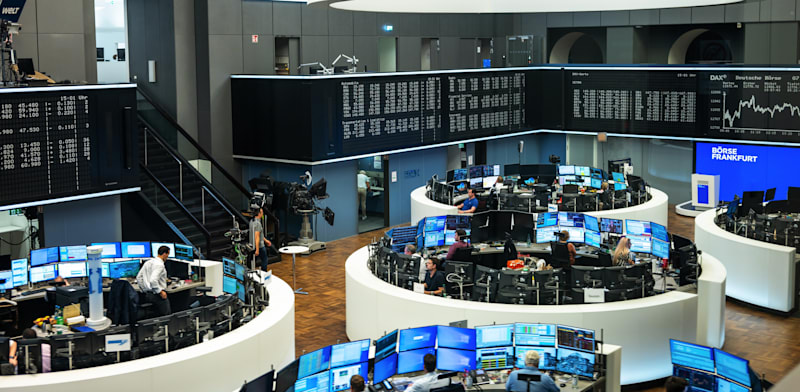
Trade overview: current reports, trends, indices, stock prices, bonds, foreign exchange and commodities and analyst recommendations
15:42
bank G.P. Morgan Chase Reported higher-than-expected profit and revenue in the first quarter, when Wall Street activity surged and the American economy remained stable.
The largest bank in the US reported a profit of 16.5 billion dollars, or 5.94 dollars per share, compared to 14.6 billion dollars in the same period last year. Analysts were expecting earnings of $5.45 per share. Revenues increased by 10% to 49.84 billion dollars, compared to a forecast of 49.13 billion dollars.
The results of the banks this week shed light on the state of the economy since the outbreak of the war in Iran at the end of February. Wall Street enjoyed record trading fee income amid high volatility in markets under President Trump, while the first quarter was characterized by a surge in trading activity.
J.P. Morgan reported that investment banking fees rose 28% in the first quarter, thanks to activity in the capital markets and an increase in transaction advisory revenues, which jumped 82% to $1.27 billion. The bank’s markets division recorded record revenues of $11.6 billion, although the bank noted that it earned less than expected from interest rate derivatives trading. Business customers increased their deposits in the bank by 12% compared to last year, to the level of 1.2 trillion dollars.
The bank’s chief executive, Jamie Dimon, said in a statement on Tuesday that the US economy had been resilient recently, thanks to consumer and business spending as well as debt repayment, but noted that uncertainty was increasing.
“There is a complex and growing array of risks, such as geopolitical tensions and wars, energy price volatility, trade uncertainty, large global fiscal deficits and high asset price levels,” Dimon said. “While we cannot predict how these risks and uncertainties will ultimately develop, they are significant and emphasize why we are preparing for a wide variety of scenarios,” he added.
It is worth noting that the bank lowered the net interest income forecast for the entire year 2026, a key driver of banks’ profits, from $104.5 billion to approximately $103 billion.
15:35
Amazon Acquires the satellite operator Globalstar in a deal worth about 11.6 billion dollars, a move that will strengthen its efforts to build an independent satellite array.
According to the announcement, Amazon is offering Globalstar shareholders a choice between $90 in cash per share, or 0.32 Amazon shares at a maximum value of $90 per share. The offer reflects a 23.5% premium over Globalstar’s closing price on Monday. The deal is expected to close in 2027.
Bloomberg reported earlier that Amazon is in advanced talks to acquire the company, and trading in Globalstar stock was suspended following the announcement. Amazon shares rose 1.1% before the opening of trading in New York.
Amazon is developing a network of low-orbit (LEO) satellites called Amazon Leo, with the aim of competing with Elon Musk’s SpaceX. Starlink, SpaceX’s satellite unit, has more than 10 million active customers and about 10,000 satellites in orbit, and is expected to generate more than $9 billion in revenue this year.
The satellite internet sector is growing rapidly, especially in remote areas, but Amazon is lagging behind the goals it set for itself to deploy more than 7,700 satellites. The company even appealed to the FCC to postpone or extend the deadline for placing 1,600 satellites until July.
15:05
Trade in Europe continues to be conducted in a positive trend. The DAX index jumps by about 1.1%, the FTSE advances by about 0.1% and the KAC adds about 0.7% to its value.
In Wall Street futures, the positive sentiment is getting a little stronger. As of now, the Dow Jones is expected to rise at the opening by about 0.1%, the S&P 500 is expected to climb by about 0.3% and the Nasdaq is expected to jump by about 0.5%.
14:20
The equipment company for chip production testing Camtech Acquires an Israeli start-up company: Camtech announced the acquisition of Visual Layer, an AI company from Tel Aviv that specializes in visual analytics. According to Finder data, the acquired company was established in 2022 and has so far raised $7 million. Camtech did not report the scope of the transaction.
Rafi Amit, the company’s CEO, said that “AI is a strategic goal for Camtech, and the purchase of Visual Layer is a significant leap forward in the depth and pace of our development. Visual Layer’s technology and team are a natural continuation of what we have built at Kamtec, and we are sure that this acquisition will allow us to respond to the ever-increasing demands of the market today.”
14:00
The Danish pharma giant Novo Nordisk Climbs in early trading by over 3%, after announcing a collaboration with the OpenAI company.
“There are millions of people living with obesity and diabetes who need treatment options, and we know there are treatments still waiting to be discovered that could change their lives,” said the company’s CEO, Mike Dostader. “Incorporating artificial intelligence into our daily work gives us the ability to analyze databases on a scale that was previously impossible, identify patterns we couldn’t see, and test hypotheses faster than ever before.”
J. times. Morgan the largest bank in the world in terms of market capitalization, published a little while ago its financial results for the first quarter, which exceeded the analysts’ forecasts in the top and bottom line. The bank reported a profit of $5.94 per share on revenues of $50.54 billion; LSEG data shows that analysts were expecting earnings of $5.45 per share on revenue of $49.17 billion. CNBC reported that the stock initially reacted with an increase, but now it is down in early trading by nearly 2%, against the background of the fact that the bank lowered its net interest income forecast.
Also the share of the investment bank Wells Fargo is now down nearly 3% in early trading, after its financial results disappointed investors, with revenues of $21.45 billion, slightly below the analyst consensus.
12:45
The positive trend in Europe continues, against the background of optimism for the renewal of negotiations between the US and Iran in Islamabad. The DAX index rises by about 0.9%, the FTSE advances by about 0.1% and the KAC adds to its value by about 0.6%.
At the same time, the futures contracts on Wall Street are also now trading at higher rates. For now, the Dow Jones is expected to open the day with an increase of about 0.1%, the S&P 500 is expected to climb by about 0.2% and the Nasdaq is expected to rise by about 0.4%.
11:15
The increases in Europe continue. The Dax index jumps by about 1%, the FTSE advances by about 0.4% and the KAC adds to its value by about 0.6%.
Oil prices continue to fall and are now trading below the $100 mark. Currently, Brent crude is trading around $98 per barrel, while US crude is trading around $97 per barrel.
10:05
After the gains on Wall Street last night, trading in Europe opened with a positive trend. The Dax index rises by about 1%, the Potsi advances by about 0.2% and the KAC adds to its value by about 0.3%. Reuters reported a little while ago that US and Iranian negotiating teams may return to Islamabad this week to continue talks, according to four sources familiar with the matter.
9:00
Asia
Asian stock markets are registering significant gains this morning, reflecting the positive sentiment on Wall Street recorded last night. The Tokyo Stock Exchange jumps by about 2.3%; The Seoul Stock Exchange jumps by about 3, after a little while ago it recaptured the 6,000 points mark; The stock markets in Hong Kong and Shanghai are climbing by about 0.3%. At the same time, oil prices fall by up to 2.5% and trade below the $100 per barrel mark.
Wall Street
On Wall Street, the leading indices opened the day with a drop, but ended it in bright green, after President Trump confirmed in a conversation with journalists that at the same time as the naval blockade of Hormuz, negotiations with Iran are still underway. “The Iranians called us, the right people – they want to work on an agreement,” he said.
On the night between Monday and Tuesday, US Vice President JD Vance said in an interview with the Fox network that the next steps in the negotiations between the US and Iran depend on Tehran. “Whether we hold more talks, whether we end up with a deal, I really think the ball is in the Iranians’ court, because we put a lot on the table,” Vance said.
At the end of the trading day last night, the Nasdaq jumped by about 1.2%, the S&P 500 rose by about 1%, and the Dow Jones added to its value by about 0.6%. All sectors of the S&P 500 ended the day in the green, with the gains led by the technology and financial sectors, which both jumped by about 1.7%. The only two sectors that ended the day In negative territory are those that are traditionally considered defensive: the infrastructure sector (-1.2%) and the basic consumer goods sector (-1%).
In general, the entry into force of the US naval blockade of the Strait of Hormuz at 17:00 did not trigger a significant reaction in the markets, nor did Trump’s threat to destroy any Iranian ship that tries to violate it. James Ragan, co-chief investment officer at DA Davidson, told the financial website MarketWatch that investors have regained some of their confidence that tensions between the US and Iran will not escalate in the immediate term. “I think there is a feeling that the move to try to close the Strait of Hormuz is still just a negotiation tactic, trying to bring everyone back a little closer to the table.”
Among the technology stocks that stood out yesterday, you can find some of the main names in the field of AI, among them Microsoft , Palantir , oracle andIntel .
Shares of cloud computing giant Oracle jumped sharply after showing off some of its AI capabilities at its Customer Edge Summit. CNBC reported that the company highlighted its AI-driven platform, Oracle Utilities Opower, and noted that it helped customers in the home electricity sector save $369 million in 2025. Share Intel Last night recorded its ninth positive trading day in the number, with a cumulative increase of 58% in the week and a half, and according to CNBC it is on its way to its best streak since at least the 1970s.
Major stocks in the fields of software and cyber security, which suffered significant pressures at the end of last week, against the background of the new developments of the AI company Anthropic, also registered a considerable recovery, among them Palo Alto , Now service , Crowd strike and more. The hedge fund IGV, which tracks software stocks, recorded a considerable recovery and climbed about 5.4%, although it is still trading at its lowest level in about two years.
Jose Torres, senior economist at Interactive Brokers, told Marketwatch that technology stocks overperformed, due to “the weakening of economic fundamentals that weighs on the involvement of buyers in most other stock sectors.” Khoza explained that “market participants want to be shareholders in companies that can survive an environment of high interest rates, rising oil prices and a cyclical slowdown”, noting that the major technology stocks met these criteria.
Despite the strong performance of the financial sector last night, a share Goldman Sachs decreased following the first quarter reports it published; This, despite the fact that its financial results exceeded analysts’ forecasts. According to CNBC, the reason for the decline in the stock lies in the fact that trading in the bank’s Fixed Income, Currencies and Commodities (FICC) division amounted to $4.01 billion – a figure significantly lower than the expectations of analysts polled by FactSet, which was $4.92 billion.
US debt market
In the American debt market, government bond yields opened the trading day with slight increases, but following Trump’s words, the trend reversed, and they ended the day with slight decreases. The ten-year yield decreased by more than 2 basis points to 4.29%, while the two-year yield decreased by a similar rate to 3.77%.
This morning, yields continue to fall: the 10-year yield is down about 2 basis points to 4.27%, while the two-year yield is down 1 basis point to 3.76%.
The commodity and currency markets
The shekel, which hit a 30-year high at the weekend (following the temporary ceasefire and the announcement of the negotiations with Lebanon), strengthened by about 0.4% against the dollar yesterday, at the same time as the increases recorded on Wall Street, and this morning its value stands at NIS 3.03. The dollar index (DXY), which measures its strength against a basket of selected currencies around the world, is down about 0.1% this morning.
The failure of negotiations between the US and Iran and the blockade imposed by the US on the Strait of Hormuz yesterday led to renewed increases in oil prices. At first, oil prices jumped sharply and crossed the $100 per barrel mark, but later in the trading day, after Trump’s words, they locked below it. Brent crude ended the day around $99 a barrel, while US crude ended the day around $98 a barrel. This morning, oil prices are down by up to 2.5%. Brent crude is trading around $98 per barrel, while US crude is trading around $96 per barrel.
At the same time, gold weakened slightly yesterday, although it is considered a “safe haven” in turbulent times. The renewed rise in energy prices leads to expectations that there will be no interest rate cuts in the US soon – and a high interest rate environment weighs on gold prices. This morning, the price of gold is up about 0.6% and is trading around $4,770 per ounce.
In the crypto market, Bitcoin is up nearly 5% this morning and climbs above the $74,000 mark – its highest level in about three weeks.
Macro
Today at 15:30 Israel time, the producer price index for the month of March will be published in the US, which will reflect the effects of the war against Iran on inflation at the wholesale level. According to Marketwatch, the median forecast is for a sharp monthly increase of 1.1%.
Recall that the consumer price index for the month of March, published last Friday in the US, indicated an increase of 0.9% – the largest monthly jump since June 2022. Thus, the annual inflation rate rose to 3.3%, well above the Federal Reserve’s price stability target (2%). Alexandra Wilson-Elizondo of Goldman Sachs commented on the price index and told CNBC that “it may be a given The best inflation we’ll see for a while, because it may only partially reflect the full intensity of the conflict with Iran.” According to her, “the Fed has room to be patient, and every good reason to do so.”
Last Friday, the University of Michigan’s consumer sentiment index for the month of April was also published, which fell sharply to 47.6 points – the lowest figure of the index ever, since its publication began about 50 years ago. But Meitav’s chief economist, Alex Zbzinski, noted in his weekly review that the American consumer weakened even before the war, and that current data from the US indicate that the “traditional” economy (outside of investments in the technology sector) is on the decline.
“In the last four months, real consumer spending has almost stagnated; cyclical consumption is notable for its weakness,” he writes. At the same time, the current consumption of the products has shrunk since August last year due to “the worsening of the consumer’s financial situation and the consequences of the tariffs”, adds Zabrzynski, who also points out the erosion of household incomes and damage to the purchasing power of the American consumer. The weakness in income “reflects trends in the labor market, where the weakening demand for workers works to restrain wage increases,” he writes. Another influencing factor, according to him, is the stock market, which “stopped generating profits for investors” in recent months. “All the influences and the war led to a situation where consumer sentiment dropped sharply to its lowest level ever.”
https://justpaste.me/6TQJ1
https://telegra.ph/From-HODL-to-Spend-The-Emerging-Shift-Toward-Real-Crypto-Usage-03-28
https://network.musicdiffusion.com/read-blog/87483
https://www.leenkup.com/read-blog/120593
https://connect.usama.dev/blogs/72809/The-Evolution-of-Crypto-Moving-Beyond-Holding-Toward-Everyday-Utility
http://jobhop.co.uk/blog/182091/from-holding-to-using-why-coinpay-reflects-the-next-stage-of-crypto-adoption
https://talkfever.com/blogs/106993/Crypto-s-Next-Chapter-Transitioning-from-Holding-to-Everyday-Use
https://www.molecularcloud.org/p/from-holding-to-using-the-next-stage-of-crypto-adoption
https://wemixplay.com/community/YMIR/12/566
https://bots.ondiscord.xyz/lists/LqUPCp_tU