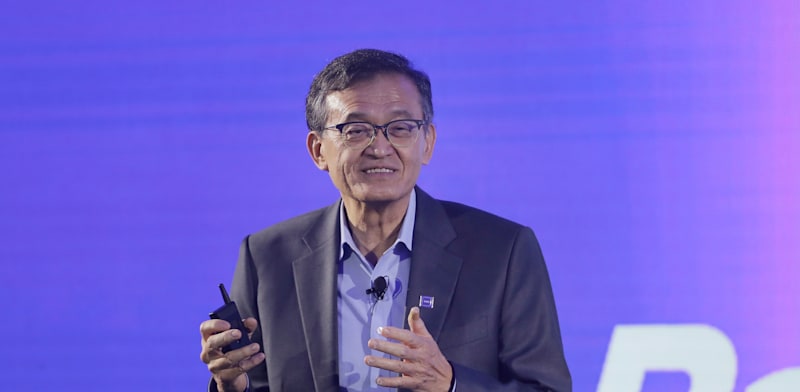
Last Tuesday evening, 85,000 Intel employees around the world connected to a virtual meeting that took place on Zoom to keep up to date with what was happening in the company directly from CEO Lip Bo Tan. The CEO walked around the stage, proud as a peacock, with a microphone in his hand and he listed the latest achievements: an increase in revenues, an increase in profitability, an acceleration in sales of artificial intelligence (AI) server chips, and the future collaborations with Google and Elon Musk.
The image he used – “a basketball team where everyone depends on everyone else” – is well known to employees from all his previous speeches. As on the floor, at Intel every employee has to take good care of his territory – maintain profitability, take care of operational efficiency, work only on what is important. Only in this way, within a small and lean team where everyone knows their role, will it be possible to take the holy grail – to penetrate the core of the AI industry and produce chips for the largest companies.
Since March, the 66-year-old Tan has turned Intel from a sinking ship into a company that is growing in the right places – selling AI processors to server farms; One that signed agreements with Google, Tesla and possibly soon with Apple as well, and whose stock grew at once from an all-time low – $20 to around $90 in just eight months – an all-time high.
Fewer meetings, fewer emails, fewer grades
For many of Intel’s employees in Israel, the company’s amazing recovery begins with Tan, a nuclear engineer by training and one of the veteran managers in the chip industry who headed the chip design giant Cadence for 17 years, and even served as a member of the Intel board of directors before resigning in protest at the actions of the previous CEO, Pat Gelsinger.
One of the first things he talked about upon entering his shoes was the rotten organizational culture at Intel: a proliferation of organizational politics, bureaucracy, dispersion and lack of focus and in general. Too much talk and less action.
Tan’s first move included the mass cancellation of company meetings, increasing the number of working days from the office and plowing deeply into the fleet of middle management layers in the organization that absorbed the bulk of the wave of layoffs about a year ago. Today, many employees believe that these moves, which received widespread support, are the ones that brought about the change of trend in the battered chip company.
3 points on Lip Bo Tan
1. Lip-Bo Tan has been the CEO of Intel since 2025
2. He is 66 years old and has a background as a nuclear engineer
3. He previously headed the chip company Cadence for 17 years
“When Lip-Bo took office, the emails from senior management members ran out to middle management members who formulate something of their own to the employees,” says a veteran employee of the company. “Lip-Bo writes an email to all the employees and that’s the end of the matter. There are no more things that go through filtering and processing, but the things seep through to all the employees now and immediately. Everyone knows where the ship is headed without filters and without compartmentalization.”
Another veteran employee explains the differences in approach between the two managers: “Gelsinger may have had good ideas, but he didn’t know how to demand them from his employees, monitor them and be tough with them, if things didn’t progress as he wanted. Intel used to be a company where they talked a lot, moved many parts at once and ‘spreaded’ the time.
“Tan is tougher and more focused. The company under him focuses on fewer products, defines what’s important and what’s less, and only works on what’s important. If it’s not necessary – we don’t do it, but once you’ve committed to meeting the schedule, you’re expected to meet it, even if you still have to pour money into it.”
According to another employee who spoke to Globes, the number of meetings has also been reduced. “There are whole days without meetings, it’s something that didn’t happen here before,” he says, “and I find myself completing tasks in corridor conversations that I used to complete in a series of emails and meetings. After the layer of middle managers was lowered, communication is shorter, the atmosphere is business-like and effective. It is true that the employees come to the office three or four days a week, but it creates an atmosphere of trust.”
About 30 thousand jobs were cut within a year
In just over a year since Tan took office, Intel’s workforce has also been reduced dramatically in line with the new spirit: from a company of 109,000 people, as of the last quarter, the company had only 85,000 people, a decrease of 22%. In Israel, too, Intel returned to a much more modest deal scope.
At its peak, Intel employed about 12,000 workers here at the development centers in Haifa, Petah Tikva, Jerusalem and at the factory in Kiryat Gat. Today, the company is down to just over 8,000 employees, according to LinkedIn. That is, a 30% decrease in the number of employees. Intel Israel now has a similar number of employees as it last employed in 2012, but since then it has acquired three companies for many billions – including Mobileye, HaBana Labs and Granulite.
Until a short time ago, everything looked different
Many of the employees who remain at Intel, including veterans who have been employed by the company for decades (the average seniority per employee is 7.4 years), still carry the scars of the difficult decade that passed over them at Intel in the company. Last year, Intel’s value reached an all-time low, when it was only about 80 billion dollars.
The company’s commercial and managerial failure, which began already in the days of Paul Otellini, the company’s veteran CEO who decided to give up Steve Jobs’ iPhone as a customer and distanced Intel from the mobile revolution, continued with the company’s loss of advantage in the chip manufacturing industry in favor of the competitor TSMC. Along the way, Intel made huge failed acquisitions and turned from a profitable and growing company to a shrinking loss-making company Gradually and actively in less interesting markets such as personal computers or server management.
The crisis came to the attention of the Israeli public precisely thanks to the cutbacks that at the end of 2024 also led to the expropriation of the free coffee corners in the company’s offices and the demand from the employees to pay for every cup of coffee they make for themselves. Many employees remember this embarrassing incident as a brief incident: within hours the network was flooded with memes mocking the company, all due to a lack of understanding between the management of the development center in Israel and Gelsinger as to how the coffee budget should be saved.
Within a week, the coffee corners were returned and today, an employee reports, “it’s hard to walk in the office without falling on a coffee stand with cakes, cookies, delicacies and cold drinks.” But the embarrassing event was also burned into the employees’ minds as a symbol of poor management. “Intel has a fleet of private planes that flies management members from site to site. It was indeed frozen due to the cuts, but instead the managers paid a fortune for plane tickets, and the company paid dearly for a petty insistence. The coffee event was symbolic, but it conveyed distress and caused people to leave,” explains the employee.
Later, other programs were cut, such as the leasing program, in which Intel was famous for having a particularly large vehicle fleet, but some of the expenses that were previously diverted to the operation and maintenance of the fleet were directed to the salaries of the employees. In addition, the annual bonus was affected, when it was only 1.4 salaries on average, lower than the average of 2-3 salaries. There were also rumors about cutting the annual sabbatical benefit (a month and a half off once every seven years), but this did not happen in the end.
Since the beginning of 2026, the stock has jumped more than 150%
A year later, those employees who remained at Intel Israel received an 8.2% upgrade in the base salary which increased to 10% along with the allowances and social allowances, along with grants. Ironically, all these came exactly one year after the coffee corner incident.
But there seems to be one component in the package of conditions for Intel employees that has suddenly made them the object of envy in the industry against all odds. The meteoric growth in Intel stock – 153% since the beginning of the year and 355% during the last year – from a low of $20. At once, all the downtrodden workers became profitable on paper.
The biggest margins are precisely the new employees, those who bet on Intel precisely in its most difficult hour – whom it had to compensate for the low share price by giving a larger amount of shares. Intel offers a stock package at a rate of about 12% of the average salary package for a hardware engineer in Israel, which is estimated to be around NIS 5,000 per month, according to the Levels website, which compiles the salary reports of thousands of employees of the world’s largest technology companies.
Those who received the same shares a year ago, were able to receive an especially high number of shares that Intel offered to reach the NIS 5,000 mark per month. But with the increase in the share price, these are now worth NIS 17,200. However, the new employees will not be able to enjoy the full increase in the value of the share since most of the shares were given to them under a block for a period of two or three years, when every quarter a certain amount of shares are released to them that they can exercise. This is to encourage them to persist in working for the company for an extended period of time.
“Many long-time employees suffered when the stock price was at $20 because a significant portion of their salary component dropped to a low,” says a source privy to the details. “Intel compensated them with a package of shares at a value of 30 or 40 dollars, but when the stock did not rise for a long time from the low, there was quite a bit of despondency among the employees. The recent rise makes it possible to bring in better talent, especially when you compare it to what your friends at Nvidia did.”
According to an employee at Intel, there are even WhatsApp groups where interventions were held between the employees that the stock would reach 75 and 150, even when it was only 25 dollars. “But there was faith that the price would get there because we see that we are doing the right thing,” he says. “Not many employees sold shares during this entire period, most of them held them, and continue to hold them with the expectation that we will reach profitability in 2027. If this happens, Intel’s situation will change fundamentally.”
Another employee from one of Intel’s development centers in Israel adds that “there are quite a few employees who saved 15% of their salary every month for the stock purchase plan, the maximum possible. There are many who started doing this when the stock was at $20 or $30 and today they are reaping the fruits of their faith in Intel.”
However, the workers maintain proportion. “The low of $20 per share did not really represent the company or its potential, even then it was a profitable company with assets and customers. Now everyone is happy about the jump, but know that it can change at any moment.”
Intel Kiryat Gat / Photo: Courtesy of Intel Israel
The company clarifies: we were not surprised by the results
“We live it and are not surprised by what everyone is seeing now,” says a company employee. “The three latest Intel chip cores were developed in Israel – and Israel generates a lot of money that enters the company from important directions, such as artificial intelligence.”
The development center not only develops three important chip cores, but also the old Intel manufacturing plant in Kiryat Gat, Pub 28, is connected to the production of Intel’s fastest growing processors, the Xion core processors for managing server farms specializing in AI. It is not a graphics processor, but a standard core processor that became necessary due to the rise of AI agents and the transition to training language models to operate them.
In this field, the production plant in Kiryat Gat has become critical for Intel worldwide. He is responsible for the production of the previous generation of Xeon 4 processors, Sapphire Rapids, and the next generation, Xeon 6, whose production is split between Ireland and Kiryat Gat. Daniel Ben-Atar, who founded the plant and for years has been one of the two leaders of Intel’s global plant sector, is a central figure in the company and is considered close to Tan.
And yet, it’s too early to open the champagne
But the employees understand very well that even when the stock touches $100 and the factory in Kiryat Gat is at full capacity – Intel’s problems have not yet been erased. Most of the recovery in sales comes from the company’s old processors, and it has not yet proven that it can provide significant competition to TSMC, the chip company that still produces the most sophisticated processors of all the technology giants, from Nvidia to Apple.
It is true that Intel has a contract with Google, but the company has been serving the search giant for more than five years. Elon Musk’s announcements are also a good start, but not enough as long as there are no signs that his joint venture with Intel, TerraFab, is even nearing construction.
Among the analysts surveyed by the Wall Street Journal, there is a certain reduction in the number of “hold” recommendations, but it still constitutes an absolute majority of 30 analysts over the number of buy recommendations – 12 in number. Intel’s share price has already crossed the analysts’ target price ($94).
Judging by the layout of Intel’s factories, they still haven’t heard about the jump in the stock or the benefit in Intel’s position. The company bought back the factory in Ireland, part of which it sold to the private equity fund Apollo, but has not yet thawed the freeze on the factories it started building in Ohio and Israel, especially after the construction of the factories in Germany and Poland were canceled.
Furthermore, in Israel, Intel intends to close the doors of Pub 38, the new production plant it intended to build here in two months, and freeze its construction until a new decision is made. This, after several years of construction and a decision to build an extension – which was also frozen until further notice. As a result of the move, contractor employees were fired and other employees were transferred from Intel projects to other projects.
Not in a hurry to hire new employees
The recovery at Intel also does not yet translate into a return to hiring. There is a gap between the flow of contracts and agreements that are officially published, and the actual growth of the company. It seems that Intel is still licking its wounds and prefers to make do with the existing workforce.
According to a Globes investigation, only about 60 new employees were hired at Intel between the months of February and April, most of them students or juniors, university graduates with a degree in engineering who are looking to take the first step in the industry. Only less than ten experienced employees were absorbed into the company, most of them ex-Intel veterans who left for other companies such as Synopsys, Qualittest, Applied Materials or Drivants, and returned to Intel after a short period outside the company.
“There are quite a few veteran employees who return to the company – even from Nvidia – people who worked here for decades before leaving with a generous retirement package, tried their way at other companies, but realize that there is no equal to the work-life balance that Intel has,” says a senior employee of the company.
“When Tan came to the company, a crazy wave of layoffs began, bigger and deeper than ever before. The previous waves were gentle compared to him and mainly included voluntary retirement, but under Tan the company fired those who they thought needed to be fired,” says an Intel manager. “But since it ended, there is a new spirit in the company.
“It is indeed a chip company where every change moves more slowly, but since then the organization is much more stable because when there are layoffs and people leave, the organization quiets down and then returns to normal and the management stabilizes. There is now a feeling of unity of destiny, of practicality, hard work and focus on the goal. The feeling is that people work harder and want the company to succeed.”