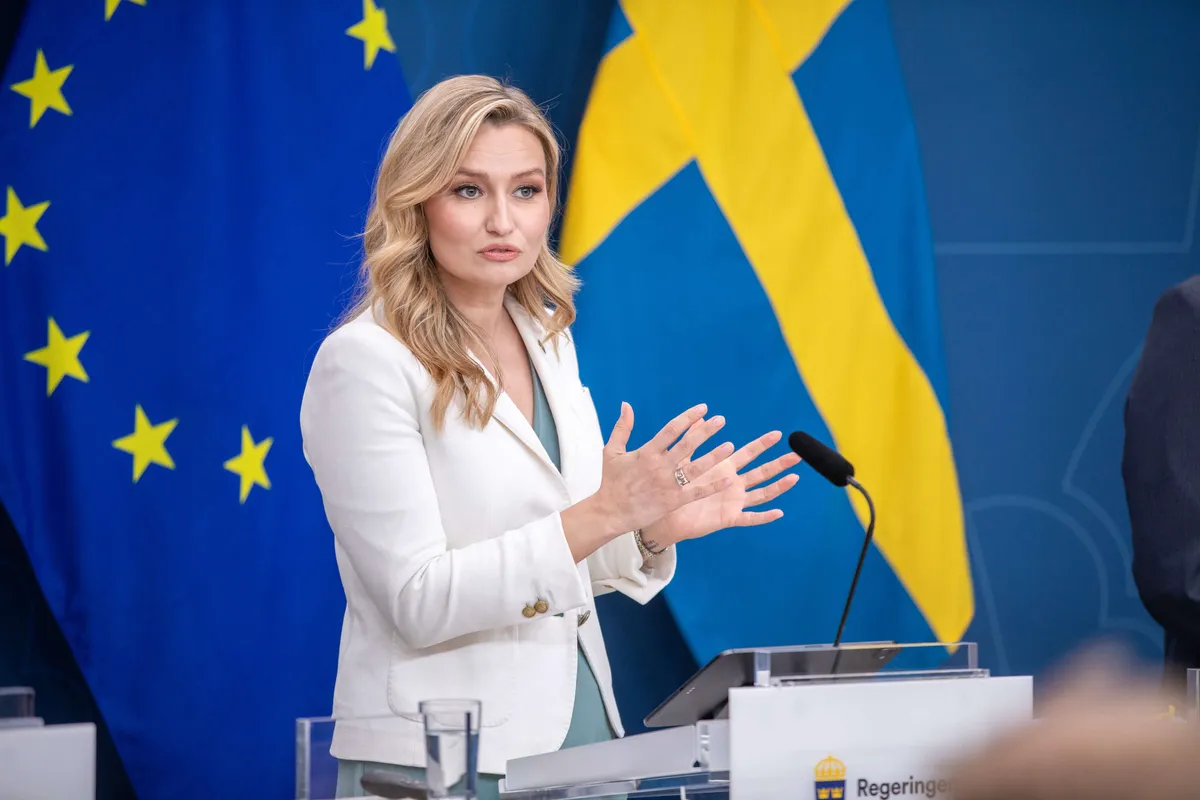
Sweden suspends the construction of an electricity transmission cable to Denmark and reconsiders cable projects to Finland, the country’s Minister of Economic Affairs and Energy said Ebba Busch on Friday.
The decision is a means of pressure in Sweden’s dispute with the EU over the use of bottleneck revenues. The EU is preparing the so-called Grids Package related to electricity transmission connections. Based on it, a significant part of the bottleneck revenues generated in the member states would be directed to the expansion of the networks in the EU region, so that renewable electricity could be transferred more efficiently around the region and thus reduce fossil energy emissions. Bottleneck revenue is accumulated when electricity is transferred with limited transmission capacity from an area with a lower electricity price to an area with a higher price.
Sweden sees this quite differently. Ebba Busch said at the press conference that the EU focuses far too much on improving the networks, which according to her is only “treating the symptoms”.
“The fundamental issues are really very simple: We lack production, the right production, in the right place, at the right time. Frankly, we lack basic power,” Busch said.
Base power here means continuously and predictably available electrical energy independent of the weather, which can balance the electrical system. For example, Sweden produces nuclear power, cogeneration of heat and electricity, and hydropower.
In Busch’s opinion, the rest of Europe could rather improve its own basic power production than secure transmission capacity from, for example, Sweden.
And in any case, EU networks should not be improved with bottleneck revenues collected from the Swedes. These investments would not benefit the Swedes at all, and Busch also implied that in the EU’s plan, the revenue could possibly be used to build more weather-dependent wind power in some countries.
“These billions belong to the Swedish people,” he repeated.
“Sweden goes to war against Brussels so that the EU does not steal Swedes’ electricity money.”
Aurora Line 2 and Fenno-Skan 3 for reconsideration
Sweden currently has about 85 billion kroner, or about 7.9 billion euros, of this income “on account”. 75 percent of them have come from electricity transmission within the country, because Sweden, unlike, for example, Germany or Finland, is divided into price zones – which is again the EU’s wish.
Sweden and France have been arguing about the Grids Package with the Commission for a long time, and according to Ebba Busch, Sweden has achieved “partial victories”. Initially, there was a proposal on the table that up to 25 percent of the bottleneck revenues could be used for EU-wide projects. According to Busch, this is now over.
“But it just means that the most serious consequences have been prevented. We’re kind of back to square one.”
The starting point is that, according to Busch, the EU focuses too much on improving transmission connections.
For this reason, the Swedish government has now decided to adopt tough measures.
“The government has decided to change [verkkoyhtiö] The mission and investment plan given to Svenska Kraftnät so that it does not include the Konti-Skan Connect cable to Denmark. We will stop that investment. At the same time, we are reconsidering cable projects to Finland, i.e. whether we will proceed to the next stage in them,” Busch said.
An Aurora Line 2 land cable is planned between Northern Sweden and Northern Finland, the design project of which should end soon. It would transfer approximately 1,000 megawatts of electricity between our countries. In addition, an 800-megawatt Fenno-Skan 3 submarine cable connection is being planned, which would replace Fenno-Skan 1, which will reach the end of its useful life in the late 2030s.
Aurora Line 1 was commissioned last November. The Swedes considered it to be the reason for the exceptionally high electricity prices in northern Sweden in the winter, and according to the Swedish network company Svenska Kraftnät, it did have an effect on the prices. Therefore, not all Swedes before the EU dispute reacted very enthusiastically for the Aurora Line 2 project.
Busch appealed to Danes to Danish and Norwegians to Norwegian
Ebba Busch made an exceptionally direct appeal to the other Nordic countries so that they would support Sweden in the EU dispute. At the press conference, he spoke a few sentences about Denmark and Norway (even though Norway is not even an EU country), but he didn’t try to speak Finland. The message was still clear:
“I am turning to our friends in Denmark, Norway and Finland. If we can build more basic power, it will make Sweden’s energy system stronger and then we can do more to make the North stronger.”
This prompted the media to question whether the government wants to use bottleneck revenues to build additional nuclear power. Busch responded that it is not the primary purpose or topic of discussion now. He just wants Sweden to be able to decide on the use of the income.
Minister responsible for Finnish electricity grids Sari Multala (kok) only had time to comment on the matter to Kauppalehti via text message on Friday. This is how the minister writes:
“In Finland’s opinion, the commission goes too far in its proposal to set aside bottleneck revenues. Bottleneck revenues must be used in the region where they are generated. In principle, we do not support, for example, that bottleneck revenues be used for electricity network projects other than those directly related to Finland. Further work is needed, and the commission must clarify several points in its proposal. I brought this up at the official meeting of energy ministers last March.”