After awareness, businesses in Vietnam have begun to implement ESG in response to market and investor pressure, according to research and experts.
In early June, HSBC announced a short-term sustainable linked trade credit for the Bach Hoa Xanh retail chain, part of Mobile World (MWG). The bank said this is the second ESG-linked credit facility structured for MWG, reflecting the continued growth of sustainable trade finance in Vietnam.
Bach Hoa Xanh operates more than 3,000 stores nationwide and has implemented solutions to minimize environmental impact such as optimizing energy use.
“In the process of expanding the network and consolidating operations, we are also focusing on achieving specific results in our sustainable development roadmap,” said Mr. Vu Dang Linh, General Director of Mobile World Group.
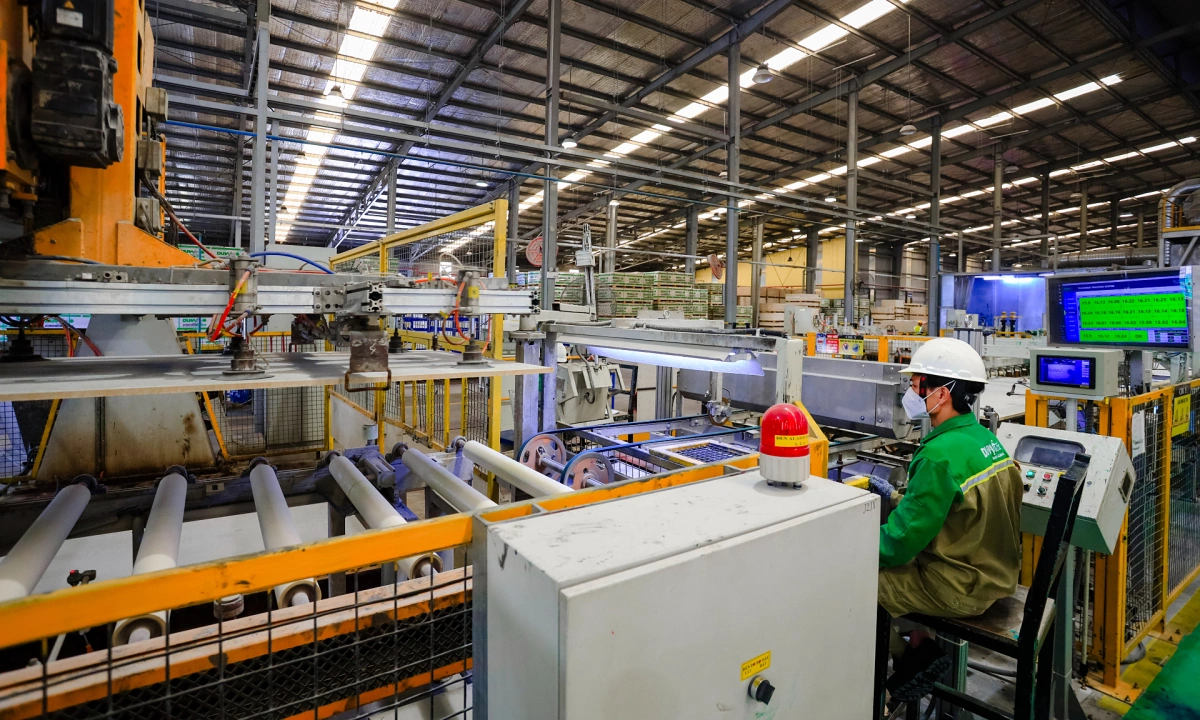
In the manufacturing industry, the DURAflex fiber cement panel factory recently became the first in the industry to achieve “Zero Carbon” (no direct and indirect emissions at Scope 1 and 2). Mr. Nguyen Truong Hai, General Director of Saint-Gobain Vietnam, said there will soon be another “NetZero” factory announced by the company.
Manufactured in DURAflex’s “NetZero” phase 1 & 2 factory. Image: Saint-Gobain Vietnam
After a period of awareness about ESG criteria (social, environmental, and business impacts), experts and surveys say that businesses in Vietnam have moved to take action.
At the “Fourth Vietnam ESG Investor Conference” late last month, Ms. Mimi Vu, Founder of Raise Partners, assessed “Vietnam is one of the fastest moving markets in the world” in terms of ESG.
The report “Vietnam ESG Practitioner Dialogue 2026” recently published by Ipsos Vietnam and Dear Our Community, stated that ESG in Vietnam “has entered the implementation phase”. Businesses see this as a “license to operate” in the global value chain and fulfillment is a prerequisite to retain customers.
“If we do not meet all ESG requirements on time, the contract will not be renewed,” said the leader of an unlisted company. There are a series of reasons for businesses to implement sustainability commitments.
According to the report, Vietnam’s Net Zero commitment by 2050 has transformed ESG from a voluntary social responsibility activity into a multi-layered requirement. For example, the Securities Commission requiring companies in the VN30 index to include ESG in their annual reports is just the beginning of a broader transformation process.
The government has also begun to impose stricter regulations on waste management and reducing plastic use on manufacturers and retailers. Programs to promote renewable energy and energy efficiency create the foundation for transformation in manufacturing industries such as construction materials, according to Mr. Hai.
“Legal frameworks on environmental impact control, reporting and compliance push businesses to move from a reactive approach to more proactive and methodical emissions management,” Mr. Hai added.
Investors view ESG as a “filter” for pouring capital. Mr. Craig Martin, Executive Chairman of Dynam Capital, said ESG reflects transparency, solid governance and proactive engagement. “Companies that commit to these pillars will demonstrate their willingness to access appropriate international capital,” he said.
Workers also tend to choose employers based on sustainable development values, while consumers use their purchasing power to promote “green” products. PwC’s “Consumer Survey 2025” said that 96% of Vietnamese consumers are concerned about climate change, the highest in Asia-Pacific.
According to research by Ipsos Vietnam and Dear Our Community, businesses in Vietnam are implementing ESG in four ways, depending on the business context. Small and medium-sized groups, second- and third-tier suppliers are mainly “passive compliance”. Medium-sized manufacturing and service enterprises “integrate step by step”.
More deeply, listed businesses and large domestic corporations approach “strategic integration”. Some pioneering Vietnamese businesses and multinational corporations have “transformed ESG into a core point in their business models”.
However, implementing ESG is not easy. The report points out 5 main bottlenecks including weak or lacking governance, measuring impact and proving investment effectiveness (ROI). Along with that is the paradox of access to capital, lack of infrastructure, technology, and professional personnel.
At the “Vietnam ESG Investor Conference”, experts assessed that the top barriers are the lack of verifiable data, management systems and the capacity to integrate these standards into actual operations. Previously, PwC’s 2025 survey of ESG adoption progress in Vietnam’s financial industry said data and reporting were the main challenges, with 78% collecting data but only 3% using advanced analytics tools and 33% applying independent auditing for ESG reporting.
Receiving opinions from 50 ESG leaders at multinational corporations, listed and unlisted enterprises in Vietnam, Ipsos concluded 3 recommendations. Specifically, businesses need to clearly identify impact indicators, track results across the value chain and provide evidence of impact to stakeholders.
With consumers expressing support for sustainability but actual decisions still driven by cost, convenience and habit, ESG initiatives should be designed around actual behavior, articulating the benefits.
Additionally, in a complex and polarized landscape, many businesses are becoming more cautious when communicating about ESG. However, silence creates ambiguity and can breed doubt. Therefore, businesses need to provide selective, clear and reliable messages about the impact of ESG activities on life.
“We don’t ask for perfection from the start; instead, we look for a willingness to change and improve over time,” Dynam Capital Executive Chairman Craig Martin encouraged.
https://SouthingtonLandscaping.us/gardening/hedging
https://SouthingtonLandscaping.us/gardening/mulching
https://SouthingtonLandscaping.us/gardening/plant-removal
https://SouthingtonLandscaping.us/gardening/pruning
https://SouthingtonLandscaping.us/gardening/weeding
https://SouthingtonLandscaping.us/lawn-care
https://SouthingtonLandscaping.us/lawn-care/artificial-grass-installation
https://SouthingtonLandscaping.us/lawn-care/dethatching-lawn
https://SouthingtonLandscaping.us/lawn-care/fertilizing-lawn
https://SouthingtonLandscaping.us/lawn-care/hydroseeding
https://SouthingtonLandscaping.us/lawn-care/lawn-aeration
https://SouthingtonLandscaping.us/lawn-care/lawn-edging
https://SouthingtonLandscaping.us/lawn-care/lawn-grubs-control
https://SouthingtonLandscaping.us/lawn-care/lawn-installation
https://SouthingtonLandscaping.us/lawn-care/lawn-leveling
https://SouthingtonLandscaping.us/lawn-care/lawn-mowing
https://SouthingtonLandscaping.us/lawn-care/lawn-renovation
https://SouthingtonLandscaping.us/lawn-care/lawn-seeding
https://SouthingtonLandscaping.us/lawn-care/sod-installation
https://SouthingtonLandscaping.us/lawn-care/weed-control
https://SouthingtonLandscaping.us/yard-clean-up
https://SouthingtonLandscaping.us/yard-clean-up/green-waste-disposal
https://SouthingtonLandscaping.us/yard-clean-up/gutter-cleaning
https://SouthingtonLandscaping.us/yard-clean-up/junk-removal
https://SouthingtonLandscaping.us/yard-clean-up/leaf-removal