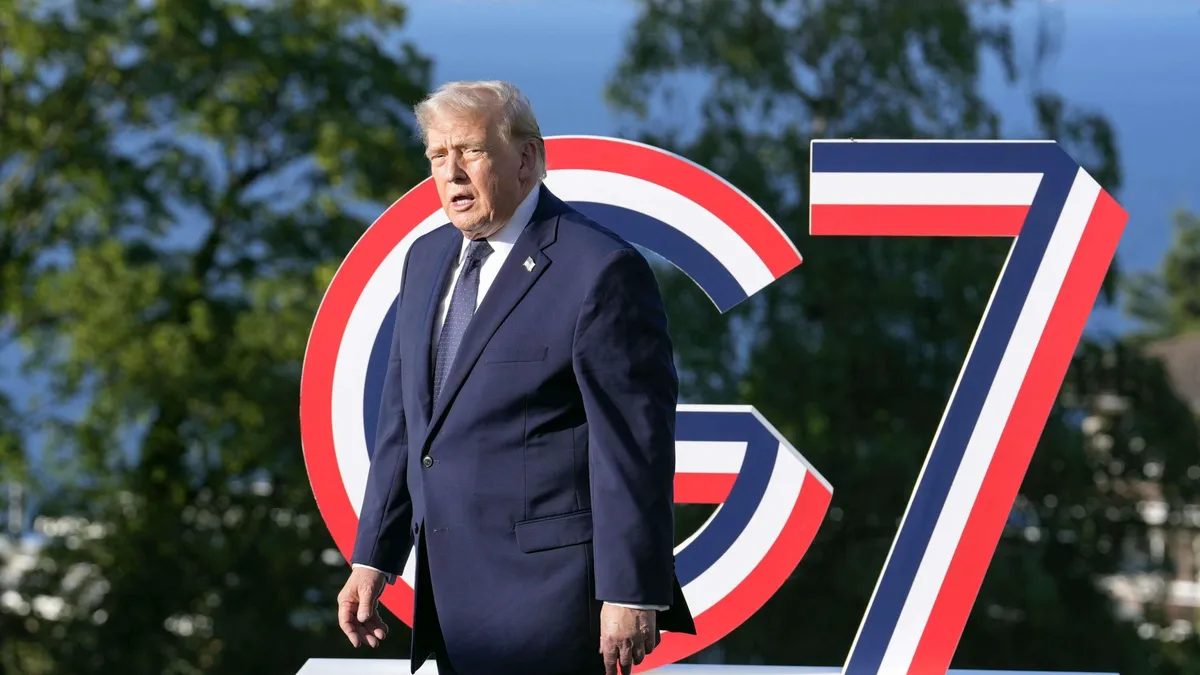
On the last day of the G7 summit in France, artificial intelligence will be at the center of the discussions. Wednesday’s program includes a lunch meeting where political leaders will meet the top names of large artificial intelligence companies. They sit at the lunch table, among other things Open AI: n managing director Sam Altman, Anthropicin managing director Dario Amodei and French Mistral AI: n managing director Arthur Mensch.
The artificial intelligence debate is overshadowed by the tightening geopolitical situation. Tensions are increased by Anthropic’s recent decision to cut off foreign citizens’ access to the latest artificial intelligence models. The decision was made by the president Donald Trump’s at the request of the administration citing national security.
However, France, the country holding the G7 presidency, strives by all means to build a common line between the member countries. The goal is to strengthen international cooperation in the management of artificial intelligence and raise the technology to a key economic and security policy issue that unites the member countries.
Turning point
G7 researcher.
Professor John Kirton of the University of Toronto is the leader of the G7 research group.
PHOTO: Kreeta Karvala
Kauppalehti interviewed an internationally known professor from the University of Toronto in Évian John Kirtoniawho serves as the head of the G7 research group. He estimates that the Évian meeting is a turning point in the global control of artificial intelligence, because now the United States has also woken up to the dangers of artificial intelligence.
According to Kirton, the United States has so far emphasized innovation without regulation and sees innovation first and foremost in American companies. The European and Canadian approach has been the opposite.
“In Europe, we think that there can be no innovation without regulation. We need the rule of law, intellectual property rights and clear rules of the game,” says Kirton.
He estimates that the events of the last few weeks have, however, also forced the United States to review its line.
Also the President of the European Commission Ursula von der Leyen stressed at Évian that to control the risks of advanced artificial intelligence models, testing and close cooperation of the G7 countries is needed.
Trump woke up
According to Kirton, the key turning point has been Anthropic’s Mythos model, which revealed the ability of artificial intelligence to break information security structures in an unprecedented way.
“It showed the US administration that even world-class cyber security is not enough. At the same time, citizens’ privacy also proved vulnerable, and virtually anyone can access it.”
According to Kirton, this has also influenced President Trump’s thinking.
“Trump has now realized that in order to correct such risks, at least some kind of regulation is needed.”
At the same time, however, the United States has tightened its line in other ways.
“Trump seems to believe that AI was born only in the United States. That’s simply not true.”
Kirton reminds that the roots of artificial intelligence are strongly international.
“Artificial intelligence was developed in Canada at the University of Toronto. Many of the key experts in the field have trained elsewhere and later moved to Silicon Valley.”
Therefore, according to Kirton, a policy based purely on national solutions does not work.
“Trump’s instinctive line of banning the export of top technology will not work,” the professor underlines.
Instead, the pressure for joint solutions is increasing.
“Regulation is needed, among other things, to ensure cyber security, to maintain a technological advantage over China, and to protect children.”
A tactical move from France
Macron’s tactics.
France wanted successful business leaders at the same table with Trump. In the picture taken in connection with the G7 meeting, the French President’s spouse Brigitte Macron, the Commission President’s spouse Heiko von der Leyen, the President of the European Commission Ursula von der Leyen and the French President Emmanuel Macron.
PHOTO: EU Commission
In Évian, attention is also focused on the role of France. President Emmanuel Macron the decision to bring business leaders to the same negotiating table with Trump is considered a working tactic. Professor Kirton also shares this opinion.
“Donald Trump is not the best listener in the world, but he listens to successful CEOs,” says Kirton.
France’s idea is that it is possible to influence Trump more effectively through business leaders than through complex technical expert speech.
In Kirton’s opinion, the message from the business leaders is surprisingly unified and partly also supports a possible political compromise.
“They say, ‘We don’t care what the rule is, as long as it’s clear, the same for everyone and doesn’t keep changing.'”
Kirton reminds that even in the United States, multilayered artificial intelligence regulation causes problems for companies.
“Companies are afraid of a situation where there are numerous rules not only in the G7 countries, but also in different states of the United States.”
Therefore, according to Kirton, the United States, Europe and Canada can come to a joint conclusion at the G7 meeting, which states that regulation should be centralized and internationally coordinated.
According to Kirton, the summit statement is expected to convey the benefits and risks of artificial intelligence.
“I think we will achieve more common vision than many expect – especially on the transatlantic divide.”
According to Kirton, the decisive factor can be Trump’s meeting condition.
“If Donald Trump is in a good mood at the end of the summit, he can agree to a compromise, but if he has worked too hard and for too long, i.e. three days, he will be grumpy,” Kirton estimates.
THE FACTS
Business leaders will participate in the G7 artificial intelligence discussion
• Arthur Mensch – CEO, Mistral AI, France
• Ujjain Anshu – CEO, Dominar AI, Italy
• Aidan Gomez – CEO and Founder, Cohere, Canada
• Ren Ito – CEO, Sakana AI, Japan
• Robin Rombach – CEO and Founder, Black Forest Labs, Germany
• Victor Riparbelli – CEO and Founder, Synthesia, UK
• Sam Altman – CEO OpenAI, United States
• Demis Hassabis – CEO and Founder, Google DeepMind, USA
• Dario Amodei – CEO and Founder, Anthropic, USA
• Vivek Raghavan – CEO, Sarvam AI, India
• Marc Benioff – CEO, Chairman and Founder, Salesforce, USA
The story was updated at 11:57 a.m. by adding a list of business leaders participating in the artificial intelligence discussion.