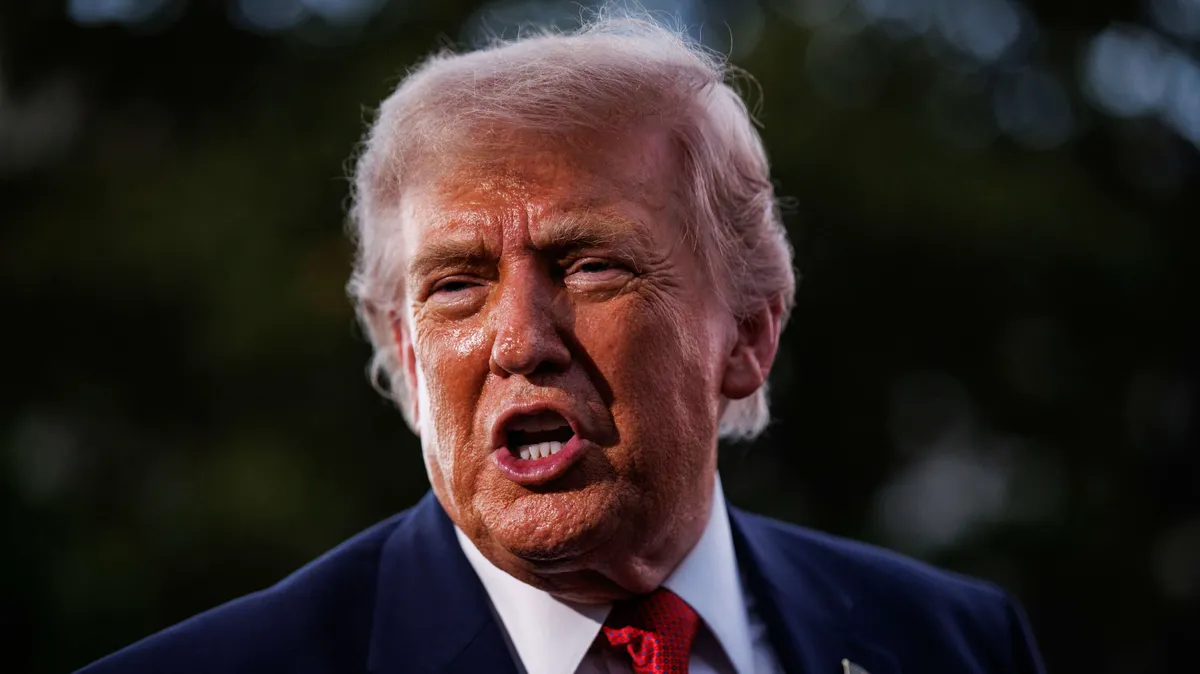
President of the United States Donald Trump threatened on Friday to impose tariffs of up to 100 percent on countries that implement a digital services tax on US companies. According to him, “numerous” European countries are close to introducing such taxes.
The background of the dispute is especially large US technology companies, such as Meta, Google, Amazon and Applewhich several EU countries want to tax more effectively than at present and whose activities are regulated in Europe in accordance with EU legislation.
Currently, among the EU countries, France, Italy, Spain, Austria, Hungary, Poland, Portugal and Denmark have a digital tax of a few percent. In addition, Belgium, the Czech Republic, Latvia, Slovakia and Slovenia are considering the possible introduction of the tax.
According to Trump, possible US tariffs of 100 percent would be based on Section 301 of the 1974 trade law, which he used in his first term as president, among other things, in the tariffs imposed on China. If implemented, the measures would supersede existing trade agreements.
The situation is complicated by the fact that digital service taxes are not covered by the recently approved EU-US trade arrangement.
The European Commission reacted strongly to Trump’s threat. Commission spokesman Thomas Regnier said on Monday that the EU and its member states have the sovereign right to regulate economic activities in their territory. He also emphasized that the EU intends to respond “quickly and decisively” if the United States takes unilateral action.
According to the Commission, the EU and the US are trying to defuse technology-related tensions by starting negotiations related to artificial intelligence, cyber security and the chip market. Regnier confirmed on Monday that the countries’ officials have started discussions in Washington as a basis for future negotiations.
“It’s a dialogue about a possible future dialogue,” Regnier described the EU director-general responsible for digital policy Roberto Violan led negotiations.
Controversy over artificial intelligence
Critical infrastructure.
Europe also wants to protect its critical infrastructure. In the photo, from left to right: the Commission’s technology spokesperson Thomas Regnier, the Commission’s Executive Vice-President Henna Virkkunen and Commissioner Dan Jørgensen. Stock photo.
PHOTO: European Commission
The US State Department has criticized the EU’s policy of emphasizing technological self-sufficiency and criticized it as protectionist. The same can be seen in the actions of the United States. At the request of the Trump administration, leading artificial intelligence companies Anthropic and Open AI for example, cannot offer their most advanced models to foreign players, including European customers.
However, according to the Commission, the situation is more complex. Regnier reminded that the possible limitations related to Open AI would only apply to the upcoming GPT-5.6 model. In addition, the US has recently allowed Anthropic to release its Mythos AI model on a limited basis to select US organizations, particularly those responsible for protecting critical infrastructure.
In Europe too, it is considered important to ensure access to advanced technology to protect critical infrastructure. The need is emphasized by the fact that many European strategic industries are closely linked to their US partners. For this reason, cooperation with the United States is considered a key part of both security and technology policy.
“We really need to protect our critical infrastructure. It’s definitely in our interests as well,” Regnier said.
Regarding the Mythos model, the commission also reminded that Anthropic has previously invited the European Union’s cybersecurity agency Enisa to discuss possible access to the technology and these negotiations are still ongoing.
“Discussions regarding this potential future access are ongoing with the company and we hope to be able to achieve this as soon as possible,” Regnier said.
According to him, the EU has not been left out.
“We have not been left out. The Commission is really making progress here and taking things forward on behalf of our strategic sectors and our Member States,” he stated.
Moving forward with cooperation
Chairman of the Commission Ursula von der Leyen emphasized earlier in June at the G7 meeting that the EU is a reliable artificial intelligence partner for the United States and American companies and not a security risk, and that it is worth cooperating with Europe to respond to possible actions of common enemies.
Transatlantic cooperation was also underlined by Regnier on Monday.
At the same time, the Commission sticks to its position that the EU and its member states have every right to regulate economic activity in their own territory.
However, the EU’s primary goal is still to get an international solution to the taxation of the digital economy. The Union supports the global model outlined by the finance ministers of the G7 countries, the aim of which is to create a fair and unified system for taxing the digital economy.