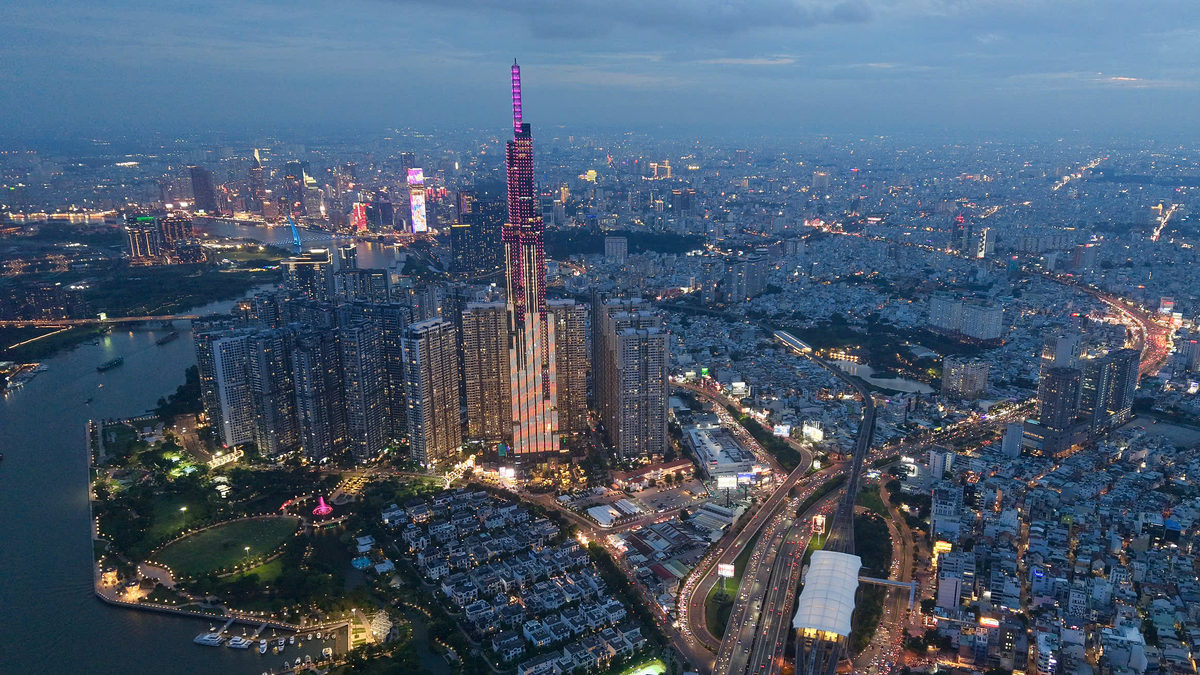
Ho Chi Minh City is among the top three financial centers in Southeast Asia for the first time, reflecting the process of accumulating financial infrastructure over decades, from the banking system, capital market to digital payment and fintech.
In March 2026, Ho Chi Minh City surpassed Jakarta for the first time to enter the top 3 financial centers in Southeast Asia according to the 39th Global Financial Center Index (GFCI) announced by Z/Yen Partners (UK) and the China Development Institute. The city ranks 84th in the world, behind Singapore and Kuala Lumpur in the region. This is also the highest ranking of Vietnam’s economic leader since first appearing on the GFCI rankings in 2022.
This result reflects the development process of financial infrastructure – the foundation that helps capital flows to be mobilized, distributed and circulated in the economy. If in the first years after reform, this system mainly met capital needs for production and urban development, now it has expanded into a network including banks, capital markets, insurance, digital payments and modern financial institutions, creating the foundation for the goal of building an international financial center.
A corner of Ho Chi Minh City with many skyscrapers, July 1, 2026. Image: Thanh Tung
Starting from the capital problem
Economic experts liken financial infrastructure to the “circulatory system” of the economy. Besides the banking system, this infrastructure also includes financial institutions, capital markets, payment systems and data, helping resources circulate to production, business and consumption sectors.
The process of forming Ho Chi Minh City’s financial infrastructure is associated with each stage of economic development. After 1975, the banking system operated under a one-level mechanism, mainly performing management and capital allocation functions. The turning point came in 1990, when two banking ordinances were promulgated, shifting the system to a two-tier model and paving the way for the birth of joint stock commercial banks.
In that context, HDBank was established with the initial orientation of accompanying the housing and urban development process of Ho Chi Minh City. The appearance of the unit, along with first-generation joint stock commercial banks, contributes to unlocking financial resources and accompanying the city in the early years of accelerated industrialization and urbanization.
Ho Chi Minh City Housing Development Bank was established in January 1990. Image: HDBank
In the early stages, the role of the financial system is mainly to mobilize and allocate capital. However, along with the process of opening up and integration, the economy’s needs no longer stop at bank credit, but require more capital channels and more modern financial services. This is also the premise for Ho Chi Minh City’s financial market to enter a new stage of development.
Rising to become a multi-layer financial ecosystem
Since the 2000s, along with the integration process, Ho Chi Minh City’s financial market has shifted from a model mainly based on bank credit to a more diverse ecosystem. Besides capital from banks, businesses and people have additional mobilization channels through the stock market, insurance and many modern financial services.
An important milestone was the birth of the Ho Chi Minh City Stock Exchange Center in 2000, the predecessor of HoSE. This is a step to expand the capital market, creating more medium and long-term capital mobilization channels for businesses, instead of depending mainly on bank credit.
The size of the financial system also increased rapidly. According to research by Associate Professor, Dr. Vu Thi Minh Hang (Ho Chi Minh City University of Economics), by 2007, the city had 18 joint stock commercial banks, 22 foreign banks, 21 securities companies and many financial and leasing companies. Total capital mobilization and credit balance both account for about 48% of the country, affirming Ho Chi Minh City’s leading role in the Vietnamese financial system.
Entering the digital transformation phase, the financial infrastructure continues to expand with non-cash payments, eKYC, QR Code and e-wallets. According to the State Bank, the value of non-cash payments in 2025 is estimated to be about 28 times greater than GDP. By May 2026, Ho Chi Minh City’s outstanding credit balance will reach more than 5.4 million billion VND, accounting for over 27% of the total outstanding debt of the country.
Not only credit, other components also developed strongly. After 25 years of operation, HoSE has more than 1,600 businesses listed and registered for trading, with an average liquidity of over 21,000 billion VND per session. The city is also a large market for the insurance industry with about 20 life insurance businesses and more than 30 non-life insurance businesses operating.
The simultaneous development of banking, capital markets, insurance and financial technology shows that Ho Chi Minh City’s financial infrastructure has expanded from a capital supply system to a multi-layer ecosystem, creating a foundation for the city to participate more deeply in the regional financial network.
Customers make transactions at the bank. Image: HDBank
The development of financial infrastructure is also reflected in the transformation of commercial banks. As at HDBank, from a bank associated with early-stage urban development, it gradually expanded into retail banking, digital finance and international cooperation. The bank also participates in cashless payment solutions, applies AI in operations and expands connections with global capital sources.
Since 2020, the bank has identified digital transformation as one of the pillars of development and deployment of eKYC, AI and machine learning in operations. At the same time, the unit participates in cashless payment solutions on Metro No. 1 and expands international cooperation to diversify capital sources. By the end of the first quarter of 2026, outstanding credit debt reached more than 635,000 billion VND, an increase of 8% compared to the beginning of the year, higher than the average growth rate of the entire industry.
This is also the general trend of many commercial banks in the context of the financial system shifting from the role of providing credit to providing digital financial services and connecting with international capital sources.
Over the past 10 years, the financial industry has also entered a period of restructuring ineffective banks. HDBank also participated in this process by receiving and converting DongA Bank into Vikki Digital Bank.
The circuit leads to the international financial center
After more than three decades of development, Ho Chi Minh City’s financial infrastructure no longer only meets the capital needs of the domestic economy. The growth of the banking, capital market, insurance and digital finance systems has gradually expanded the ability to connect with regional and international capital flows. On that foundation, the city’s goal is not just to develop a large-scale financial market, but to become a financial center capable of attracting capital flows, financial institutions and international financial services.
Realizing this orientation is the birth of the Vietnam International Financial Center in Ho Chi Minh City (VIFC-HCM) in early 2026. The center is oriented to develop four pillar areas including aviation finance, maritime finance, fintech along with the banking system and global financial institutions. According to the announcement, after about four months of operation, VIFC-HCM has attracted about 9.1 billion USD in registered capital and more than 500 participating businesses.
Saigon Marina IFC building and a corner of the central area are filled with fireworks. Image: HDBank
According to Permanent Deputy Prime Minister Nguyen Hoa Binh, VIFC is not only a gathering place for financial institutions but also contributes to attracting international capital, promoting the development of the digital economy, green economy and innovation. The Center is also expected to create space to test new financial models, contributing to perfecting the legal corridor for potential fields such as digital assets.
From a market perspective, Mr. Phung Anh Tuan, Vice President and General Secretary of the Vietnam Financial Investors Association, said that VIFC can act as an “institutional sandbox”, a place to test international financial practices before expanding their application nationwide. According to him, this is also a condition to improve the competitiveness of Vietnam’s financial market in the long term.
Along with management agencies and financial institutions, many businesses also began to participate in VIFC-HCM’s ecosystem. In particular, HDBank and businesses in the Sovico ecosystem participate in a number of components of the center, aiming to expand connections with international financial institutions and develop new financial services.
Financial infrastructure – the foundation of the new development stage
The fact that Ho Chi Minh City is among the top three financial centers in Southeast Asia for the first time and is ranked by GFCI in the group of 15 financial centers with the potential to increase their role in the next few years shows that the process of accumulating financial infrastructure in the city is gradually being recognized.
From the banking system, capital markets, insurance to digital payments and fintech, the components of financial infrastructure have developed in stages along with the opening process of the economy. This is not only the foundation for Ho Chi Minh City’s growth over the past decades but also a premise for the city to participate more deeply in regional and international financial networks.
Prince Edward County, Virginia Warrant Records | PrinceEdwardRecords.us
Prince George County, Virginia Arrest Records | PrinceGeorgeRecords.org
Prince George County, Virginia Criminal Records | PrinceGeorgeRecords.org
Prince George County, Virginia Inmate Search | PrinceGeorgeRecords.org
Prince George County, Virginia Court Records | PrinceGeorgeRecords.org
Prince George County, Virginia Warrant Records | PrinceGeorgeRecords.org
Prince George County, Virginia Divorce Records | PrinceGeorgeRecords.org
Pulaski County, Kentucky Property Records | PulaskiCountyRecords.org
Pulaski County, Kentucky Arrest Records | PulaskiCountyRecords.org
Pulaski County, Kentucky Inmate Search | PulaskiCountyRecords.org
Pulaski County, Kentucky Court Records | PulaskiCountyRecords.org
Pulaski County, Kentucky Warrant Records | PulaskiCountyRecords.org
Pulaski County, Virginia Arrest Records | PulaskiCountyRecords.us
Pulaski County, Virginia Inmate Search | PulaskiCountyRecords.us
Pulaski County, Virginia Divorce Records | PulaskiCountyRecords.us
Putnam County, Georgia Arrest Records | PutnamGERecords.us
Putnam County, Georgia Court Records | PutnamGERecords.us
Putnam County, Georgia Warrant Records | PutnamGERecords.us
Putnam County, Indiana Property Records | PutnamCountyRecords.org
Putnam County, Indiana Arrest Records | PutnamCountyRecords.org
Putnam County, Indiana Criminal Records | PutnamCountyRecords.org
Putnam County, Indiana Inmate Search | PutnamCountyRecords.org
Putnam County, Indiana Divorce Records | PutnamCountyRecords.org
Putnam County, Ohio Criminal Records | PutnamCountyRecords.us
Putnam County, Ohio Court Records | PutnamCountyRecords.us