Experts believe that applying residential electricity prices based on time of use (TOU) can help adjust usage demand, reducing pressure to invest in new sources in the context of rapidly increasing electricity consumption.
The Ministry of Industry and Trade is studying to apply retail electricity prices for domestic use in three time frames: peak, normal and off-peak, when technical conditions allow. This is an expansion of the time-of-use (TOU) pricing mechanism, which has been applied for many years with manufacturing and business customers.
Unlike the current ladder tariff, TOU does not depend mainly on the total electricity consumed in the month but also takes into account the time of use. Normally, electricity used during off-peak hours may be cheaper, while electricity used during peak hours may be more expensive. Thus, two households consuming the same 500 kWh per month but using it at different times may pay different bills.
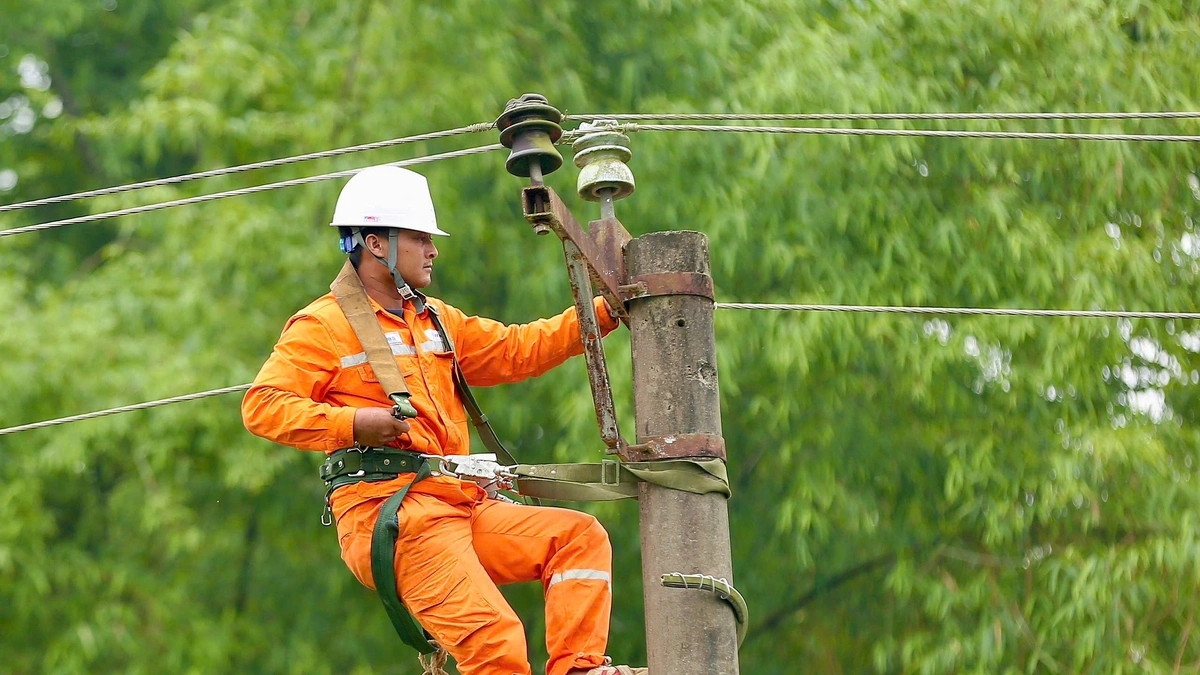
Electricity staff checks the system. Image: NPC
According to Dr. Nguyen Huy Hoach, the cost to provide 1 kWh of electricity is no longer the same at all times of the day. During off-peak hours or when renewable energy sources are abundant, the cost of mobilizing power is often lower. On the contrary, during periods of high demand, especially in the evenings on hot days, the system must mobilize additional power sources with higher costs.
“TOU better reflects the cost of electricity supply at each time of day,” Mr. Hoach assessed.
But experts say that the adjustment is not simply about changing the way of calculating money but is aimed at operating the electricity system.
Previously, electricity demand adjustment programs were mainly aimed at manufacturing enterprises – the largest electricity consuming group for many years. However, the customer group becomes a factor that has a great influence on the entire system.
The reason is that the development of solar energy makes electricity abundant at midday, while household demand increases sharply in the late afternoon and evening – a time when renewable energy sources decline.
“As a result, the system’s peak load is increasingly shifting to the time frame from about 5:30 p.m. to 10:30 p.m.,” Mr. Hoach said. This is also the time when millions of families simultaneously turn on air conditioners, cook, take hot baths, use televisions and many other electrical devices.
In fact, on hot sunny days at the end of June, the national system’s largest electricity consumption capacity continuously appeared in the 8-10 p.m. frame instead of noon like many years ago. This forces the system to mobilize additional high-cost power sources to meet demand in just a few hours.
According to energy expert Dao Nhat Dinh, the biggest goal of applying TOU is to adjust electricity demand at the right hours when the system is under the greatest pressure. Currently, in addition to the consumption peak in the afternoon, the North also has an additional peak at around 9:00 p.m. This is a time when there is no more solar power, so electricity supply costs are very high.
“Hourly electricity prices are a tool to encourage people to transfer part of their electricity demand to times when prices are cheaper, thereby reducing pressure on the system,” Mr. Dinh said.
Expert Nguyen Huy Hoach estimates that if millions of households partially shift their electricity demand away from peak hours, the total maximum capacity of the system could be reduced by thousands of MW. This level is equivalent to building one or more large-scale power plants but at a much lower cost. Thereby, the system will reduce the need to invest in additional power sources and grids just to serve peak hours every day. This benefit in the long run will contribute to reducing electricity supply costs for the entire society.
In the context of rapidly increasing electricity demand, this role becomes even more important. According to calculations, each year Vietnam’s power system needs to add about 4,000-5,000 MW of new source capacity to meet demand growth. Meanwhile, to build an LNG or offshore wind power project with a scale of about 1,000 MW usually takes at least 3-4 years of preparation and construction.
To implement this model, experts believe that the electricity industry needs to synchronously invest in both technical infrastructure and technology. According to expert Dao Nhat Dinh, Vietnam has basically met the technical conditions to deploy this mechanism when more than 90% of customers have used electronic meters. The remaining problem is mainly perfecting the software system and how it operates.
However, the biggest difficulty lies not in technology but in the ability to change the behavior of electricity users.
Mr. Dinh believes that less than half of households actually have the conditions to change the time they use electricity. Most workers only return home after 6:00 p.m., while the period from 7:00 p.m. to 10:00 p.m. – the system’s peak hour – is the time to cook, bathe, and use air conditioning and other household appliances. Therefore, many households have almost no opportunity to switch electricity use to off-peak hours.
Therefore, experts believe that changing behavior will be more effective with devices that consume large amounts of electricity instead of devices that use less energy. For example, people can set a timer to hot water, cool the house before returning home or change the charging time for electric cars and electric motorbikes to night time.
Regarding the roadmap, he proposed that it should first be applied in large urban areas – where electronic meters have been popularized and have appropriate technical infrastructure. At the same time, the electricity industry needs to make data transparent, allowing customers to track the amount of electricity consumed hourly instead of just viewing total daily output as currently, thereby proactively adjusting usage habits.
He also said that time-based electricity prices are just one of many electricity demand management tools, which need to be deployed synchronously with other mechanisms. In the long term, when a competitive retail electricity market is formed, it is possible to research and allow customers to choose between many pricing options such as uniform electricity price, ladder tariff or electricity price based on time of use, depending on the needs and ability to optimize costs of each household.
Schertz, TX Professional Pruning Services | SchertzLandscaping.us
Schertz, TX Professional Weeding Services | SchertzLandscaping.us
Schertz, TX Professional Lawn Care Services | SchertzLandscaping.us
Schertz, TX Professional Artificial Grass Installation Services | SchertzLandscaping.us
Schertz, TX Professional Dethatching Lawn Services | SchertzLandscaping.us
Schertz, TX Professional Fertilizing Lawn Services | SchertzLandscaping.us
Schertz, TX Professional Hydroseeding Services | SchertzLandscaping.us
Schertz, TX Professional Lawn Aeration Services | SchertzLandscaping.us
Schertz, TX Professional Lawn Edging Services | SchertzLandscaping.us
Schertz, TX Professional Lawn Grubs Control Services | SchertzLandscaping.us
Schertz, TX Professional Lawn Installation Services | SchertzLandscaping.us
Schertz, TX Professional Lawn Leveling Services | SchertzLandscaping.us
Schertz, TX Professional Lawn Mowing Services | SchertzLandscaping.us
Schertz, TX Professional Lawn Renovation Services | SchertzLandscaping.us
Schertz, TX Professional Lawn Seeding Services | SchertzLandscaping.us
Schertz, TX Professional Sod Installation Services | SchertzLandscaping.us
Schertz, TX Professional Weed Control Services | SchertzLandscaping.us
Schertz, TX Professional Yard Clean Up Services | SchertzLandscaping.us
Schertz, TX Professional Green Waste Disposal Services | SchertzLandscaping.us
Schertz, TX Professional Gutter Cleaning Services | SchertzLandscaping.us
Schertz, TX Professional Junk Removal Services | SchertzLandscaping.us
Schertz, TX Professional Leaf Removal Services | SchertzLandscaping.us
Schertz, TX Professional Tree Removal Services | SchertzLandscaping.us
Hutto, TX Landscaping Services | HuttoLandscaping.us
Hutto, TX Professional Gardening Services | HuttoLandscaping.us