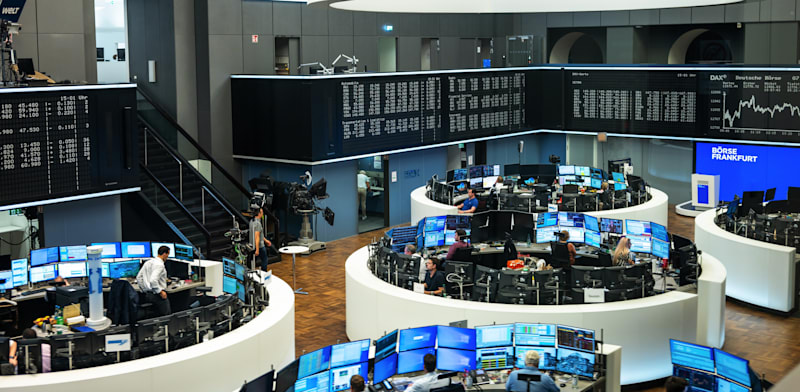
Trade overview: current reports, trends, indices, stock prices, bonds, foreign exchange and commodities and analyst recommendations
10:20
European stock markets open the trading day with declines. The Dax index weakened by about 0.4%, the Potsi fell by about 0.2% and the KAC retreated by about 0.6%.
8:50
Asia
The trading day in Asia is being conducted in the shadow of another round of American attacks on Iran and the latest attacks against targets in the Gulf countries. The Central Command of the US Army stated that the wave of attacks lasted for about five hours and that during the night Iranian defense systems, missile sites and UAVs and naval capabilities of Iran were attacked.
The stock markets on the continent are trading with slight gains, although the volatility is high. Currently, the Tokyo Stock Exchange is up by about 0.5%, the Hong Kong Stock Exchange is adding about 0.3%, the Shanghai Stock Exchange is up by about 0.4% and the Seoul Stock Exchange is advancing by about 0.8%. At the same time, the futures on Wall Street indicate slight increases.
After jumping by over 9% yesterday, oil prices continue to climb today and rise by over 1%. Brent crude is trading around $84 per barrel, while US crude (WTI) is trading around $79 per barrel.
China’s exports in June rose 27% compared to the same period last year in dollar terms – the strongest increase since October 2021, customs data released today showed. CNBC reported that this is an acceleration compared to an increase of 19.4% in May, when the figure far exceeded the forecasts of economists who expected growth of 18.2%.
Imports grew by 36% in June – the sharpest jump since June 2021, which is an increase in pace compared to growth of 27.4% in May and bypassing economists’ forecasts for growth of 24%. The trade surplus in June was 125.6 billion dollars.
Wall Street
Last night on Wall Street, the leading indices ended the day in decline, amid the escalation between the US and Iran and the surge in oil prices. The Nasdaq fell by about 1.5%, the S&P 500 lost about 0.8% and the Dow Jones weakened by about 0.3%.
Chip stocks led the declines, after the South Korean memory chip giant SK Hynix’s stock fell by over 15% on the Seoul Stock Exchange and recorded its weakest day ever; This, after it climbed over 10% on the day of its giant IPO on the Nasdaq. The stock fell by over 8% yesterday in trading on the Nasdaq.
The basket fund SOXX which tracks the broad chip sector, shed about 5%. Among the stocks that stood out in the declines, you can find Nvidia , AMD , Intel , Broadcom , Marvel , TSMC and more.
The basket fund DRAM which specifically tracks the memory stocks, came under heavier pressures and dropped by a sharp rate of about 10%. Significant declines were recorded in stocks Micron , Western Digital , Seagate andSanDisk .
Brian Mulberry, chief market strategist at Zacks Investment Management, told MarketWatch that he thinks geopolitical tensions are weighing on markets more than the tech selloff. “I feel like there’s just been a bit of a rebalancing and a broader pullback in risk-taking,” he said. “Beneath that, memory and chip stocks have performed so well year-to-date and looking back 12 months, so there seems to be a lot of profit-taking in addition to the broader rotation from risk assets.”
Another sector that stood out negatively yesterday was the banking sector. The shares of the largest banks in the US, among them J. According to Morgan , Goldman Sachs , Morgan Stanley , Bank of America andCitigroup are trading lower ahead of the publication of their quarterly reports today and tomorrow (Wed). On the other hand, against the background of the sharp jump recorded in oil prices, the shares of the oil producers jumped, among them misfortune , Exxon Mobile andConoco-Phillips .
stock SpaceX Elon Musk’s fell to $139 – the lowest since its IPO on June 12, when the stock started at $135. Let’s recall that a few days after that offering, which was the largest in history, the stock jumped sharply to a price of $225, scraping the $3 trillion market value mark and even briefly overtook Microsoft and Alphabet in terms of market value. This means that in about a month, SpaceX stock wipes out over a trillion dollars in market value.
Michael Ashley Shulman, an investment strategist at Cerity Partners, told Marketwatch that “the fact that SpaceX is trading around its IPO price is far from a crisis. This is a sign that the narrative premium embodied in the IPO may have nowhere else to go in the short term.”
Shulman added that “we’ve already seen this movie in the past with other publicized IPOs”, which left almost no room for the stock to rise.
As mentioned, the report season for the second quarter will begin to gather momentum today, with reports from some of the largest banks in the US. Sam Stovall, the chief investment strategist at CFRA Research, estimated that the report season could be challenging, given the high expectations for the companies’ profits. He noted that according to S&P Capital IQ estimates, the earnings per share of the S&P 500 companies is expected to show an annual growth of 20.9% – almost double from the average annual growth for the quarter since 2009, which is 11.6%. “Entering the second quarter reporting season with such high growth expectations could prove to be a challenge, especially if forward projections are constrained by inflationary uncertainty,” Stovall wrote.
Macro
Today at 3:30 p.m. Israel time, the consumer price index for the month of June will be published in the US. Against the background of the drop recorded in June in oil prices, the index is expected to retreat by 0.1%, so that annual inflation is expected to fall back below the 4% mark. However, core inflation, which deducts the volatile energy and food prices, is expected to climb by 0.3%, and thus continue to serve as a source of concern for Federal Reserve.
Alex Zbrzinski, Meitav’s Chief Economist, He referred to inflation in the US and noted that “in our estimation, if the consumer price index indicates a continued acceleration of inflation, and in particular in the core index, the likelihood of an interest rate increase at the end of the month will increase significantly. However, from the governor’s statements and the semi-annual report on monetary policy, it appears that at this stage the Fed prefers to wait and examine whether this is a temporary development. We still estimate that after the end of the summer events, the expiration of the government’s incentives, private consumption will return to the weakening trend that characterized it in the last two years. In this scenario, the labor market is expected to cool down again and demand-side inflationary pressures will moderate.”
Fed Governor Christopher Waller said yesterday at a conference in New York that if the consumer price index for June surprises negatively, the central bank may be forced to raise interest rates soon. “If we get another warm reading of core inflation this week, then the Fed’s Open Market Committee will have to consider monetary tightening in the near term,” he said. “Staring sternly at inflation until it melts in front of our penetrating gaze is not an option.”
Let us remind you that this evening (17:00 Israel time) the two-day testimony of the new Fed Chairman Kevin Warsh will begin in front of the US Congress, following the publication of the central bank’s semi-annual monetary policy report at the end of last week. The importance attached by the markets to the event is expected to be greater than usual, especially in view of the fact that Warsh’s approach is to reduce the central bank’s signals to the markets as much as possible.
Commodities and currencies
Against the background of the escalation in the Middle East and the declines recorded on Wall Street last night, the shekel weakened yesterday against the dollar by approximately 0.8% and its continuous rate was NIS 3.02. This morning the trend continues and the dollar-shekel exchange rate is approaching the NIS 3.03 mark.
At the same time, the dollar strengthened globally. The dollar index (DXY), which measures its strength against a basket of currencies around the world, strengthened by about 0.3% to a level of 101.2 points. According to Yossi Menashe, co-founder and CEO of Altshuler Shaham Financial Services, the strengthening of the dollar is due to the increase in demand for safe haven assets, against the background of the escalation. In his estimation, “the shekel is expected to trade in high volatility, when the increase in the regional risk premium supports the demand for the dollar.”
Oil prices jumped by more than 9% yesterday, as mentioned, to levels last seen only before the signing of the memorandum of understanding between the US and Iran. Brent crude oil closed around $83 per barrel and recorded its biggest daily jump in six years; American crude oil (WTI) closed around $77 per barrel and recorded its biggest daily jump since last April. This morning, following the exchange of overnight shocks between the U.S. And Iran, prices are climbing by about 2%, with Brent oil trading around $84 and American oil trading around $80.
Also in the commodity market, gold weakened by more than 2% and fell to a level of about 4,000 dollars per ounce, among other things, against the background of the strengthening of the dollar in the world. This morning, he is recovering a little.
In the crypto market, Bitcoin lost its value by about 3%, in view of the negative sentiment recorded on Wall Street towards risk assets and traded around $62,000.
forecast
stock dark climbed yesterday on Wall Street to a new all-time high, after the investment bank Citi raised its target price per share from $315 to $365 – which reflects an upside of about 15% compared to its current price.
Citi estimated that the technology giant will continue to increase its market share, despite the expected slowdown in the smartphone and personal computer markets. “We believe Apple’s ability to implement selective price increases will help offset pressures on profit margins, while its premium brand and loyal customer base should limit weakness in demand,” wrote Asia Merchant, an analyst at the bank.
The bank added that the September 18 iPhone launch will also be a positive catalyst that can strengthen investor sentiment, with the assessment that there will be a price increase, “which will likely focus on the more advanced models, where demand is more robust.” The bank also noted that there will be an expected launch of a foldable phone in the fourth quarter of this year.
Since the beginning of the year, Apple’s stock has climbed nearly 17% and its market value stands at approximately 4.66 trillion dollars, second only to the chip giant Nvidia’s stock.
Viešas profilis – framepimple84 – Meistrai ir specialistai
Streamyogurt56
pyjamajeep57
partmove55 » A-TAXI служба таксі Великий Березний | +380951206000
framehour78 » Aryba.kg – Бар бол!
Roy's Profile page
femalehubcap52 » Sonnik Nalench: Толкование снов 24 сонник онлайн
Profilo pubblico – femalewish46 – apunto.it
printheaven35, Autore presso http://www.annunciogratis.net
insectsofa09
quillroom07 – Bands Works Concerts
franceroom66 » ""
Member Profile: hyenaepoxy10 | Blurb Books
streamjohn37 » Производственная компания Ok Print
A Personal Brand Web Site for Technology and Storytelling
fishfood88 » Скачать Windows образы iso оригинальные и сборки 64 bit торрент
Public profile – womanfood92 – adpost4u.com Free Classifieds
Combating Urban Intruders: The Growing Importance of Pest Proofing in London
Note : Understanding the Role of a Pest Control Company in Modern Homes
View As Owner
Penzu
Pest Control Challenges in London’s Urban Landscape – HackMD
Protecting London Homes: Effective Strategies for Pest Proofing
The Rising Demand for Professional Pest Control Services — DecorationStar
Why Choosing the Right Pest Proofing Company Matters More Than Ever — HomeServiceZone