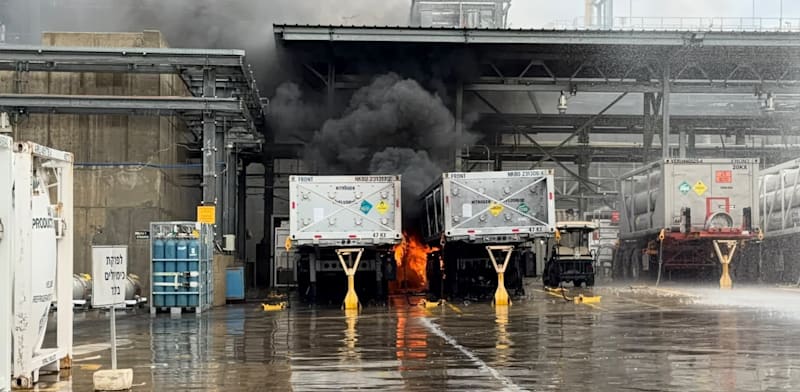
Two weeks and a day ago, a mushroom of black smoke rose over Intel’s old chip factory in Kiryat Gat, FAB28, which was inaugurated almost twenty years ago. The plant is considered one of the most advanced in Intel worldwide and is responsible for the output of the 10 nm chips, one of the company’s flagship products embedded in laptops and computer servers. Upon the arrival of the MDA and Rescue Unit forces at the scene, it became clear that during the unloading of a gas tank from a truck, the neck of the tank exploded, an event that led to the death of two workers: Ilya Chechulin (49) and Kikir Koshovili (35), and the injury of a third worker who is still hospitalized in Soroka Hospital.
● Report: The Israeli Sayara is going to recruit according to a particularly ambitious value
● 6.3 billion dollars in 20 minutes: the five biggest crypto hacks in history
● Half a Trillion Dollar Loss: What’s Behind Google’s Worst Day?
The official Intel limited itself to responding to Kony – lamenting the death of the two and a statement of full cooperation in the investigation of the incident – but the state of the plant remained in the dark until yesterday, when Intel’s CFO David Zinsner and CEO Lip-Bo Tan discovered the dramatic impact the accident in Kiryat Gat had on the entire company.
stock Intel plunges sharply in trading on Wall Street in a way that brings it closer to a dramatic drop of a quarter of the company’s stock – not only due to the accident in Kiryat Gat but also due to the pessimistic forecast for a decline in personal computer sales and the downward revision of the forecast for the fourth quarter due to the same factors. If the investors’ forecast comes true at the opening of trading in the afternoon – Intel is expected to write off about 120 billion dollars from its value.
The factory has been closed for two weeks
Intel feared that an Iranian or Gazan missile would hit the factory during the war – but it turned out that it was actually a random work accident that led to the largest recorded damage in the history of Intel factories worldwide. During the investors’ call, Zinsner revealed that the factory in Kiryat Gat has been closed for two weeks, and that he believes that production will begin by next Sunday – although he refrained from making a commitment that this would happen. “While we are preparing for the return to production, we are trying to assess (the possible damage) to all the silicon wafers in the production line – what is usable and what is not usable of these materials.”
The words of the CFO are particularly worrying in light of the fact that he uses vague terms: “This is a preliminary assessment, to a certain extent, for both the fourth quarter and the first quarter” – that is, Zinsner does not rule out the spillover of financial damages from the plant shutdown into next year as well. “But I believe that the assumption now is that we will have an impact of about 300 million dollars (in estimated revenues – AG) on the fourth quarter.” Intel also estimates that the shutdown will lead to a decrease of 2 in the gross profit rate in the forecast for the fourth quarter.
The alarming figure and the reaction of the investors prove how dependent Intel is on the factory in Israel: the 10 nm chips produced in the factory are not considered the pinnacle of technology today – Intel operates more advanced factories in Ireland and the USA that already produce with more advanced technologies – 7 nm and 5 nm, and recently even very advanced chips of 1.8 nm (18A), but exports from Israel are responsible for flagship products Intel’s in the field of laptops: the Alder Lake and Raptor Lake transitions, and the Sapphire Rapids and Emerald Rapids server processors, which are based on the Xeon architecture, and help Intel grow in the artificial intelligence market, when more AI processing tasks move from the graphics processor to cheaper processors like Intel’s.
The company does not expect a real recovery
The explosion at the factory in Kiryat Gat illuminated the well-known and long-standing problem of Intel that has been with it for three or even four decades – dependence on the personal computer and laptop market in which it still dominates – a volatile market whose bad news joins the tragedy in Kiryat Gat.
Intel expects revenues of 15-16 billion dollars for the current quarter compared to an original forecast of 17 billion – partly also due to a lack of memory chips needed for personal computers and their increase in price, which increases the final price of those computers – an effect that does not necessarily depend on Intel’s performance. Therefore, it is expected that the revenues of the fourth quarter in the field of computers are expected to decrease by 20% compared to the third quarter, with Intel estimating that the number of computers that will be sold in the world will decrease in 2026 by about 12% (in the second half by more than 20%), and in 2027 by about 10%.
According to Zinsner, the inventory reduction will mainly affect the fourth quarter and the first, and maybe a little on the second as well. Furthermore, the company does not expect a real recovery until the supply of memory improves and its prices stabilize.
The good news
However, there was also some good news hidden in Intel’s reports: the field of personal computing is still dominant in Intel’s revenues, but its share stands at 49% of its revenues, when revenues decreased by 5% year-on-year. The server chip business – those chips that integrate into the AI revolution thanks to simpler artificial intelligence agents that can also operate on less expensive processors compared to those of Nvidia, increased by 78% compared to the corresponding quarter and by 17% compared to the previous quarter, generated an operating profit of 3 billion dollars and contributed 42% of the revenues.
Like the other AI companies, Intel also admits that the only factor limiting sales in the field – unlike the personal computer market – is the supply, not the demand. Intel estimates that the entire industry will suffer from a supply shortage throughout 2027 and into 2028, and that server processor sales in the industry will grow by more than 30% in both 2026 and 2027. The supply at Intel is still limited by the yield figure per silicon slice (yields), lack of production materials (substrates) for the advanced packages, with Tan admitting that he is “disappointed that we were not able to meet the strong demand of the customers this quarter”.
However, Intel is expressing optimism in this area as well: 18A production costs have dropped by about 40% since the first quarter. In the first quarter, personal computer processors in 18A accounted for less than 5% of revenues, and today they constitute almost a third of personal computer processor revenues.
For your attention: The Globes system strives for a diverse, relevant and respectful discourse in accordance with the code of ethics that appears in the trust report according to which we operate. Expressions of violence, racism, incitement or any other inappropriate discourse are filtered out automatically and will not be published on the site.
Calgary DUTCH Hormone Testing: Costs, Panel Options & Insurance Guide Released | MarketMinute
Cash Discount Program To Reduce Credit Card Processing Fees: Solution Updated | MarketMinute
Claim or Lawsuit? León Law Firm Explains the Difference After a Texas Car Crash | MarketMinute
Columbia City, IN Whole House Electrical Panel Installation: Service Update | MarketMinute
Essential Oil-Infused Stickers To Help Distracted Kids Focus At School Announced | MarketMinute
Flat Fee MLS Alaska Listings From $299 – Congress Realty Equity Guide Released | MarketMinute
Frequency Specific Microcurrent for Pain Relief: Professional Unit Announced | MarketMinute
Globe Packaging Releases Pokémon Card Shipping Envelope Guide for UK Sellers | MarketMinute
Hazlet NJ Medicare Diabetic Shoe Coverage & Eligibility: Guide Released | MarketMinute
Heavy Metal Forgers Releases 2026 Holiday Gift Guide for New Blacksmiths | MarketMinute
HIPAA Risk Assessment Is More Than a Checklist or Scan, DYOPATH Guide Says | MarketMinute
Hollywood Hills Custom Upholstery For Sofas & Headboards: Service Expanded | MarketMinute
Houston Intermodal Trucking For Long-Haul Freight: New Guide Explains Cost Risks | MarketMinute
Houston IRS Trust Fund Recovery Penalty: Letter 1153 Guide For Business Owners | MarketMinute
Leawood Smart Motorized Cellular Shades with App Control: Installation Announced | MarketMinute
Leeds Commercial Property Conveyancing for Leases & Purchases: Service Launched | MarketMinute
Local SEO & Google Business Profile Optimization For Roofers: Service Update | MarketMinute
Meta Ad Intelligence Tool With AI-Powered Creative Options Announced | MarketMinute
Multichannel Content Campaigns for Local Business AI Search Visibility Announced | MarketMinute
New Haven, IN Level 2 EV Charger Installation: Electrician Service Update | MarketMinute
NJ Home Improvement Contractor Local SEO & AEO Marketing Service Expands | MarketMinute
Nottingham Multiple Dental Implants: Denture Alternatives For Seniors Announced | MarketMinute
Pittsburgh Destination Day Spa: Organic Hungarian Body Treatments Expanded | MarketMinute
PubConcierge Highlights Key Checks Before Buying ISP Proxies | MarketMinute
San Diego DUI Lawyer Victor Orsatti Explains Post-Arrest Steps Before Halloween | MarketMinute
Shadow AI Governance & Policy for Safe Agent Deployment: Program Announced | MarketMinute
Small Business Press Release Distribution: Costs & Options Guide Published | MarketMinute
Texas Property Tax Protest Guide Released – 2026 Deadlines, Changes Explained | MarketMinute
White Noise Digital Unveils High-Intent Search Framework for Regional Plumbers | MarketMinute
ACR Contrast Allergy Premedication Protocol for Imaging Centers: Guide Published | MarketMinute