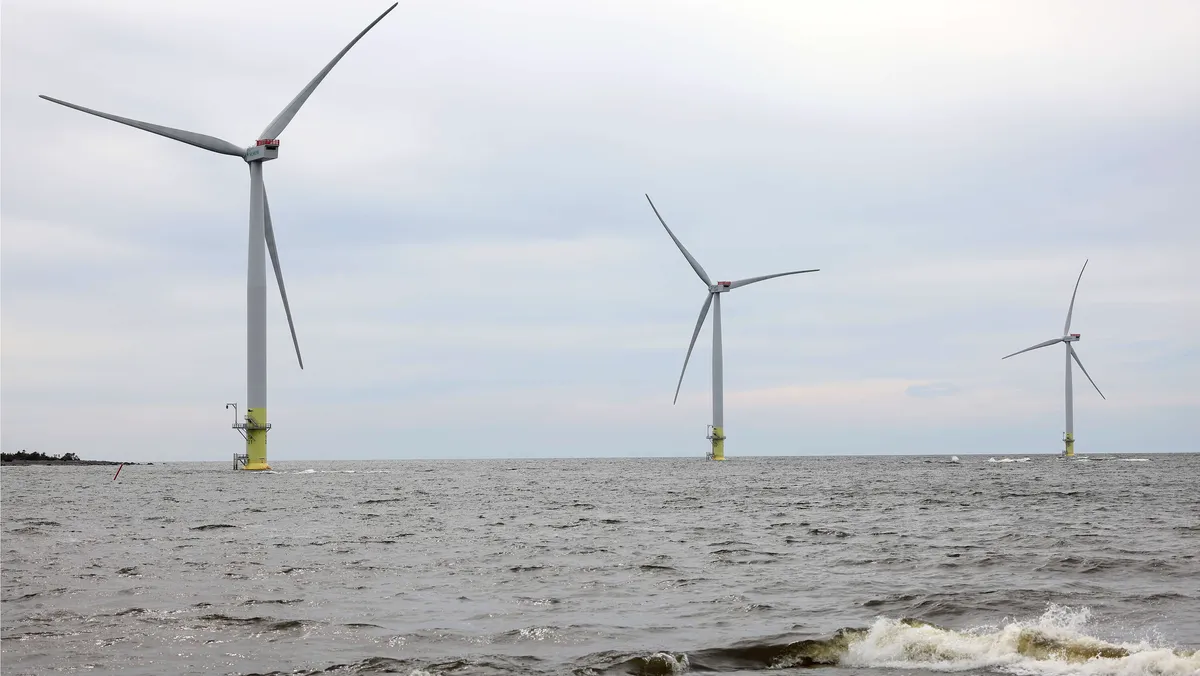
The strong growth in electricity consumption is now setting the pace for offshore wind power projects. Energy Agency says that the Government has designated four new sea areas in Finland’s economic zone for offshore wind power production.
Of the four indicated areas, two are located in the Selkä Sea and two in the Pärä Sea. The Energy Agency is responsible for tendering the regions, and the southern region of the Pärämere is the first to be tendered. The remaining three areas will be tendered later.
According to the Energy Agency, the goal is to enable the construction of new electricity production in a situation where electricity consumption in Finland is expected to grow strongly.
The growth of consumption is particularly accelerated by the electrification of industry and data center investments. According to the grid company Fingrid’s estimate, electricity consumption may rise from the current approximately 85 terawatt hours to 138–267 terawatt hours by 2040
The state’s goal is to enable the construction of two gigawatts of offshore wind power capacity in the economic zone by 2040. According to the Energy Agency, the annual electricity production of such a capacity could correspond to approximately 3–7 percent Fingrid’s estimated electricity consumption in 2040.
In the competition, a project developer is selected for each area, who can be granted a utilization permit. The permit gives the exclusive right to utilize wind energy in the area, to make more detailed investigations and to apply for other necessary permits. The procedure complies with the Economic Zone Offshore Wind Power Act and the European Union’s License Agreement Directive.
“The project developer needs assurance of his exclusive right to utilize the area’s wind energy. The state must accordingly ensure that the project is promoted and not just reserved for the future”, Energy Agency lawyer Ella Kainulainen tells.
Without sufficient demand, production will not be built
When implemented, new offshore wind power production can increase the supply of electricity and curb the rise in electricity prices. However, the effect on the price of electricity also depends on the development of electricity demand.
“Designating an area for offshore wind power use does not yet guarantee production. If there is not sufficient demand for electricity, production will not be built,” says the Energy Agency’s tender expert Roland Magnusson.
The production costs of offshore wind power are higher than onshore wind power, but according to Magnusson, the production per power station is greater and is more evenly distributed throughout the year. Profitability is affected by, for example, construction and electricity transmission costs and the market price of electricity.
The distance from the coast also affects the whole. The further away the power plants are from the population, the lesser the landscape and noise problems, but a longer electricity transmission connection increases the costs.
The Perämeri south, which will be the first to be tendered, is located approximately 30 kilometers from the coast.
According to the Energy Agency, the project developer selected through the competition is responsible for the more detailed studies required. Before construction, it is necessary to find out, among other things, the conditions of the seabed, the solutions for setting up power plants and the effects of the project on marine nature.
“Studies play a part in determining where power plants can be placed, what kind of foundations they require and how much construction costs,” says Magnusson.
Casion Catbet
HayleeBlair
The Doc Of West Loop 357188.Html
Brown Edge Directory.com – Search Listings > Search Results
Disqus Profile – thedocofwestloop
Gosearch.Php
0919920148
The DOC of West Loop
30862173
The DOC of West Loop
The Doc Of West Loop Chicago Il 60607
TheDOCofWestLoop Profile and Collections | Wakelet
https://www.a-zbusinessfinder.com/business-directory/The-DOC-of-West-Loop-Chicago-Illinois-USA/34651673/
The DOC of West Loop
The DOC of West Loop · Chiropractor in Chicago
The Doc Of West Loop
00833466446D3590F9140
2034564445 The Doc Of West Loop
The Doc Of West Loop 2626289.Html
Connectively: Connecting Publishers with Subject Matter Experts
The Doc Of West Loop
The DOC of West Loop
https://www.find-us-here.com/businesses/The-DOC-of-West-Loop-Chicago-Illinois-USA/34651673/
The DOC of West Loop – США, 1144 West Randolph Street suite 2 – Chicago | Fresha
The DOC of West Loop
The DOC of West Loop | 👍 – 5.0/5 – 103 Reviews | 1144 W Randolph St, Chicago, IL | n49.com
Node: The DOC of West Loop (14345714753)
The DOC of West Loop – Chiropractor in Chicago, USA – Reviews, Address, Phone & Info | place123.net
The Doc Of West Loop
Thedocofwestloop