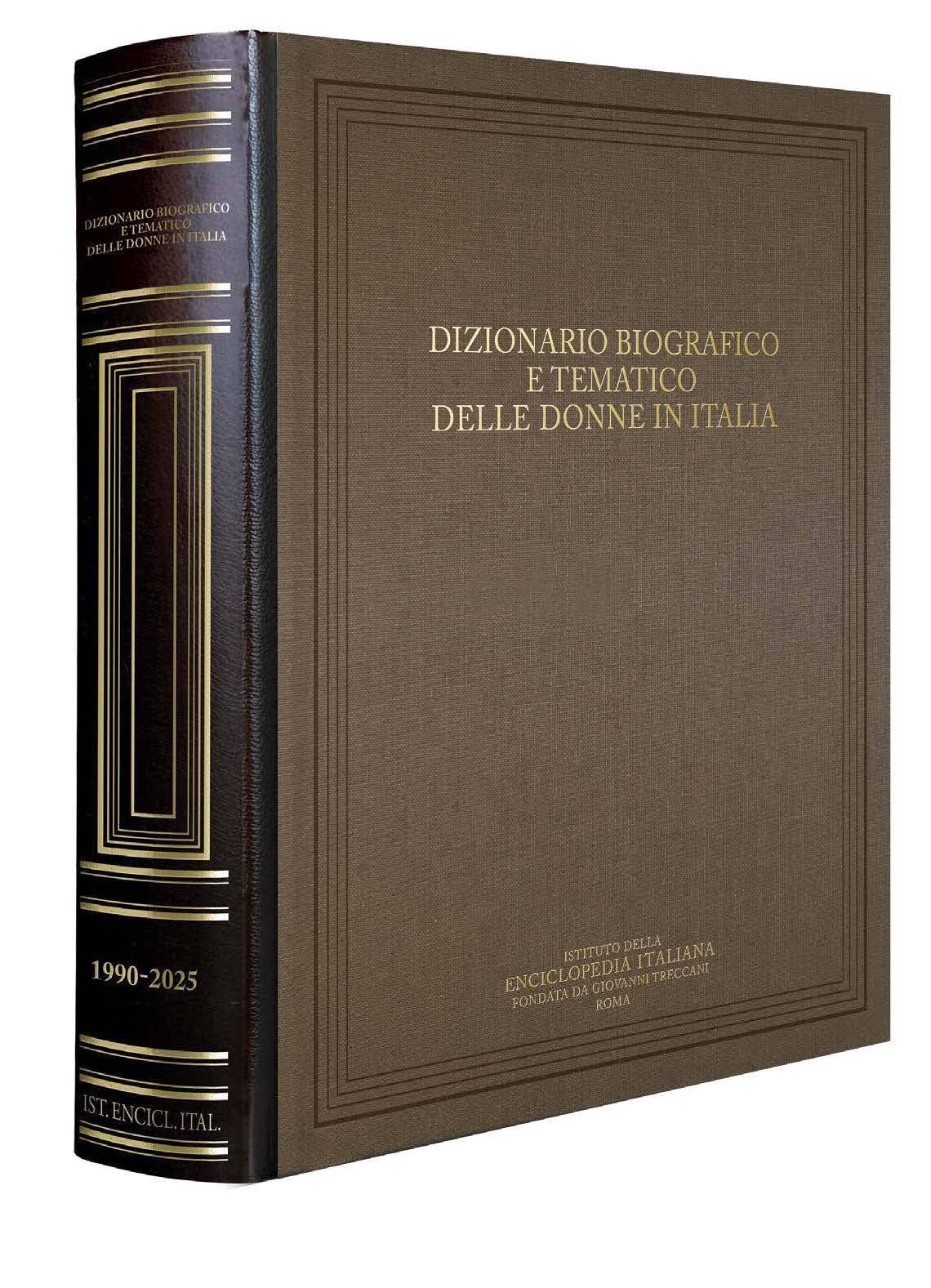
A work in three volumes of over 2,500 pages which collects 650 biographical profiles of women who have left a lasting mark in our country in the fields of culture, politics, art, science and sport, from the eighteenth century to the present day: it is the biographical and thematic dictionary of women in Italy, directed by Emma Giammattei, Italianist and cultural historian, published by the Treccani Italian Encyclopedia Institute. The new encyclopedia was created with the aim of reconstructing the historical and geographical network of Italian women – or those who lived in Italy and were significantly linked to the history of the country – along a chronological span that spans the eighteenth, nineteenth and twentieth centuries and reaches the first decades of the twenty-first century.
In this perspective of active civil consciousness of the encyclopedic institution, the Biographical and Thematic Dictionary of Women reconstructs the complex mosaic of ‘female biography as lived and as a historiographical problem’, where a functional chronological score is adopted that overcomes the automatism of the centuries. Among the many names registered, those of Grazia Deledda, Camilla Cederna, Oriana Fallaci, Margherita Sarfatti, Alda Mderini, Titina De Filippo, Sibilla Aleramo, Marisa Bellisario, Maria Goretti, Eleonora Duse, Eleonora Fonseca Pimentel, Elsa Morante, Ada Gobetti, Camilla Ravera, Luisa Spagnoli, Tina Agostena Bassi, Tullia Zevi, Milva, Patrizia Cavalli, Paola Borboni, Monica Vitti, Suso Cecchi D’Amico, Fausta Cialente, Valentina Cortese, Adele Faccio, Carla Fracci, Nilde Iotti, Rita Levi-Montalcini, MIriam Mafai, Lea Massari, Mariangela Melato, Moira Orfei, Franca Valeri, Alda Merini, Anna Maria Ortese, Michele Murgia, Raffaella Carrà, Giuni Russo, Rossana Rossanda, Franca Rame, Fernanda Pivano, Goliarda Sapienza, Inge Feltrinelli, Renata Tebaldi, Alida Valli, Lina Wertmuller, Tina Anselmi.
“This Dictionary – states Emma Giammattei, Scientific Director of the work – was born from a need that was both cognitive and moral, which had already emerged in the final phase of the Biographical Dictionary of Italians, when it became evident, in the seminars dedicated to the key issues, the structural gap that had marked the relationship between masculine and feminine in the original project. It is not a question of retroactively filling an absence nor of integrating an already given canon, but of restoring visibility to what had long remained out of the field, allowing the feminine to fully enter in the historical dynamics. In this sense, the Dictionary is configured as a work endowed with its own methodological freedom, which capitalizes on the considerable progress of studies of women’s history and gender history and is capable of dealing with the always open process of history”.
In recent years, Treccani has increased and brought out attention towards women and gender equality issues, monitoring the political, social and linguistic transformations underway, as well as the obstacles erected against them by old and new resistance. From this commitment was born the Biographical and Thematic Dictionary of Women in Italy, which invites us to reconsider the entire field of national memory in the light of a presence that has long been marginalized. From the best-known figures, such as Rita Levi-Montalcini, who led our Institute from 1993 to 1998 and to whom the work is dedicated, to the lesser-known ones, the Dictionary returns the stories, the knowledge, the responsibilities of women who with competence and tenacity have contributed to the modernization processes of our country.
The first volume (1700–1918) includes, in two sections, the eighteenth and entire nineteenth centuries up to the end of the First World War and outlines the start of the long process of formation of female consciousness in Italian history. The second volume (1919–1989) is dedicated to the twentieth century, marked by dictatorships, wars and profound political and cultural transformations that favored the redefinition of the roles and forms of presence of women in the life of the country. The third volume (1990–2025) deals with a shorter time span but characterized by a plurality of biographical paths that restore the complexity of the contemporary era.
The work is based on a methodological system that combines the biographical principle with the essayistic-encyclopedic one; the individual profiles – reconstructed in their historical context, in the times and places of experience, in social, economic and political relationships – are accompanied by thematic essays that delve into some crucial points in the history of women and gender history: from the emancipation movements in the eighteenth century to the female presence in the Risorgimento and fascism, from journalism to entrepreneurship between the nineteenth and twentieth centuries, from Italian sovereigns to the fields of writing, art and fashion, up to passionate monopoly of environmentalist battles. And there remains, against the backdrop of the present, the phenomenology of the relationship between women and work in the 21st century, of inequalities, discrimination and the growing – not yet brought into focus in its precise contemporary reasons – gender violence.
Extraordinary, often unprecedented and surprising, the imagery constituted by the iconographic system comes forward together with the text which, in the constant dialogue with the stories of the protagonists, enriches them with meanings and suggestions. The choice of images always responds to a criterion of rigorous accuracy: period photographs, portraits and documents make the narrative visible and constitute an organic part of the historiographical discourse.
On the occasion of the release of the work, the Institute of the Italian Encyclopedia dedicates the podcast “Effetto Matilda” to the biographical and thematic dictionary of women in Italy, created by Edulia dal Sapere Treccani and available from 8 March on the main audio streaming platforms. The project, divided into ten weekly episodes and conducted by Sofia Assante, offers insights into some of the profiles present in the volumes: from Rita Levi-Montalcini, neurobiologist and Nobel Prize winner for medicine in 1986, who undertook scientific research despite gender prejudices and racial laws, standing out for her determination, modernity of thought and civil commitment, introduced by Massimo Bray; to Maria Callas, a soprano capable of combining technical virtuosity and dramatic intensity, told by Sandro Cappelletto; by Fernanda Pivano, protagonist of an intense cultural activity and decisive mediator in the reception in Italy of some of the major American authors of the twentieth century, remembered by Ilaria Gaspari; up to historical figures such as Paolina Bonaparte, icon of a nascent romantic sensitivity, and Anita Garibaldi, among the best-known female names of the Italian Risorgimento, long eclipsed by the epic of the “hero of two worlds”; and to contemporary protagonists such as Anna Marchesini, an actress-author of extraordinary versatility, capable of combining acting, writing and directing in a large number of masks marked by an irony that is both melancholy and introspective, and Michela Murgia, writer, essayist, critic and activist, among the most incisive voices of our time, who has contributed significantly to the debate on the issues of gender identity and civil rights. The journey ends with a special episode, in which Sofia Assante talks to Emma Giammattei, scientific director of the work.
The biographical and thematic dictionary of women in Italy consists of three illustrated volumes (23.5 × 31 cm), bound in leather with gold letters and friezes. The first volume includes 760 pages and 325 images; the second 896 pages and 378 images; the third 884 pages and 354 images. (by Paolo Martini)