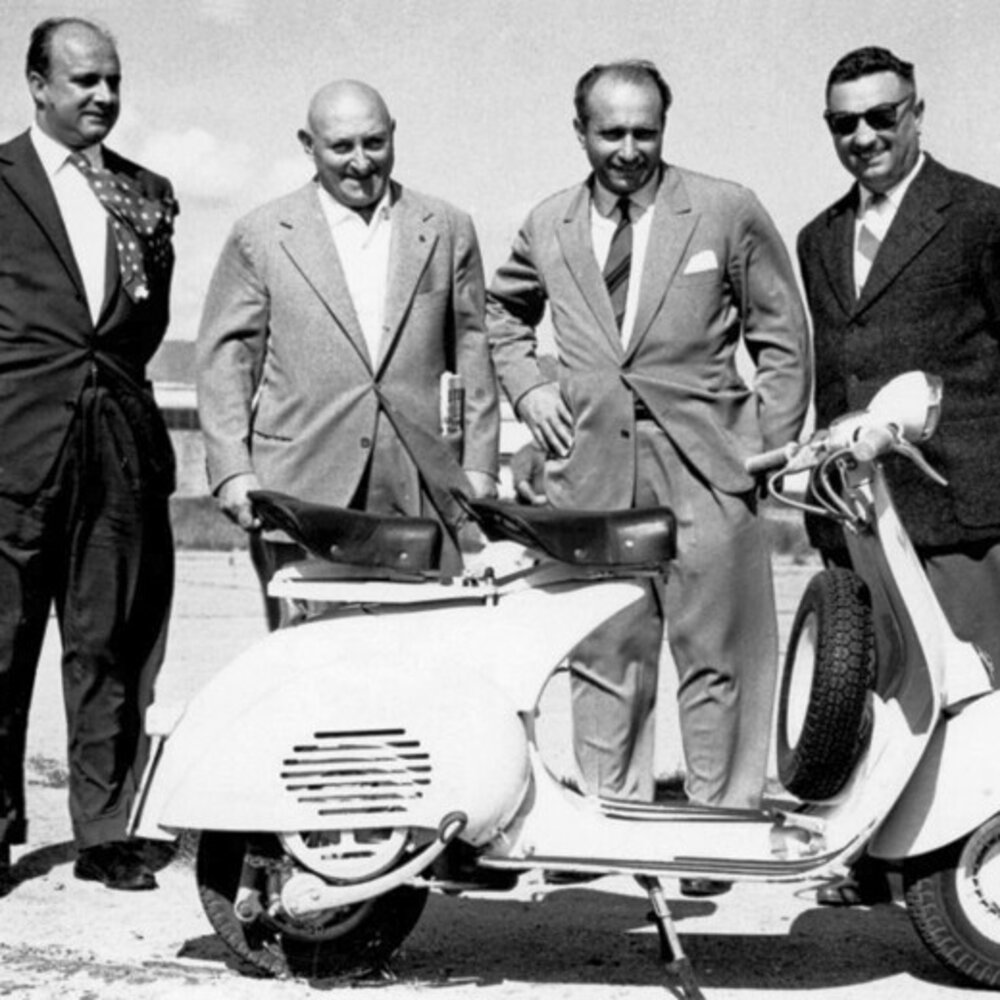
A stroke of absolute genius made him guess everything except the name. When naming his creature that would conquer the streets of the world, he had chosen to call it Donald Duck, but Enrico Piaggio decided that it would be called Vespafor that small screw tightened between the shell that contained the engine and the floor that ended with the shield.
On 23 April 1946, patent no. 25546 was filed in Florence for a “Utility Model”: it was the birth certificate of the universal scooter conceived the year before, a masterpiece of design and technique, with the signature of the imaginative aeronautical engineer from Abruzzo Corradino D’Ascanio (1891-1981) and the entrepreneurial intuition of an industrialist who had to reinvent his present after the disasters of the Second World War.
Designed by engineer D’Ascanio who couldn’t stand motorcycles
As in all success stories, there are many legends surrounding the Vespa. But it’s true that only a man could design it who couldn’t stand motorcycles because they were uncomfortable, didn’t want to dirty his trousers or burn his leg with the muffler, and wanted to be able to replace a wheel with absolute ease. D’Ascanio did not invent the scooter, because it already existed and English paratroopers during the conflict launched a tubular model in special metal containers to allow very rapid motorized movements, but he did much more: he invented a myth by sketching it around a sitting man.
A total, unscratchable, absolute myth, which runs with its unmistakable two-stroke burble on every type of track in any continent, iconically darts through black and white and color films as a phenomenon of custom, has colonized cities and countryside, brought the Italy of ingenuity and creativity to the top and as an example.
The aeronautical vocation of the inventor, “father” of the first helicopter in history
Long before Domenico Modugno launched “Volare” into the hits of all time, D’Ascanio was chasing the myth of Icarus. In the small but ancient Popoli, then in the province of L’Aquila and since 1927 in Pescara, he challenged the laws of physics to conquer the ways of the sky with gliders and hang gliders. A dreamer, before graduating as an engineer in Turin, but undoubtedly a genius.
The First World War brought D’Ascanio into contact with the newborn aviation and he immediately patented the variable pitch propeller adopted in all piston engines and the system for detecting the inclination of aircraft. But his desire is vertical flight. After the war he entered into a partnership with Baron Pietro Trojani and in 1926 he raised the first helicopters in history in the Camplone Foundries in Pescara, which were named after their initials: the D’AT1 and D’AT2.
When the D’AT3 arrived in 1930, the first three world records would also arrive (height, 18 m; duration, 8’45”; distance, 1078.60 m), as is remembered in an inscription at Ciampino airport where it took off from the ground, while no evidence of pioneering remains in Pescara: neither the long-dismantled foundries, nor a plaque or a monument as would be right. The father of the helicopter will never succeed in his entire life to see one of his mass-produced models, just as he will never see one of his planes online, despite his inventions and innovations.
The Piaggio of Pontedera during the Second World War had built the only Italian four-engine bomber designed by engineer Casiraghi: the P.108 was excellent in concept but unrealistic from a construction point of view, so much so that the pilots had renamed it Flying Weakness (as opposed to the American B-17 Flying Fortress). In the second half of 1945, Piaggio no longer existed from a production point of view, destroyed by bombing, and the limitations imposed by the Allies blocked the path to aeronautical commitment. There was no shortage of bits and pieces, but an idea was needed for the conversion.
The reconversion of Piaggio with a revolutionary model
Enrico Piaggio then asks D’Ascanio to pull the flash of genius out of the hat. Aeronautical structure with a load-bearing body instead of tubes, everything covered but everything accessible, gear shift on the handlebars, wheels with aeronautical model shock absorber and it might even be said that the 98 cc single-cylinder engine. was the starting one for the bombers, but that wasn’t the case (they were compressed air).
However, the idea was very clever: anyone could dismantle, repair, restart, wherever they were and in any condition on the disastrous post-war Italian roads, even and above all unpaved and in the countryside. A couple of wrenches and a couple of screwdrivers were enough for everything, maintenance reduced to zero and very low consumption. With the Vespa the mass motorization of Italy began, and after a very timid start the success became as striking as it was unexpected, yet overwhelming.
The first examples were numbered starting from 1,000, so as not to disfigure; the price was neither unaffordable nor unsustainable, and started from 55,000 lire payable in installments. It carried another person behind the driver who sat down without having to get on as on a motorbike, and even a woman who had to ride sideways found it comfortable to travel on a Vespa, which when it hit a pothole with water didn’t splash the passengers.
The Vespa smelled like a mixture, it could even stop, but it always started again: a little cleaning on the spark plug, a little push, it never stopped even due to a not infrequent puncture, because the nuts were unscrewed, the rim with tire and inner tube came out of its seat without dismantling anything else, another one was put on and off it went.
Four-wheel version built in France so as not to compete with the Fiat 500
Since 1946, millions of Vespas have colonized the world, in many versions, some of which are authentic icons, such as the 50 Special and the 125 Primavera. The beauty of classicism, because every model has always been destined from birth to become a classic. Not only does the Museum of Modern Art in New York welcome the seductive Vespa which is the sexiest attraction of Made in Italy. The volcanic Corradino D’Ascanio, who among his extraordinary inventions includes the electric oven for bread making (adopted all over the world) and even the speed camera, also provided the Vespa with a third wheel, calling it the Ape intended for transport, and also the fourth to turn it into a car.
The Vespa 400 seemed destined for the same success as its two-wheeled sister, but in 1957 it competed with Dante Giacosa’s 500 Fiat and given the good relations with Agnelli, Piaggio’s choice was to divert production to France, to Fourchambault, from where around 30 thousand Acma models took to the streets. D’Ascanio kept an example for himself and his family with which he traveled 300,000 km without any problems.
When the Leonardo of the twentieth century, as he had been defined, died, he had the satisfaction of having Igor Sikorski’s paternity of the invention of the helicopter recognized in the United States, but not of seeing one of his prototypes on the assembly line, neither for Piaggio nor for Agusta. With the Vespa, however, he entered legend: around twenty million units produced, the only model in the world for which spare parts are available for any version. And there is no one who doesn’t know the word Vespa and what it represents as a symbol of Italy.
https://chathamcountycourt.us/divorce-records
https://chathamcountycourt.us/inmate-search
https://chathamcountycourt.us/probate-records
https://cherokeecountycourt.us
https://cherokeecountycourt.us/arrest-records
https://cherokeecountycourt.us/divorce-records
https://cherokeecountycourt.us/inmate-search
https://cherokeecountycourt.us/probate-records
https://chestercountycourt.us
https://chestercountycourt.us/arrest-records
https://chestercountycourt.us/divorce-records
https://chestercountycourt.us/inmate-search
https://chestercountycourt.us/probate-records
https://chesterfieldcountycourt.us
https://chesterfieldcountycourt.us/arrest-records
https://chesterfieldcountycourt.us/divorce-records
https://chesterfieldcountycourt.us/inmate-search
https://chesterfieldcountycourt.us/probate-records
https://clackamascountycourt.us
https://clackamascountycourt.us/arrest-records
https://clackamascountycourt.us/divorce-records
https://clackamascountycourt.us/inmate-search
https://clackamascountycourt.us/probate-records
https://claytoncountycourt.us
https://claytoncountycourt.us/arrest-records