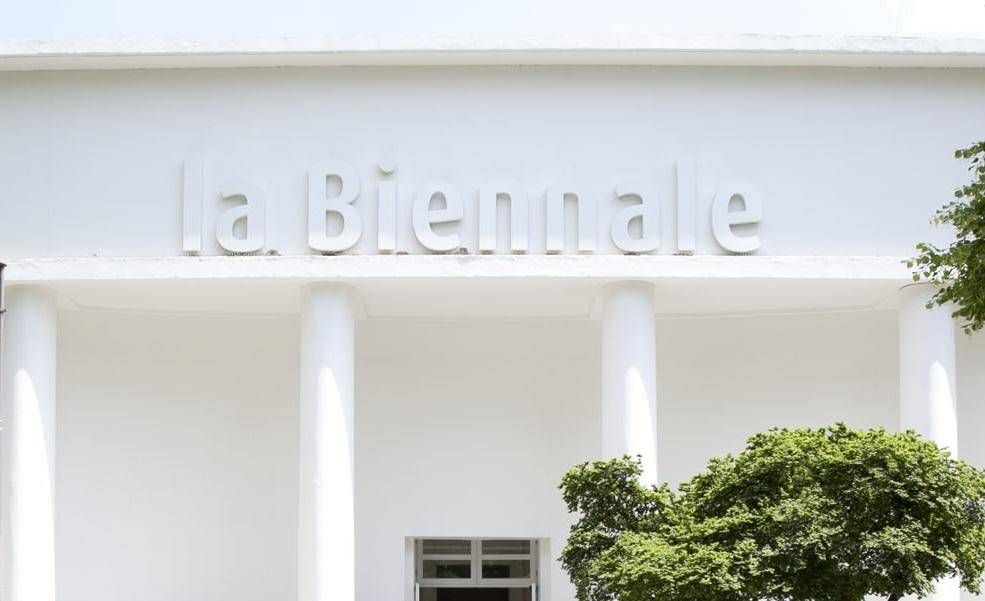
“No prizes for countries accused of crimes against humanity” that will expose them to Biennale Arte 2026. They are therefore Russia and Israel were also excluded from the competition to win the Golden and Silver Lions. The decision was adopted by the jury of the 61st International Art Exhibition of the Venice Biennale: countries whose leaders are currently accused by the International Criminal Court of crimes against humanity will be excluded from the evaluation for the top prizes, which will be awarded on May 9th.
The position was made public today, April 23, immediately after the appointment of the all-female jury, chaired by Solange Farkas, founder of Videobrasil. The document marks a position that intertwines ethics, politics and the historical function of the Venetian event. In the text, as reported by Adnkronos, we read that the jury recognizes “a responsibility towards the historical role of the Biennale as a platform that connects art to the urgencies of its time”. A statement that explicitly places artistic production within contemporary geopolitical tensions. Shortly afterwards, the statement defines its value orientation by indicating the “defence of human rights” as a guiding principlein continuity with the curatorial vision of artistic director Koyo Kouoh, who passed away in May 2025.
The choice is destined to cause discussion: “Accordingly, this panel will refrain from considering those countries whose leaders are currently charged with crimes against humanity by the International Criminal Court.” The decision directly involves two central players on the international scene who have been at the center of controversy for months over their presence at the Biennale Arte: Israel and Russia. Both countries are in fact the subject of proceedings at the International Criminal Court. In 2023, an arrest warrant was issued for Russian President Vladimir Putin in relation to the war in Ukraine. In 2024, a similar provision concerned Israeli Prime Minister Benjamin Netanyahu for the conflict in the Gaza Strip. The jury of the Biennial it does not intervene on the presence of the national pavilions, but limits its action to the selection of the main prizesincluding the Golden Lion.
In the jury document fIrmato dalla president Solange Farkas, Chair Zoe, Butt Elvira Dyangani Ose, Marta Kuzma and Giovanna Zapperiwe read: “We, members of the international jury of ‘In Minor Keys’, are honored to have been chosen by Koyo Kouoh, artistic director. We are committed to contributing to her project by nominating the artists for the Golden Lion and the Silver Lion, among the one hundred and ten artists selected for the exhibition”. The overall vision of the edition is summarized in a central passage: “Rejecting the spectacle of horror, the time has come to listen to the minor keys, to tune in softly to the whispers, to the lowest frequencies; to find oases and islands where the dignity of all living beings is preserved”.
The decision is part of an already highly polarized climate. In recent years, the Russian and Israeli pavilions have been at the center of protests, calls for boycotts and strong political tensions. The war in Ukraine and the conflict in the Middle East have transformed the Biennale into a space where art inevitably becomes a terrain of symbolic conflict. Already in recent weeks, several artists and curators of the main exhibition “In Minor Keys” had published an open letter calling for even more drastic measures. The text states that “there is a threshold beyond which participation in the Biennale should not be normalised”. And again: “As already happened in 2022, current conditions require that the Venice Biennale exclude any official delegation from regimes involved in war crimes, including Israel, Russia and the United States.” A request that broadens the perimeter of the symbolic conflict, also including the United States, despite the absence of international proceedings against them.
And another central issue concerns the absence of an official Palestinian pavilion. Various artistic organizations have long denounced what they define as the structural inequality of the event. In a further document from the Art Not Genocide Alliance collective we read that this situation “accentuates the inequality implicit in the presence of the Israeli pavilion”. The issue is also linked to the international recognition of Palestine, which is not considered a state by Italy and cannot therefore access the status of official national pavilion.
Faced with growing pressure, the management of the Biennale, chaired by Pietrangelo Buttafuoco, reiterated its historical line, based on the principle of inclusion of recognized state representations. The institution has repeatedly stated that it “rejects any form of exclusion or censorship of culture and art”, supporting the separation between artistic production and the political responsibilities of governments.
Russia’s presence has once again caused discussion following the return of its pavilion to the Giardinthe. In 2022 the artists Alexandra Sukhareva and Kirill Savchenkov closed the exhibition space, calling the war in Ukraine “unbearable”. In 2024 Russia even handed over its pavilion to Bolivia, while in 2026 it returned with direct participation, fueling new tensions also at the European level. The Russian pavilion, entitled “The tree is rooted in the sky”, brings together over fifty musicians, poets and philosophers, proposing a vision in which culture is presented as an eternal dimension, distinct from political contingencies.
The situation of the Israeli pavilion is more complexwhich is not located in the Giardini but in the Arsenale due to renovation. Some observers interpret this choice as a strategy to dampen possible protests, after the pavilion was closed on the day of its opening in 2024 by the artist Ruth Patir, in protest at the war and the hostage issue.
The political dimension of the Biennale is not limited to the cultural world. Some European countries have taken explicit positions. Finland and Latvia have announced the possibility of boycotting the inauguration in case of Russian participation. At the same time, the European Union is evaluating the suspension of 2 million euros in funding for cinema projects in response to the presence of the Russian pavilion. The Italian Ministry of Culture has also taken action, asking the Biennale for documents relating to the presence of the Russian pavilion, but so far no critical issues have emerged regarding the failure to comply with the sanctions imposed on the Russian Federation for the war in Ukraine.
Biennale Venezia: “Jury acts in full autonomy and independence”
“The Jury of the Biennale Arte, like all the juries of the events of the Venice Biennale, operates in full autonomy and independence of judgment in the exercise of its functions. Regarding the declaration released today by the jurors, it is a position that the members have decided to anticipate and make public. A natural expression of the freedom and autonomy of which La Biennale is guarantor”, specifies in a note the press office of the Venice Biennale following the announcement. (Of Paolo Martini)
https://jugabet1.org/registro/
https://jugabet1.org/casino/
https://jugabet1.org/bonos/codigo-promocional/
https://jugabet1.org/bonos/
https://jugabet1.org/app/
https://jugabet1.org/apuestas/
https://jugabet1.org/juegos/
https://jugabet1.org/juegos/balloon/
https://jugabet1.org/juegos/plinko/
https://jugabet1.org/juegos/aviator/
https://jugabet1.org/retiro/
https://jugabet1.org/contacto/
https://jugabet1.org/sobre-nosotros/
https://jugabet1.org/politica-de-privacidad/
https://jugabet1.org/terminos-y-condiciones/
https://jugabet1.org/juego-responsable/
https://jugabet7.org/iniciar-sesion/
https://jugabet7.org/registro/
https://jugabet7.org/casino/
https://jugabet7.org/bonos/codigo-promocional/
https://jugabet7.org/bonos/
https://jugabet7.org/app/
https://jugabet7.org/apuestas/
https://jugabet7.org/juegos/
https://jugabet7.org/juegos/balloon/