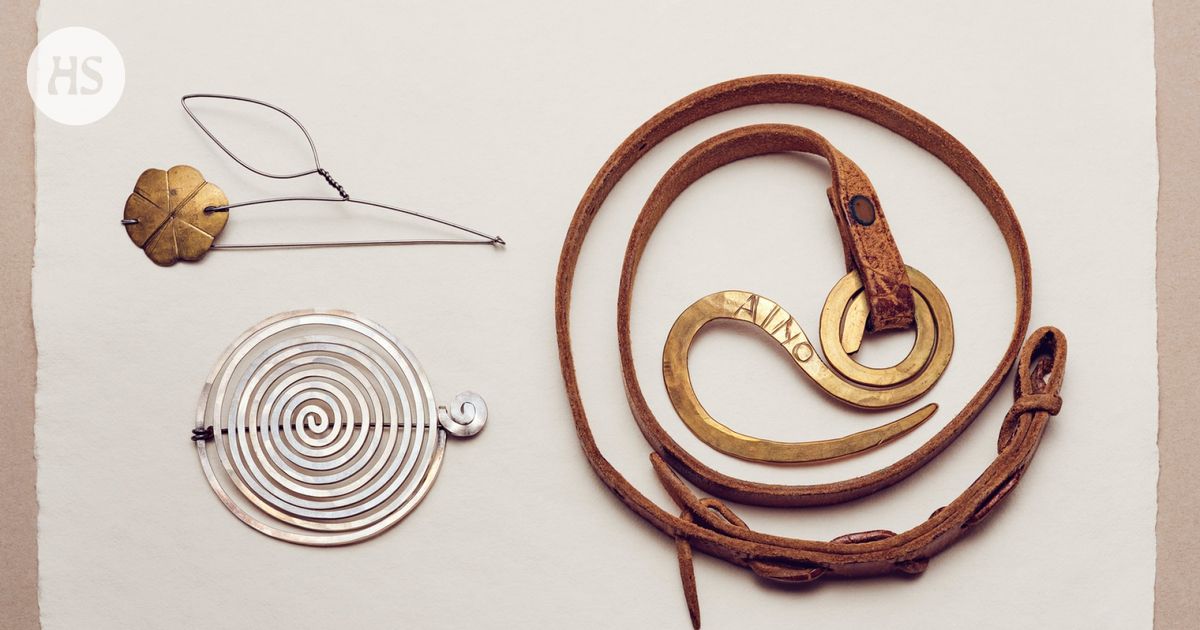
DesignThe auction house sells jewelry that the world-famous sculptor Alexander Calder made for the architect Aino Aalto.
The Bukowskis auction house sells jewelry made by sculptor Alexander Calder for architect Aino Aalto.
Johanna Alanen’s estate put the jewelry up for sale, and the Administrative Court of Turku overturned the export ban imposed by the Museum Agency.
Jouni Kuurne, curator of the Norwegian Museum Agency, and Jukka Savolainen, museum director of the Alvar Aalto Foundation, hope that the jewelry will remain in Finland.
The auction continues until May 3, and the starting prices for the jewelry are 35,000–40,000 euros per piece.
Finnish might lose three small cultural-historical treasures on Sunday, when the current one auction ends. The Bukowskis auction house is selling three Alexander Calderin jewelry she made, which she gave as a gift to her friend Only for Aino and to his daughter To Johanna Alase.
If they end up with a foreign buyer, they can probably also be exported. The Museum Agency initially banned the export of jewelry, but the ban was overturned by a decision of the Administrative Court of Turku. The two brooches and the belt for sale have been handed over to the auction by the estate of Aalto’s daughter Johanna Alanen (1925–2022).
American the world-famous sculptor Alexander Calder (1898–1976) is especially known for his kinetic sculptures, i.e. mobiles, and his large-scale public sculptures. Alvar Aalto he met in 1937 in Paris.
Soon, Alvar Aalto’s wife Aino Aalto also met Calder, when a meeting between Calder and Fernand Légerin show. The Aaltos were among the founders of Artek and Aino Aalto worked as its CEO in the 1940s.
Alexander Calder’s artworks are currently on display at the Fondation Louis Vuitton in Paris until mid-August.
Two the object now on sale was made by Calder in the 1940s for Aino Aalto. Aalto’s first name is also engraved on the belt buckle. The estate of the third piece of jewelry on sale says that Calder gave it to Johanna Alase after Aino Aalto’s death.
“The jewelry tells about Aaltoje’s connection with the international pioneers of avant-garde and abstract art at the time, as well as Aaltoje’s close and extensive connections with the international art field”, the decision of the National Museum Office described.
Johanna Alanen’s estate appealed against the negative decision of the Finnish Museum Agency to the Administrative Court of Turku. According to the estate, Aino Aalto cannot be considered the kind of cultural icon referred to in the law on the export of cultural objects – such as Alvar Aalto, for example.
Administrative Court of Turku overturned the export ban on the grounds that the objects in question are not particularly rare, and they cannot be considered to be related to significant events in terms of national history. Thus, the estate can take the objects abroad.
Auction started on Friday, April 24 and will continue until May 3. As of Wednesday morning, April 29, none of these items had reached the floor price, or the lowest acceptable price set by the seller for them.
They were also still considerably far from the starting price determined by the auction house, i.e. their estimated current market value. The starting price for each has been set at 35,000–40,000 euros, and the highest bid, i.e. 20,000 euros, was made for a spiral brooch. The prices for other items were around 5,000 euros.
The Museum Office curator Jouni Kuurne says that if the objects are sold and their new owner tries to take them abroad, he will probably have to apply for a new export permit for them.
“At that point, you have to think about whether you have to apply for a country export license again, because the current license was applied for by the current owner. But we have no chance to ban it either, because the reasons for the ban would be the same ones that the Administrative Court of Turku has already overturned.”
However, the Museum Agency still hopes that Calder’s objects will remain in Finland. The Alvar Aalto Foundation, which oversees the intellectual heritage of the Aaltos, also agrees, says the foundation’s museum director Jukka Savolainen.
“Our view is that they are part of Finland’s national heritage. And it would be great if they remained in Finland,” says Savolainen.