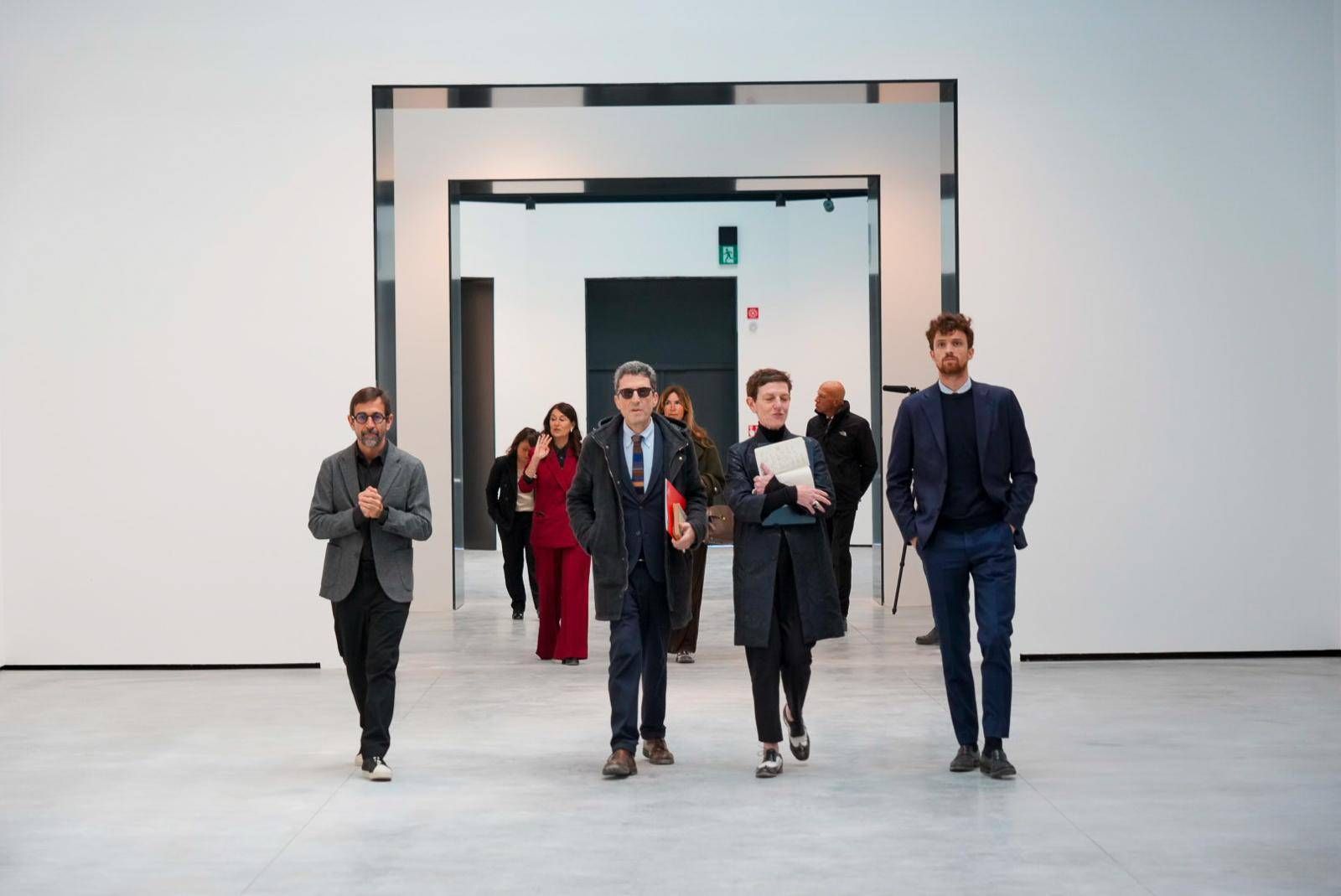
There is something profoundly unexpected – and almost fictional – in the figure of the writer and journalist Pietrangelo Buttafuoco, successor of Roberto Cicutto at the helm of the Venice Biennale, with the direct appointment of Gennaro Sangiuliano, former Minister of Culture under Prime Minister Giorgia Meloni. Where many expected an intellectual organic to the Italian right, ready to leave an ideological mark on the Biennale, he instead revealed himself to be an unpredictable, eccentric and difficult to classify director. In a word: free. The portrait drawn by Lila Azam Zanganeh – writer and cosmopolitan intellectual, born in Paris to Iranian parents, educated at the École Normale Supérieure and then professor at Harvard, now resident in New York – restores precisely this elusive quality. Not a man of apparatus, but a literary figure, almost a character straight out of a twentieth-century European novel. A free man.
Zanganeh, who met Buttaufuoco in the last winter months, published a long article in the English-language magazine “Now Voyager”, published by singular coincidence on April 30, the same day on which the international jury of the 61st International Art Exhibition resigned. This is the title and summary: “A free man. The conservative intellectual Pietrangelo Buttafuoco should have brought his politics to the Venice Biennale. He turned out to be outside the box – and freer – than anyone could have imagined”.
Buttafuoco, Sicilian, born in 1963, brings with him a biography that alone would be enough to generate distrust or curiosity: origins in a fascist family, a conversion to Islam, a career spread across journalism, fiction and theatre. Yet, as emerges from the report published in “Now Voyager”, every attempt to pigeonhole him fails. His appointment as head of the Biennale, supported by the Meloni government, had sparked fears on the left and expectations on the right. The former feared an identity shift, the latter hoped for a cultural revenge. “Both have been proven wrong.”
Zanganeh writes that Buttafuoco has chosen a surprising line: international openness, cultural contamination, rejection of orthodoxies. The appointment of the Cameroonian curator Koyo Kouoh, the confirmation of Alberto Barbera at the Venice Film Festival, the hiring of Willem Dafoe for the theatre: decisions that defy any simple ideological reading. More than a political strategy, they seem to respond to an aesthetic and spiritual sensitivity.
And this is perhaps the crux: Buttafuoco does not think like a politician, but like a writer. His gaze on the world is nourished by myths, philosophy, theology. Sicily – evoked by him as a universal crossroads of civilizations – is not just a geographical place, but a mental category. Ancient Greece, Islam, Christianity, demons and saints coexist in it. A vision that makes any nationalist reduction impossible.
It is not surprising, then, that he views ideologies with suspicion. Nationalism, he says, is “a poison”. Politics is, at best, an imperfect endeavor. Freedom, on the other hand, is a solitary practice. It is no coincidence that he defines himself – and is defined – as “a free man”, perhaps the freest on the Italian right.
This freedom comes at a price: isolation. A dimension of solitude, almost existential, clearly emerges in the portrait. Buttafuoco doesn’t really belong to any camp. It is not completely accepted by the right, nor comparable to the left. He lives in an intermediate zone, where thought becomes personal, irregular, at times contradictory.
His conversion to Islam, far from being a break, is described as a return. Here too, there is no clear break: rather a spiritual continuity that crosses different traditions. Faith, for him, is a more reliable compass than politics.
And then there is literature. In his novels – often provocative – evil is not abstract, but concrete, embodied. He says he saw the devil as a child in the Sicilian fields. An episode that seems to come out of a Gothic tale and which instead becomes the key to understanding his entire work: the world as a place of conflict between light and darkness. In this sense, Buttafuoco truly appears as an “anti-modern”, in the sense outlined by French criticism: a man who rejects the myth of progress while living fully in the present. Look at the past without sterile nostalgia, but as a reservoir of lost meanings.
At the Biennale, this vision translates into a cultural practice that favors dialogue between distant worlds, the plurality of voices, the freedom of art over political pressure. Not without tensions: the issue of Russian participation, for example, has shown how difficult it is to maintain this autonomy in a polarized geopolitical context. Yet, its originality is measured precisely in this tension. Buttafuoco does not offer reassuring answers, nor does he lend himself to becoming a symbol of one party. He is, rather, a liminal figure: between East and West, between faith and literature, between past and present. Perhaps this is what makes it so interesting today. In an era of rigid identities and declared belongings, Buttafuoco represents the anomaly. A man who continues to say, like his beloved Cyrano de Bergerac: “No, thank you”. And which, precisely for this reason, remains irreducible. And free. (by Paolo Martini)