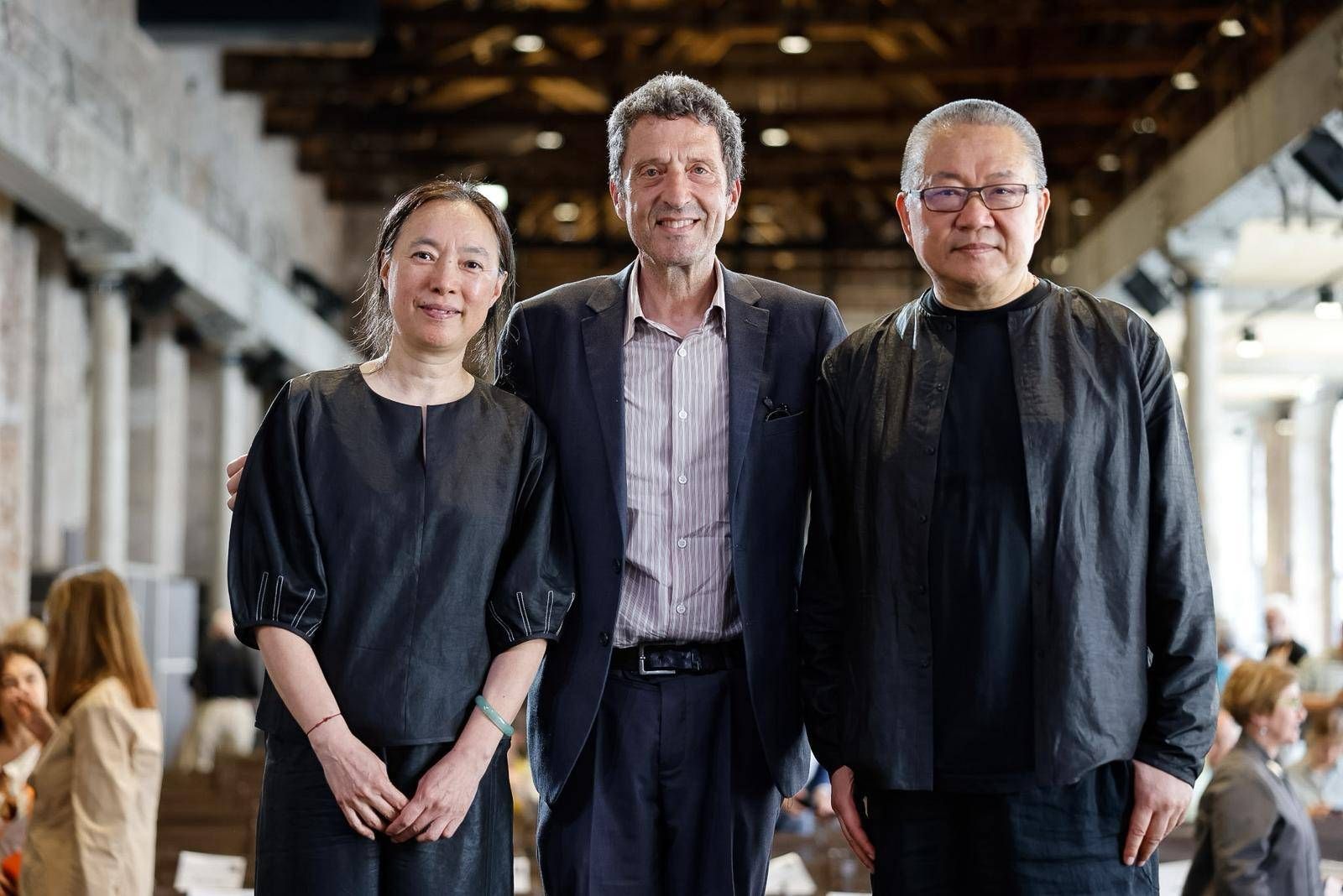
“We need a sustainable response to excessive urban development. Skyscrapers may be shiny and please many, but they are not the solution: thus we risk losing the memory and reminders of time, as well as inflicting wounds on nature.” This is the message that comes from the Chinese architects Wang Shu and Lu Wenyu, directors of the 2027 Architecture Biennale, protagonists today of a conference in the headquarters of the new Historical Archive of the Venice Biennale, dedicated to their research and their design vision as founders of Amateur Architecture Studio in Hangzhou. A message that comes from China, where the development of metropolises proceeds incessantly, transforming cities into true megacities. Their speech at the Arsenale – delivered in the presence of the president of the Biennale, Pietrangelo Buttafuoco – does not sound like a slogan, but like a clear judgment on the “exaggerated model” of urban growth of recent decades: acceleration, replacement, loss of memory.
Winner of the prestigious Pritzker Architecture Prize for his sustainable approach, which fuses traditional Chinese construction techniques with contemporary architecture, Wang Shu founded the Department of Architecture at the China Academy of Art in 2003, together with his wife Lu Wenyu. In 2007 they then established the School of Architecture, of which Wang Shu was the first dean. During the conference they also talked about their professional experience and the daily work of the studio and on the university campus.
“We see glittering glass and steel buildings but we are nostalgic for the past,” said Wang Shu, referring in particular to the transformation of cities like Hangzhou, where in thirty years large portions of historic fabric have been demolished to make room for skyscrapers. In this dynamic, it is not only the architecture that changes, “but the very relationship between community and memory of places”. Hence a second key statement: “We start from the ruins that contain memory and history”. For Wang and Lu, the ruins are not a residue to be removed, but a design resource. “They are what remains of time and which, precisely for this reason, can still generate the future”. Even “the recovery of materials becomes part of this approach: not simple recycling, but continuity between past and present, between matter and memory”.
The position of Wang Shu and Lu Wenyu is in open tension with the global imagination of contemporary cities, also dominated in China by glass and steel. “Everyone wants shiny buildings,” they observed, “but we prefer dull, low-rise buildings close to village scale.” A direct reference to the Chinese construction tradition, historically made up of one or two-storey buildings, integrated into the landscape and daily life. The central issue of their reflection concerns precisely this: how to prevent the acceleration of urbanization from destroying what it claims to improve? “How can we ensure that development does not go to the detriment of history, memory and traditions?”, they asked themselves. The answer lies not in the rejection of modernity, but in its transformation from within.
“We are not conservative but radical in our experimentation,” underlined Wang Shu, overturning a label often attributed to their work. Radicality, in their approach, does not coincide with spectacular or iconic form, but with the ability to question the dominant models of contemporary architectural production. “Experimenting means trying, making mistakes, repeating, adapting”, is their message. From this perspective, the relationship with the landscape also changes. “New buildings must fit well into the environment,” they explained, meaning the environment not only as nature, but as a combination of soil, materials, historical and cultural stratifications. Architecture does not overlap with the context: it crosses it, reactivates it, interprets it.
A central role is also entrusted to the experiments conducted in rural Chinese villages, Wang Shu and Lu Wenyu, where the small scale and continuity between buildings and territory represent “a still living form of balance”. Not a nostalgic model, but a concrete possibility of rethinking urban growth outside the vertical logic of skyscrapers.
Their educational path at the Department of Architecture at the China Academy of Art is also linked to this vision. “The future of architecture passes through education”, they recalled in Venice, indicating the school as the place where “the most profound change” is built. For Wang Shu and Lu Wenyu, teaching architecture means above all bringing it back to its concrete dimension: “building, experimenting, working on materials”. Not abstract knowledge, but a practice that measures itself against reality.
The connection with Venice adds a further level to their reflection. “It is a light to link the past with the present,” they said, recognizing in the lagoon city a unique example of coexistence between historical stratification and contemporary life. Even the reference to Marco Polo, visitor to China and admirer of the city of Hangzhou, reinforces this connection between distant cultures and histories that “meet in urban space”.
The theme of the next Biennale 2027, “Do Architecture”, i.e. “Making Architecture”, fits directly into this perspective. Architecture is understood as a “philosophy of doing”: not a system of representation, but a set of practices that act on the real world. Building means entering into a relationship “with what already exists”, accepting its contradictions and fragility. The questions posed by the curators summarize the meaning of the project: can the territory coexist with architecture without being erased by it? Can memory and innovation coexist without one prevailing over the other? Can technology integrate with local knowledge without reducing it to decoration? “We need experimentation, repeated attempts,” concluded Wang Shu. A phrase that returns the nucleus of a new thought that reaches the West from the most frenetic East: architecture not as a definitive solution, but as a continuous process. An exercise in unstable balance between past and future, in which the city never stops transforming without losing its memory. (by Paolo Martini)
https://submeet.vet/forum/topic/3394
https://mforum3.cari.com.my/home.php?mod=space&uid=2556058&do=blog&quickforward=1&id=611882
https://www.ibmmainframer.com/forums/article/instagram-clone-app-cost-mvp-to-full-platform-primocys/
https://www.freedomteamapexmarketinggroup.com/board/board_topic/8118484/8424055.htm?page=1
https://www.ttlxshipping.com/forum/topic/450518/gaming
https://www.allstarsdisposal.ca/post/hamilton-disposal-bin-rental-20-yard-bin-best-choice-for-large-projects?commentId=a18b79e8-e71a-457a-a87a-bfade9369f99
https://www.futureag.ca/post/challenges-facing-alberta-s-beef-industry-in-2026?commentId=4c8f0faf-a133-47b1-997d-73d1ce5f7d90
https://tuservermu.com.ve/index.php?topic=102052.0
https://winningwithin.ca/forum/topic/gaming-7/
https://fiofiorello.com/forums/viewtopic.php?p=340#p340
https://convivea.com/forums/index.php/topic,15993.0.html
https://www.gametracker.com/clan/Dynamickillercs/forum.php?thread=209432
https://www.thirlwallandcross.co.uk/group/mysite-200-group/discussion/d64bfd6a-7d37-494e-92b0-4431814015b7?commentId=8c7451b5-a3f6-464e-9524-48c94fa4a356
https://www.introvertit.net/forum/viewtopic.php?f=8&t=174856&p=245718#p245718
https://www.professionistidelsuono.net/forums/showthread.php?tid=34490
https://www.boygeorgefever.com/board/board_topic/9134313/8423689.htm?page=1
https://ipv4.ezega.com/Communities/Forums/ShowThread/55688/Gaming
https://www.crossroadsbaitandtackle.com/board/board_topic/9053260/8423698.htm?page=1
https://www.pleasemoveme.ca/post/how-do-i-know-if-it-s-the-right-time-to-move?commentId=d4702897-b533-4955-bc0d-832baf09af26
https://www.crosscountrycanada.ca/post/denso-tough-as-a-canadian-winter?commentId=89c627a5-6abc-4c2d-b11f-483903bc5f1c
https://www.littlestarsiowa.net/group/meals-nutrition/discussion/2baafa43-a4b0-48b6-a758-c35234ab9018?commentId=676aa66e-c491-4a68-8aef-246d018b2880
https://www.tma.or.th/group/tma-official-website-group/discussion/8e52a506-a69f-42cc-a1ba-2f680bb8eab0?commentId=0f358314-e45a-4bfe-9fa5-d581a87202cf
https://www.tekno50.com/forum/forum-kurallari/gaming-6319/
https://telegra.ph/Gaming-05-27-15
https://esanslot.com/index.php?PHPSESSID=294dc763c82ded8f32e268d62af93842&topic=833.0